Testing: ORCA Transient Engine Dynamometer and Two Others

Smokey Yunick
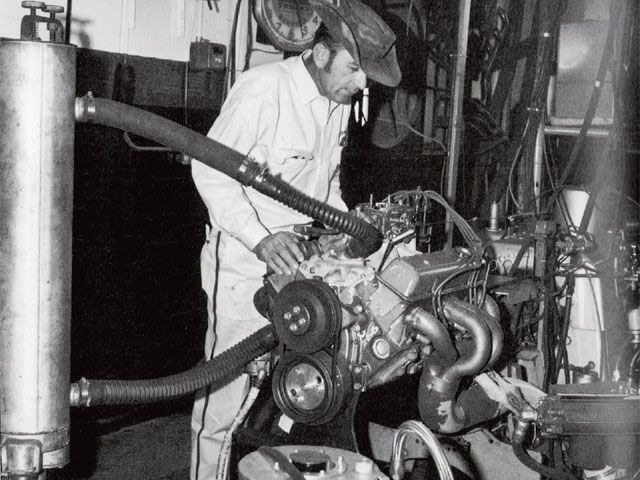
An engine dynamometer, not a chassis dynamometer, is the proper research tool. Smokey Yunick sought answers for questions no one thought to ask and he outsmarted and outran the best through his own research, on his own nickel. The innovations he came up with are often now the accepted standard like reverse flow cooling, longer connecting rods, raised deck blocks, 28" standard for airflow testing, and many others. Many of the questions he asked were answered in thousands of hours of testing on his dynamometer at "The Best Damn Garage in Town".
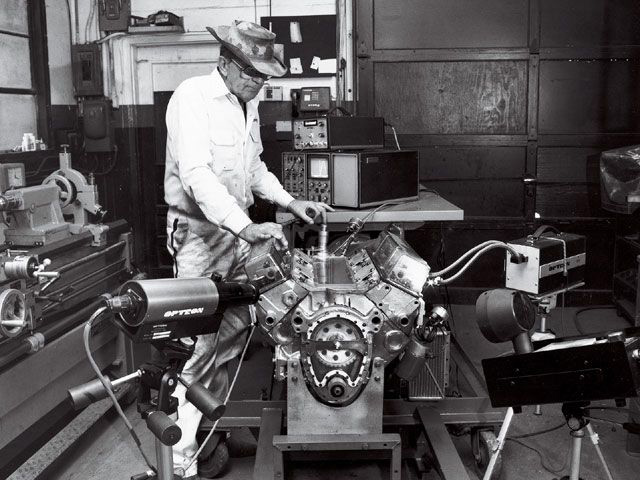
Whether it was Smokey's water brake dyno or his Spintron machine the engine development was always done directly on the engine. You are looking for that "unfair advantage" that will give you the power to win. We have, for the most part, always relied on actual riding and racing to develop our products. This is where the art comes in because single-minded focus on hp numbers on dynos and "dyno charts" does not guarantee results at the track. You have to deal with the total system running in the real world, be it at the track or on the road.
The difficulty comes in where, at RB Racing, we have to deal with high horsepower turbos that have such an extreme performance envelope that riding becomes more and more dangerous and less and less amusing (to the authorities) as time goes by. In the late 1980's we did over 5,000 miles of street testing on our Suzuki turbos with many runs over 200 mph. The bikes were very succesful at Bonneville, El Mirage, and umpteen dyno contests due to all the testing and never an engine failure. How we stayed out of jail is a mystery.
It's better to do engine
development on an engine dyno and use all of your experience to tailor
that development based on your experience in actual real world, be it
the Bonneville Salt Flats on simply wound out through
the gears in the middle of nowhere racing yourself or the unfortunate
fool that decides to take you on.
Ask the Right Question

No money no honey...no honey no love. No Dyno no development...no development no win. You get the idea. If you don't have the tools you won't get the results whether you are in NASCAR, Formula 1, or NHRA or AHDRA drag racing. The first question in any endeavor is to figure out what questions to ask. You ask the wrong questions and even if you get the right answers they may be the wrong answers to your real problem whatever that is. If you're confused by all of this hang in a little longer and it will all become clearer as we go along.
What is the Right Question ?
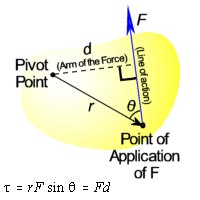
Is an engine that produces 135 hp is better than an engine that produces 125 hp?..Well maybe it is and maybe it isn't. What is the definition of horsepower anyway? The common definition is HP = (Torque x RPM) / 5252. Everyone is so enamored of peak horsepower these days that they will trailer their hot rodded V-Twin from dyno contest to dyno contest searching for bragging rights as to who has the most peak horsepower.
We hate to burst their ego-filled bubble, but in the real world it's the rate of acceleration that wins races, not peak horsepower. Torque is the most important element of the equation and if you can't produce torque in the lower rpm ranges it will take forever to get to the upper rpm ranges where the dyno junkies worship the God of peak horsepower. Every time you grab the next gear your rpms fall and you have to climb that elusive mountain to get back to those so damn important peak power readings. The rate of acceleration from one point to the next is how we judge a vehicle's performance, not how much peak horsepower it makes. The right question isn't peak horsepower but is the search for maximum torque in the rpm band that produces the greatest transient acceleration.
The next time you need a definition of usable power take a look at all the diesels roaming the highways. They are out there for a good reason, they make a bunch of torque right now, not at the top of the rpm band. A typical diesel will crank out 90% of its torque by 2000rpm!
Chassis Dynos: Lies, Damn Lies, and Statistics
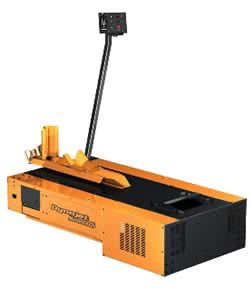
Put your bike on an inertial only chassis dyno and spin up a 900 to 1200 lb steel drum and pick up your dyno slip. This is a great method to impress your friends and to develop motors that you are designing to spin steel drums. How many people have called us that spent $10,000 on a "billet motor" that was slower than their stock motor when they did roll ons against their friends...Oh, the billet motor made a lot of peak power, and as long as you left it on the trailer you didn't have to worry about the pesky real world. The real world, however, is where we live and it's not a simplistic world like accelerating 900 lb steel drums. Racing stoplight to stoplight and passing semis at 70 mph or banging the next shift headed for the traps is where the rubber meets the road not where the rubber meets the steel drum. Chassis dynos are useless for development but a great way for people to gather and see who has the most peak horsepower.
As the people who sell them will tell you..."They are a great way to build traffic by organizing dyno contests!". If you ever pay close attention to the time these dyno runs take and compare the time to the way you ride or race in the real world you will see there is no 1:1 correlation. Often these "dyno runs" last only a few seconds, not exactly the way we ride motorcycles.
If you'd like a bit of an eye-opener look up a Hot Rod Magazine article that did a comprehensive back to back test of chassis dynamometers. Results were all over the place.
For a bit of Dynojet history we suggest you read this document.
Method 1: Superflow CycleDyn...Testing a Running Motorcycle..Inertia and Load
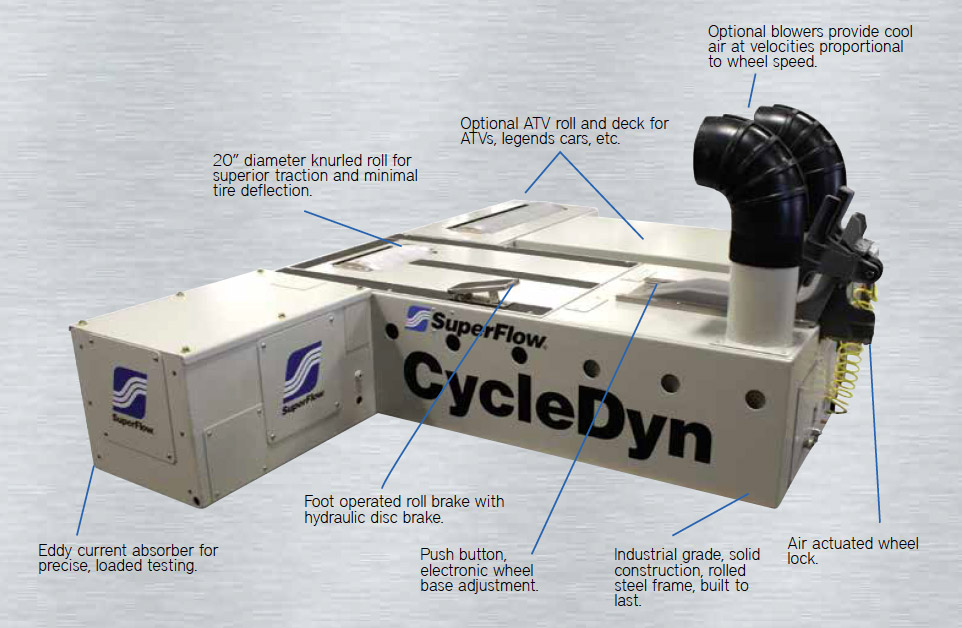
If you are going to use a chassis dyno it has to be a tool and not a toy. At RB Racing we use the Superflow CycleDyn as it best emulates the real world. We use it for development and not for publishing "dyno charts". Most of our work is with Pectel SQ6M controllers which have extensive internal datalogging and playback capabilities up to 2000Hz sampling rates. With the Superflow we can program specific tests and transient sweeps with our turbocharger systems up 750 hp in inertial mode or 500 hp in Eddy Current controlled accelerations.
Steve Cole (TTS MasterTune) who has spent untold thousands of hours on every dyno imagineable has this to say about CycleDyns:
Steve Cole: "In the
development side what I can say is the SuperFlow when setup properly
emulates the real world much better. As an example the only way to get
a DynoJet to give you HP and TQ is a WOT unloaded run. The SuperFlow
allows that plus just about any other combination you like with real
torque output. So what does any of it buy you becomes the question. I
can tell you that if we tune to a DJ and get the best we can, then
repeat on the SuperFlow using real world acceleration rates for the
engine being tested the results are very different. Take the final
calibrations and run them in both dyno's unloaded and the DJ developed
type calibration will show the most HP and TQ in those conditions, on
both the SuperFlow in DJ mode and the DJ. Then take the SuperFlow
controlled condition calibration and load it in the bike the power will
go up when tested in the SuperFlow mode again which can only be done on
the SuperFlow.
Now the hooker, take the bike and put one of the finished calibrations
in it and give it to the customer and say go ride it and come back
after you've ridden it well, to know how it feels/runs. They come back
after an hour or so then load the other calibration and ask them to do
the same riding over and come back again. Each and everytime we have
done this every customer has picked the calibration that was done on
the SuperFlow under the controlled acceleration modes! So pick what
works for you but there is a difference. Does it take longer, does it
end with a measurable difference............. YEP!"
Wind Tunnel Dyno
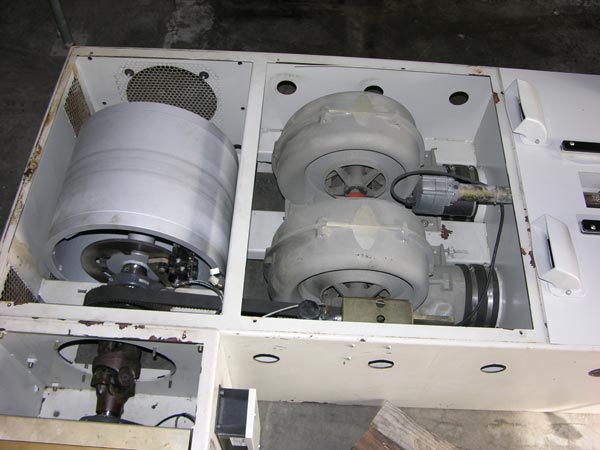
These optional
$5,900.00 internal "High Pressure Blowers" provide cool airflow to
match road speed 1:1 up to 200 mph. The CycleDyn is calibrated at
Superflow at the time of manufacture to measure and account for this
additional drag. Like tuning in a wind tunnel. Far more accurate results this way.
Tuned by Shane T
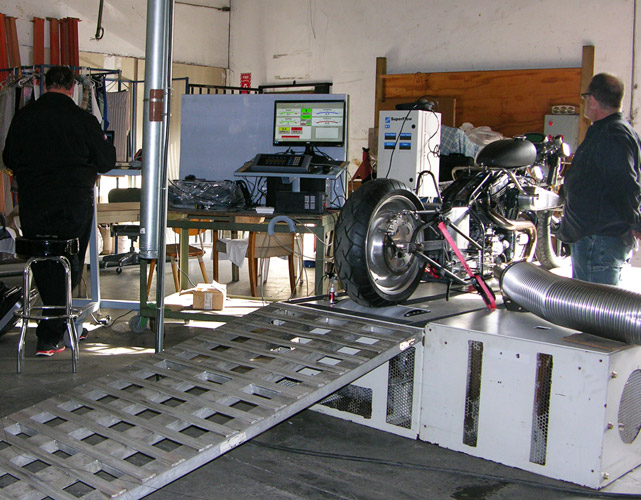
Shane Tecklenburg tuning a
Motec M130 on Tom Bookhamer's 120 Inch Bonneville bike on RB Racing's CycleDyn.
We use 30 feet of 8" stainless tubing for exhaust extraction with an 8"
Blower. The blower draws in 1725 CFM of free air mixed with the exhaust
and extracts it far away from the operators and the building. Carbon Monoxide is not an issue with this evacuation. Shane has
more time on dynos in more places all over the world than about anyone
we have ever met. Shane is the "go to guy" when you get serious about
Motec electronics.
Shane stepped off the airplane after a 25 hour flight from Bahrain ...tuned a Harley and headed home. He lives close by so it was a tight but convenient schedule for Tom and Shane. Tom all the way from Florida and Shane all the way from EKanoo racing in Bahrain. Strange world of racers.
Dynamometer Exhaust
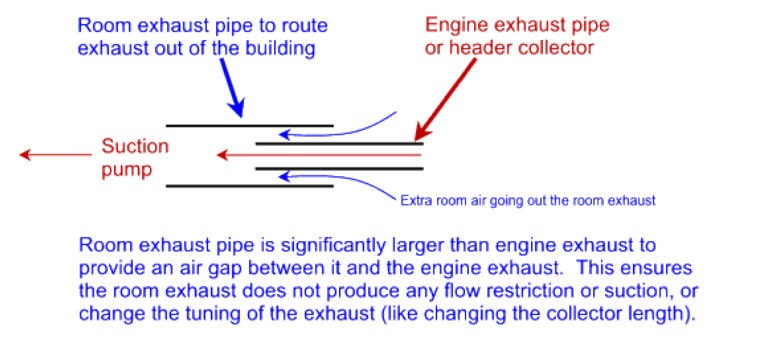
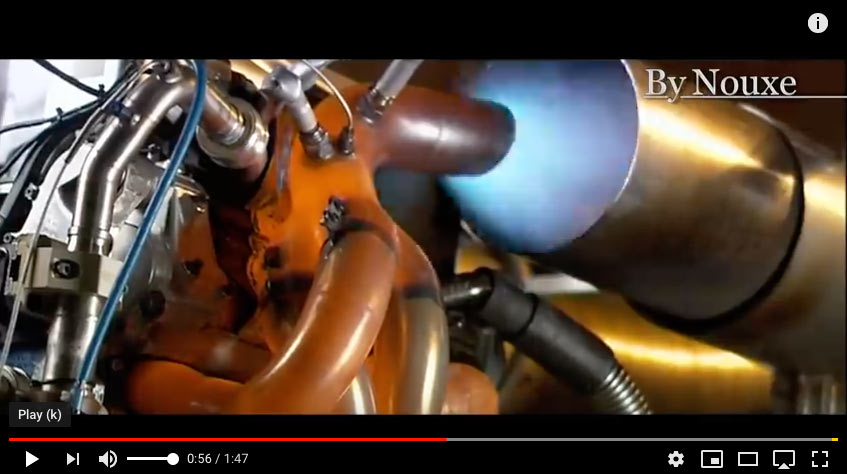
Exhaust extraction on a F1 engine. Clean
air is positively fed to the inlet and the exhaust is extracted from
the Dynamometer Cell. Figure millions of dollars just for the test cell.
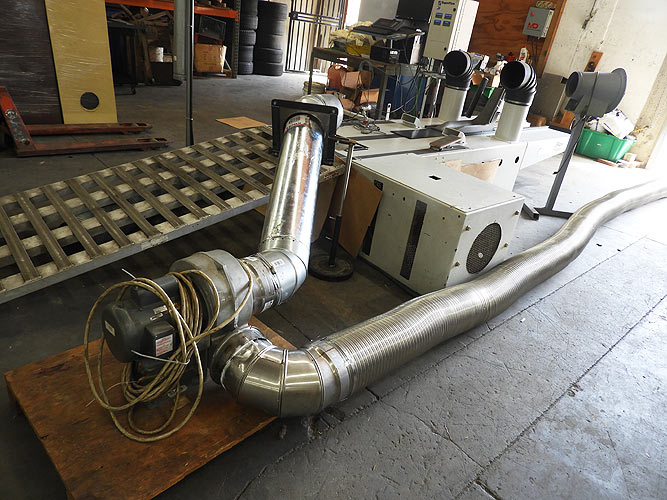
Carbon Monoxide is a killer. It has to be positively scavenged and discharged away from the building. All exhaust fumes must be vented so the operator and the engine cannot re-breathe spent gases. Carbon Monoxide is odorless and flat-ass dangerous. We have a CO meter on the dyno operators console.
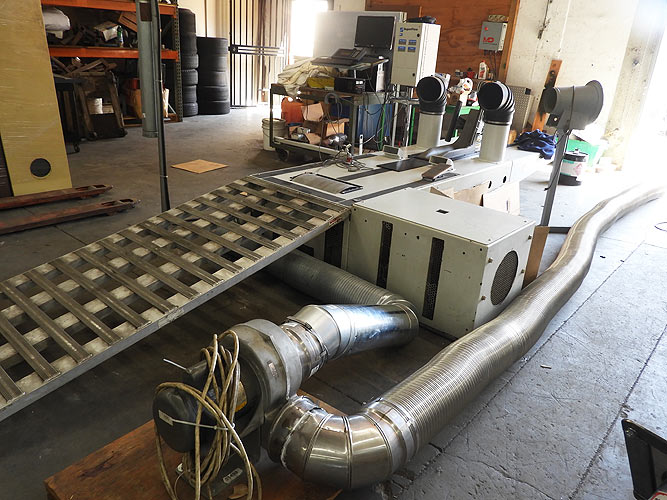
We have 8" diameter stainless steel extraction ducts for both left side turbocharger and right side LSR 2-1 exhaust development.
Conventional Engine Dynamometers
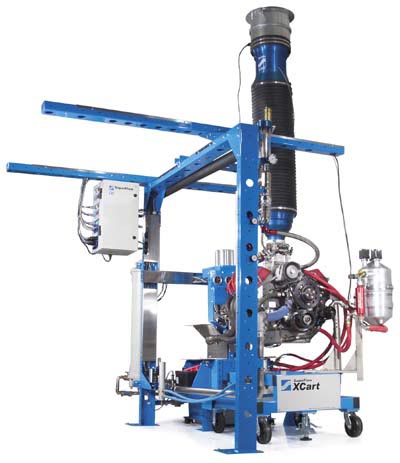
Water brake Dynos (many manufacturers) like Superflow are routinely used in performance engine development. You program these dynos to hold or stabilize your engine for "x" number of seconds in a series of ascending rpm steps to measure the torque at wide open throttle at each step. These steps are then plotted to generate the "Dyno Curve" for the engine. Usually, depending on the software and flow controls, transient accelerations are not measured, only the torque the engine will produce at specific points while being artificially held there so measurements can be made.
Without going to million dollar AC Transient Dynamometers these dynos are the best type of dyno for both brief and extended testing. Water cooling and high rpm capabilities make them the engine developer's choice.
When was the last time you were racing that holding a particular rpm had anything to do with winning? A race vehicle is always accelerating not sitting at some particular rpm and the vehicle with the most torque will always beat the motor that sacrifices torque for peak horsepower...This is why an engine with 135hp is not necessarily a better motor than one with 125hp.
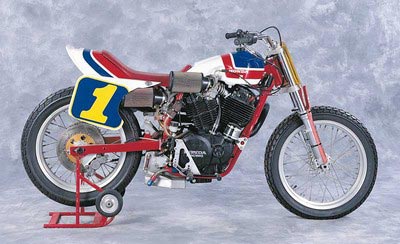
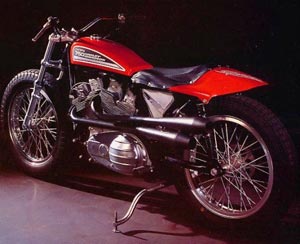
Races are won, not on one factor, like peak power, but on a myriad of variables like traction, driveability, a wide torque curve etc....and if you don't believe this then why did Honda struggle so hard in Class C AMA racing against the archaic XR 750 Harley-Davidsons and finally had to take out horsepower in their search for traction and driveability. Honda won the Championship 1984-1987. It's all XR's now.
Multi-million dollar dyno cells are pretty much going to AC style water-cooled dynamometers. The accurately control the rpm and load at lightning speed and pump power back into the power grid.
Eddy Current Dynos
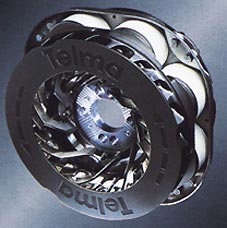
RB Racing uses Eddy-Current Dynos to do load testing. It's the cheapest form of accurate control of load and rpm but still has variables. These type of dynos can perform automated tests such as roll-on times from one rpm band to another, quarter mile et and mph as well as other tests since rpm and load is all under computer control. We have our Dynos set up to do engine direct as well as chassis-mounted testing. Companies like Superflow use Telma retarders.
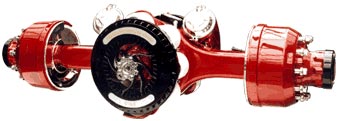
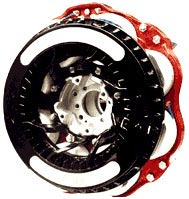
Eddy Current brakes or retarders were originally developed to provide frictionless braking on trucks and industrial equipment. They have been adapted for dynamometer use in both air cooled and water-cooled (vastly more expensive) variations.
With
Chassis mounted testing you still end up with all the variables of
gearbox, tire pressures, etc. but it still is the best way to do
in-chassis testing. All those variables such as brake heating, tire
heating etc are still present. It does afford you computer control of
engine rpm and load. This allows you to examine specific areas. Without
expensive water cooling these aircooled units rapidly lose
effectiveness as the brakes heat up.
Companies like Dynojet use Frenelsa retarders in their eddy
current dynamometers. Some companies re-badge Mustang
Dynos as sell them under different names. There are some things that
are pretty well defined, however, like roller diameter. Smaller rollers
like 12" are only good up for brief tests into the low to mid 100mph
range. The people who rebadge Mustang motorcycle dynos use a small
roller under the guise that it has "low inertia". The fact is you need
to get up to about a 20" diameter roller for 200 mph brief
accelerations...smaller rollers place too much strain on your tire.
Rollers are round and you race on a
flat road surface. No matter what you do any roller is a compromise,
and don't forget you are dealing with gearbox loses, tire pressure
variances, tie strap tension, and techniques of the operator. Lots of
variables between the crankshaft and the roller.
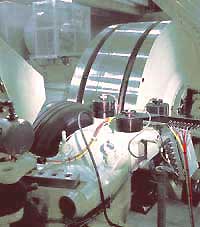
When you get into serious high speed testing and the tire-roller contact surface area needs to be accurately modeled, rollers about 10 feet in diameter are called for. Like most things, the science and engineering was done a long time ago, now the compromises are the norm.
Method 2: Eliminate the Tires
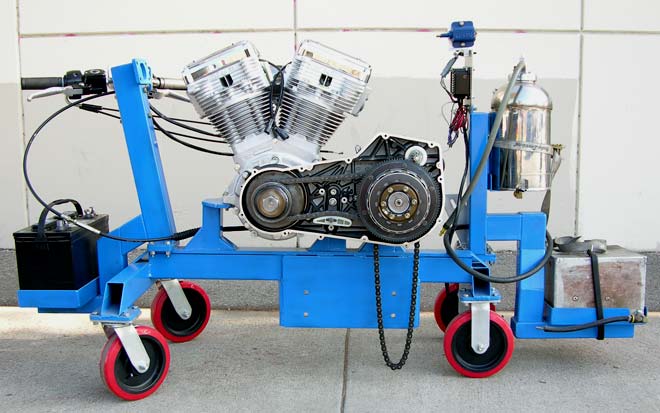
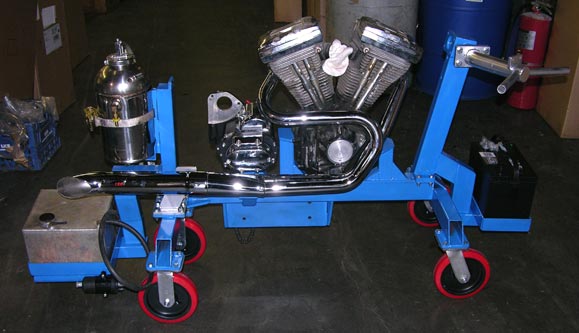
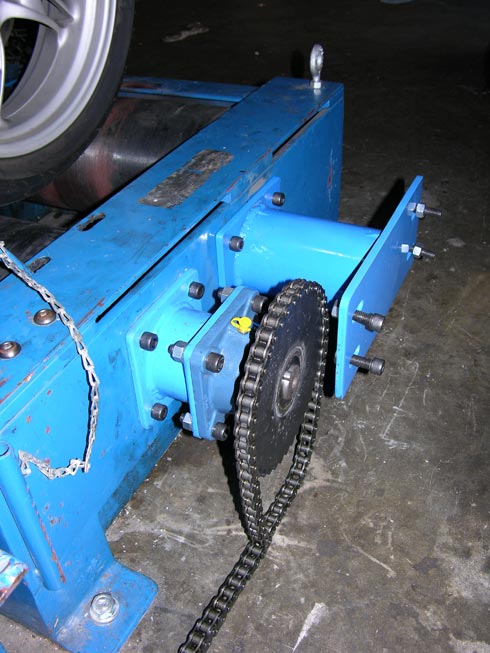
We can run the engines
direct to a 250hp Mustang Dyno Eddy Current Controller though a
transmission without having to deal with the tires etc. Good way to
run-in an engine befoe it gets stuffed into a chassis
Real World Testing, The Old Way
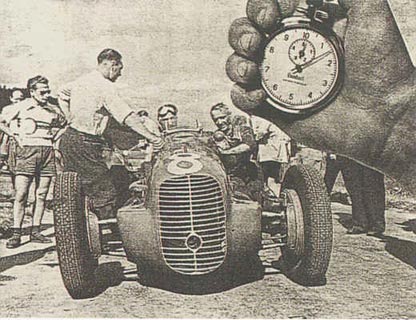
We
spent thousands of hours measuring rates of acceleration trying to
develop carburetion in the 1980's endlessly recording 40 to 60 and 60
to 80 mph times as well as quarter mile e.t. and mph readings. If we
couldn't get three tenths to half a second improvement in these
"roll-on" tests and six tenths and six mph gains in the quarter mile we
wouldn't sell the carb and pipe packages we were developing. We took
stock engined 750's and put them in the tens and took stock 1100's and
put them in the nines with no internal engine work. As they say..wasted
days and wasted nights and pie a la mode and coffee at 2 AM at
the long gone "Ships Diner".
When the Harley-Davidson Evo motors
came out in 1985 we took a dead stock 4 speed California spec big twin
and with only a RB Racing 2-1 and a 38mm "PowerMaster" flat slide carb
we developed ran a 12.90 @ 104.37 quarter mile. We didn't use any dynos
because we found the early chassis dynos like the Patraco and even the
early Superflow SF-900 series to be useless for carburetion
development...Our only recourse was to instrument the bikes and ride
them to measure the transient accelerations to see if we were making
progress. If you spend 2500 hours doing this, sooner or later you
stumble on workable solutions and formulate approaches to tuning...like
recording all the temperatures, barometric pressures, relative humidity
readings and changes in altitude. It was an expensive and stupid way to
insure we always had three to sixth tenths of a second advantage when
we went hunting whether it was on the street or at the track. Real
World.
It was also a process that had a lot
of variables that were difficult to sort out like rider technique and
road conditions and gradients. It was also dangerous because you were
instrumented to high heaven and taking your eyes off the road made life
interesting. Then there were the cops who took a dim view of 120 mph
passes past Donut shops while trying to get exhaust gas readings with a
tube stuffed up the exhaust. These days you have cameras and cell phones to worry about...
What are you measuring?
Take
an inertial dyno that everyone is searching for bragging rights on.
Take the oil out of your transmission. Put on the lightest rear wheel
than you can. Put on a chain and can the belt drive. Regear the mother.
Shave the rear tire. Put on a set of 20" stepped drag pipes. Shave the
flywheels. You win. Do you really? Not in the real world.
Method 3: Engine Direct: ORCA Transient Engine Only Dynamometers
Eliminate the variables. No tires. No gearboxes. Just the engine.
These days we use personal computers that are more powerful than what was used to be called "Super Computers" to develop things like fuel curves, ignition curves, piston shapes, port configurations and the like. Running from the cops might be a lot more exciting but the cops have lost their sense of humor and they tend to be a bit rough on you and your motorcycle...handcuffs for you and chains wrapped around the bike to tow it away. Then there are the lawyers!
To develop the ORCA big twins we use a sophisticated engine dyno that we have developed to accurately measure transient accelerations in minute fractions of time in order to optimize the engine's torque where in counts, in the mid range not just at peak rpms. We can datalog multiple channels of information during lightning fast transitions without having to artificially hold the engine in a series of rpm steps. Your motor's transient acclerations in the real world do not look like series of steps but are in fact a continuous curve that we can minutely quantify.
ORCA transient dynos work by creating a load that accurately reflects the real world load in terms of the mass your motor really has to accelerate and not some fixed 900 pound drum like you find on chassis inertial dynos. We set the transient loads to mimic exactly what your engine would see if it was going down the quarter mile for some peak rpm or simply for a typical roll-on from 2500 to 4000 rpm. By evaluating the piston, combustion chamber and port shapes not to mention the fuel, timing and camshafts we can direct our research to get the highest rate of acceleration for the intended application. An ORCA Transient engine dynamometer is exactly that...i.e. an engine dynamometer. ORCA Dynos measure directly from the engine to the dyno and not through any transmission, final drives or tires. This is the only way we can eliminate the variables that contaminate chassis dyno results.
We can also load the engine and hold it and do
controlled sweep tests because we built a low intertia water brake dyno
into the system. Unlike high inertia eddy current units with their
large iron rotors that heat up quickly and give varying results, a
water brake absorption unit can run endurance tests...like simulated
250 mph high boost runs at Bonneville. Try to hold 450 hp for two
minutes on your Dynojet.
How do you make an ORCA Engine Dynamometer?
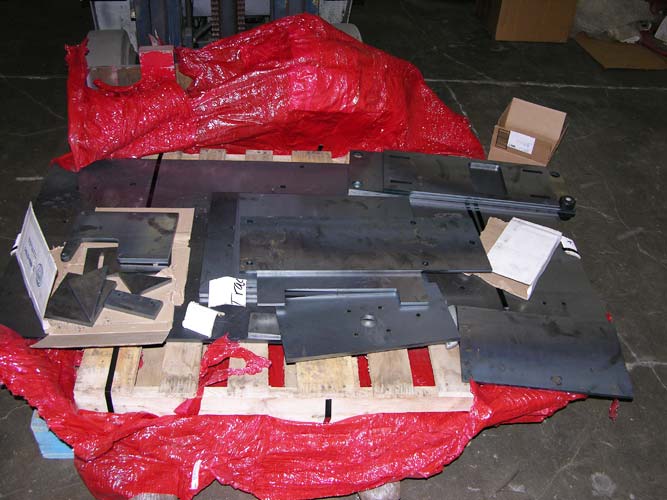
Well, you start out with
500 lbs of laser cut steel plate for part of the upper structure.
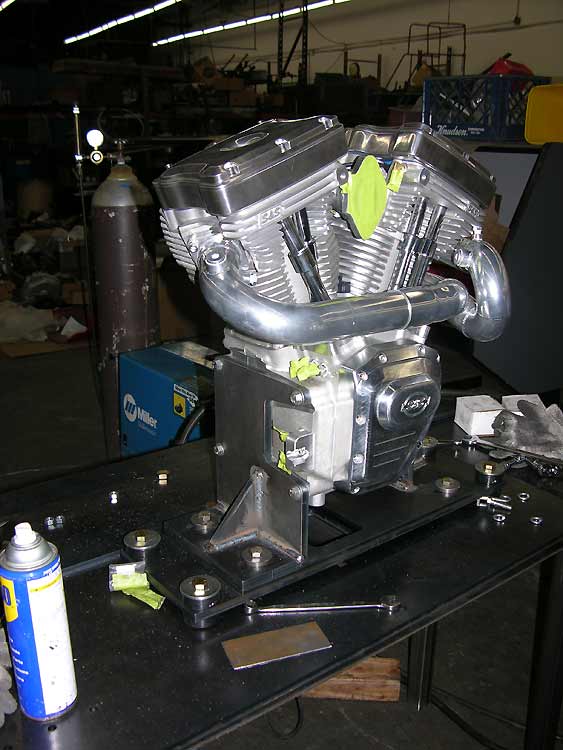
Next you get to design
engine mounts for Evolution big twins, pre-2007 Twin Cams, and 2007 and
up Twin Cams. If you don't rubber isolate the structure, even though it
will end up weighing close to 3,000 lbs, you are going to break
something.
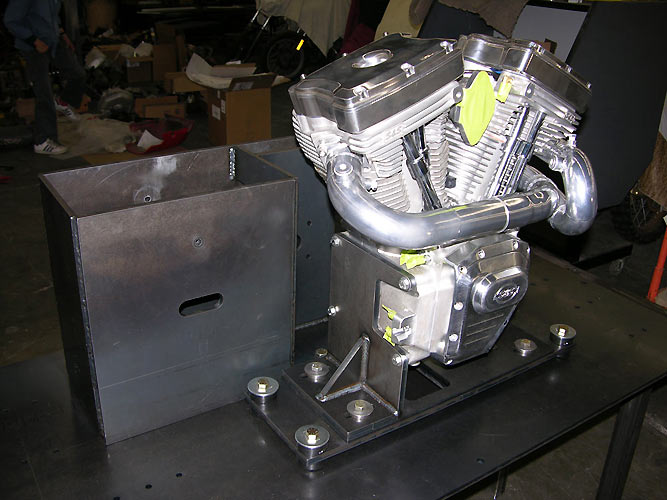
A chain-driven jackshaft
arrangement with torsional vibration dampers allows the engine to spin
the water brake dynamometer at the proper ratio to control the test rpm operating
range. Uses Depac Dyno software to control the waterbrake for accurate transient sweeps.
Show Me the Torque!
Harley
V-Twins will destroy most any dynamometer if you attempt to directly
couple the motor to the brake assembly. Two jackhammer pistons will
destroy either the engine's crankshaft or any dynamometer if you hook
it directly on a 1:1 basis. We know a famous race shop that could not
"control" a Harley V-Twin on their Superflow engine dynamometer so the
put a weight on the crank and the torsional vibration promptly snapped
the end off the crankshaft.
Water brake dynos are largely uncontrollable below
2800-3200 rpm so any attempt to run them 1:1 effectively kills 50% of
the operating range. We use a double jackshaft arrangement to spin the
brake assembly at a multiple of crank speed which gives us complete
control from low to peak rpms.
By making the ORCA dyno bulletproof we can test both normally aspirated and turbo ORCAS and have repeatable results time after time without tearing up or overheating the absorption units. This is the only way to develop an motor and it is the method we used to develop ORCAS for touring, racing, and the other real world applications that we all face. There simply is no other way to do the research so it correlates to the real world. You should realize by now our research is not dedicated to the mindless pursuit of accelerating your motorcycle's rear tire on 900 to 1200 pound steel drums. We don't have a lot of time to fool ourselves with the clock ticking away quicker everyday. You have to keep it clear in your mind that it's where the rubber meets the road that we ride, not strapped down to some stupid inertial dyno with tie downs like some dominatrix trying to melt down most of Milwaukee. Oh, the metal will scream, but it won't give you the truth.
Only an engine dyno can be used for serious
development. You have to get rid of the variables and measure things at
the crankshaft. Nascar, F1, and all the OEMs do it. We can't
afford a a multi-million dollar, climate-controlled, low inertia,
Transient AC Dyno so we made our own ORCA Dynamometer. With
sophisticated engine control systems we can datalog and adjust our engines
in real time.