RB Racing Harley Turbos

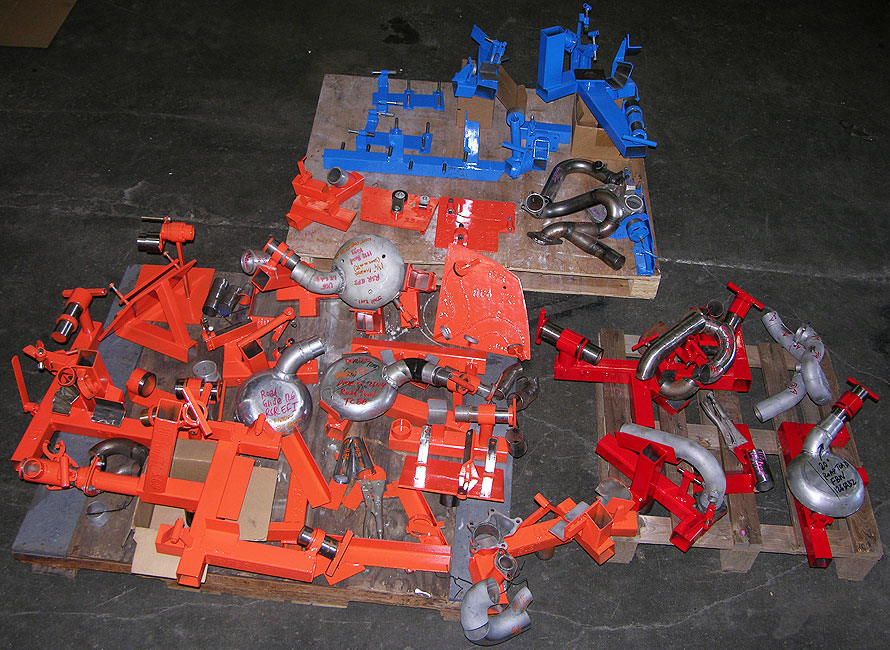
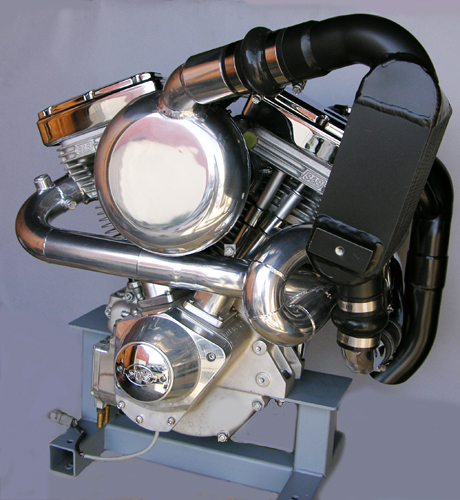
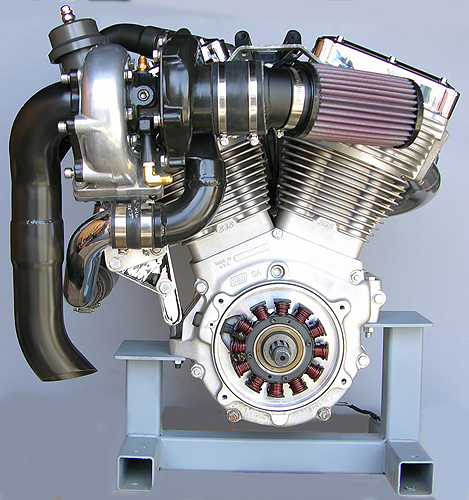
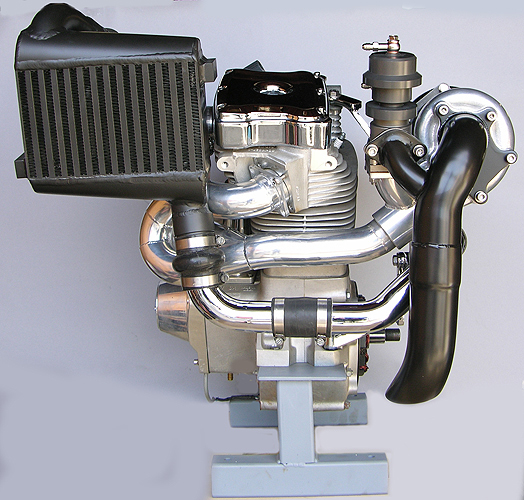
Pictured is one of our 139" Water cooled Harley Bonneville motors. Intercooled. Fuel Injected. Sort of serious. Over 400 hp. Here we prototyped the exhaust manifold in mild steel with special 2" radius bends and then made the fixtures and made the part in stainless steel. See the fabrication process involving purging the tubes with argon as they are welded.
New Turbo Technical Publication

Jeff Hartman's new book features Mike's 139" ORCA engine on the cover and some pictures of the Bonneville Bullet. Very professional turbo book for those interested in the technology. Jeff covers a myriad of subjects in great detail and explains the math behind tubos and forced induction.
250 Hp Blackbird / 350 Hp Pro Street / 500 Hp Pro Gas

These are the 5th Generation in the line of RB Racing's Harley Turbo Kits. "Kits" is actually a misnomer as these items have evolved into sophisticated systems that integrate electronic fuel injection, intercooling, and custom designed turbos that cover everything from 74 inch Evo Sportsters to 160 inch Billet full-on race machines, with horsepower potentials from 250 to over 500 hp!
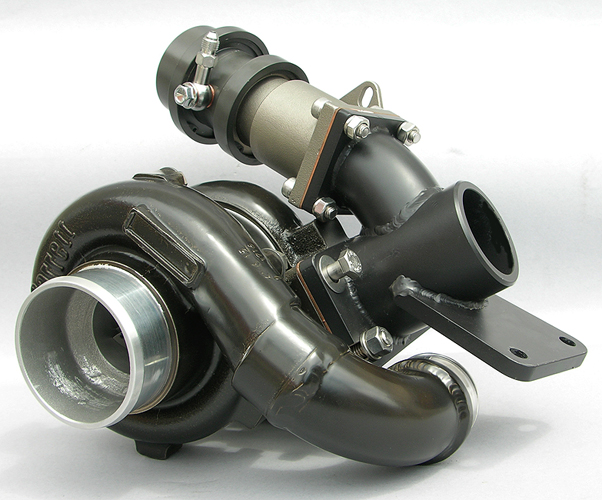
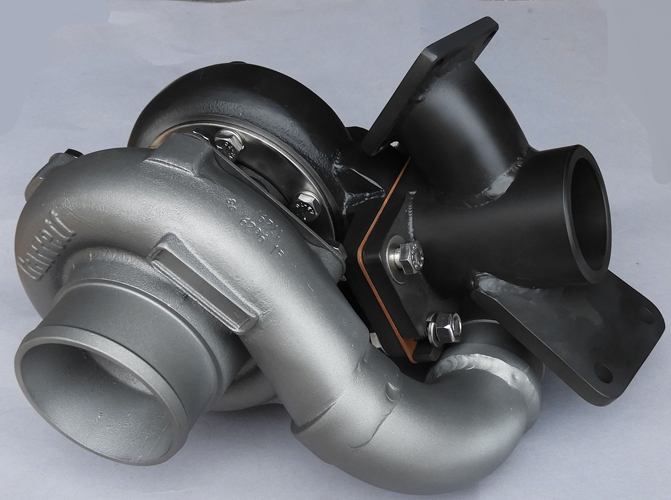
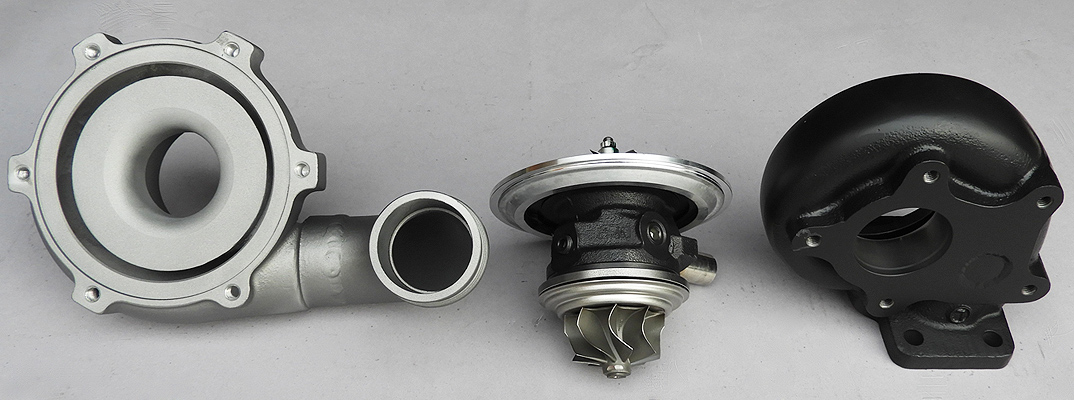
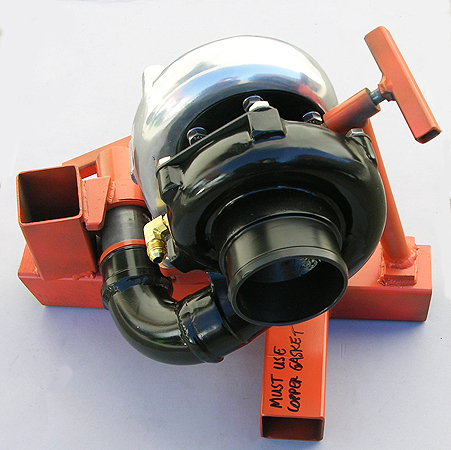
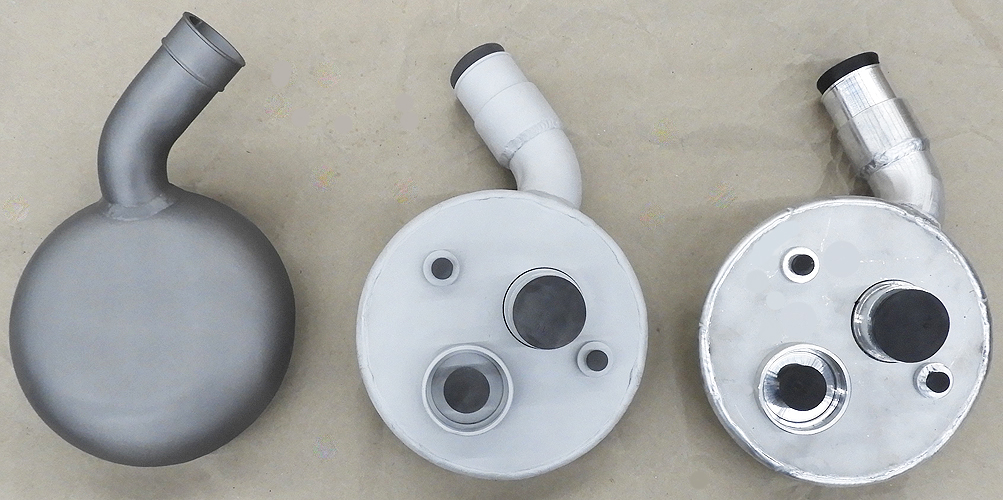
Left to right: Blackbird and Pro Street, and Pro Gas Turbos. These guys get ceramic coated and coated with special anti-corrosion heat dispersant paints. When you go to Bonneville the salt bears eat everything.
Polish, Ceramic Coat

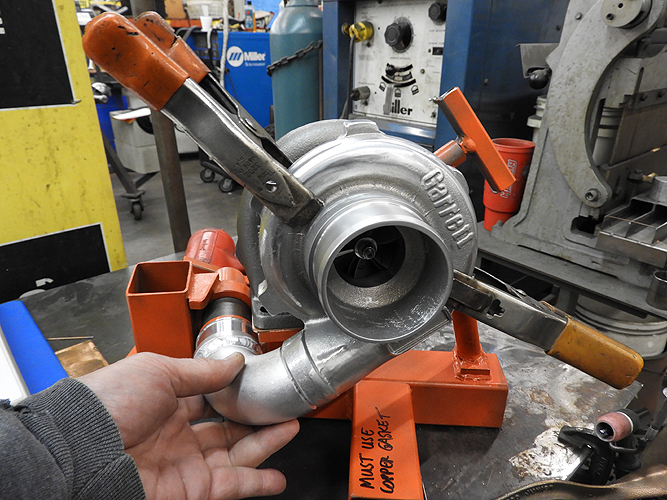
We spend a lot of time and money to pretty up the turbo which is sort of a raw industrial product. Polishing, chrome plating and ceramic coating as well as replacing rust-prone hardware.
Newly Redesigned Turbo Systems
Note: For custom frames with 40 degree rake center mount turbos with center mounted intercoolers are available. For standard frames all turbos are left mount with right mounted intercoolers._N__Note:N______Note
|
|
|
|
|
|
|
|
|
|
|
|
|
|
|
|
|
|
|
|
|
|
|
|
|
|
|
|
|
|
|
|
|
|
|
|
|
|
|
|

Here's the 139 Inch Orca Bullett with it's large diameter stainless steel merge collector exhaust system and large air to air intercooler. Pretty much state of the art insofar as pushrod Dinosaurs go. Designed for the long course at Bonneville.
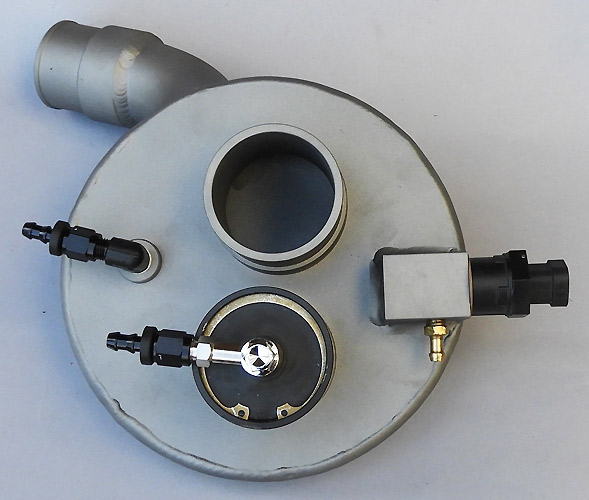
Mike Geokan's RB Racing Turbocharger uses a separate oil system that has a stainless steel oil tank and an electric feed pump that maintains a constant 30 psi to the ball bearing turbocharger. The engine runs 50 weight Brad Penn (ne Kendall) "Green Stuff" oil and the turbo runs Brad Penn 20-50W.
30 Years of Experience
We have turbos for small motors and turbos for big motors. We have turbos for stock frames and we have turbos for custom frames. We have center mount turbos and we have left side mount turbos. We have turbos for street and we have turbos for racing. We have turbos for gasoline and we have turbos for methanol. We can run dual fuel strategies with gas and methanol at the same time. We can set the bikes up with two or three or four injectors with injectors rated up to and beyond 1600cc/minute. We have fuels pumps for 250 horsepower. We have fuel pumps for 500 horsepower and we have special pumps for alcohol. We have water injection systems for high output horsepower increases.
We have turbos with different primary tube sizes for different displacement motors. We have turbos to fit standard port cylinder heads as well as S&S SA and S&S B2 raised port, four bolt heads.
New Larger Intercoolers

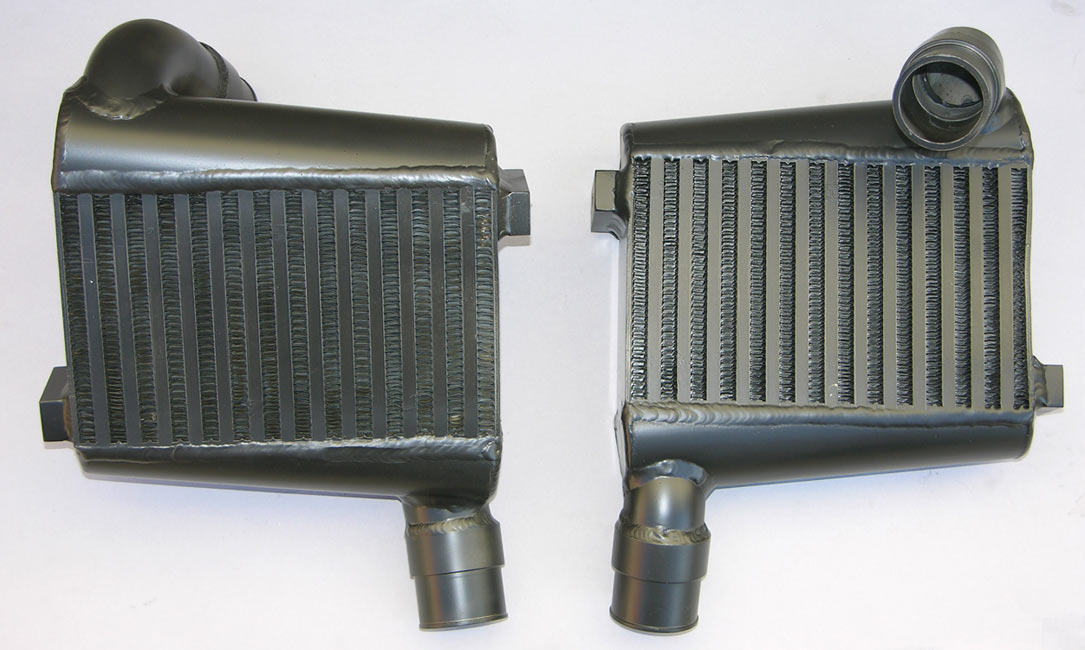
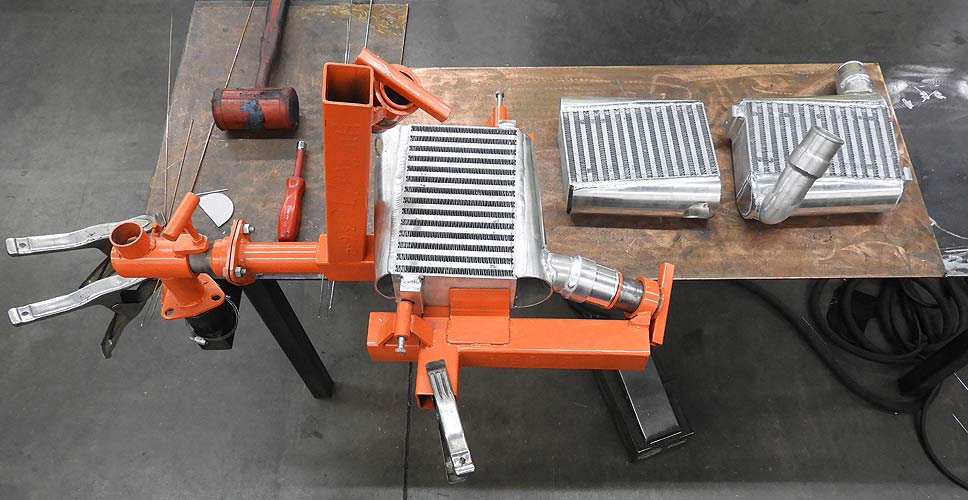
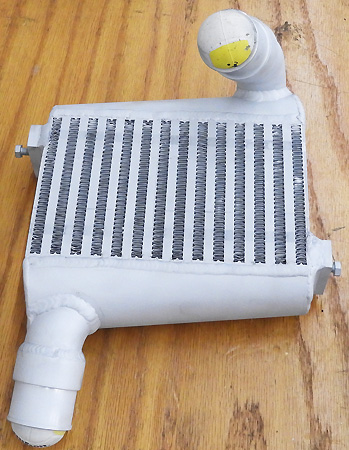
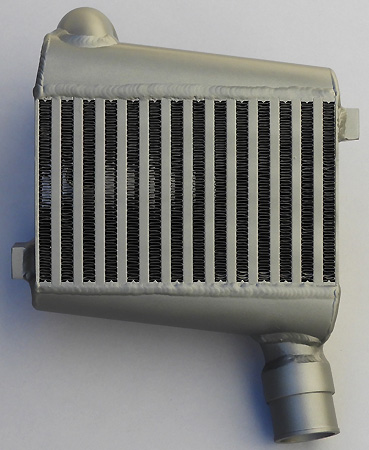
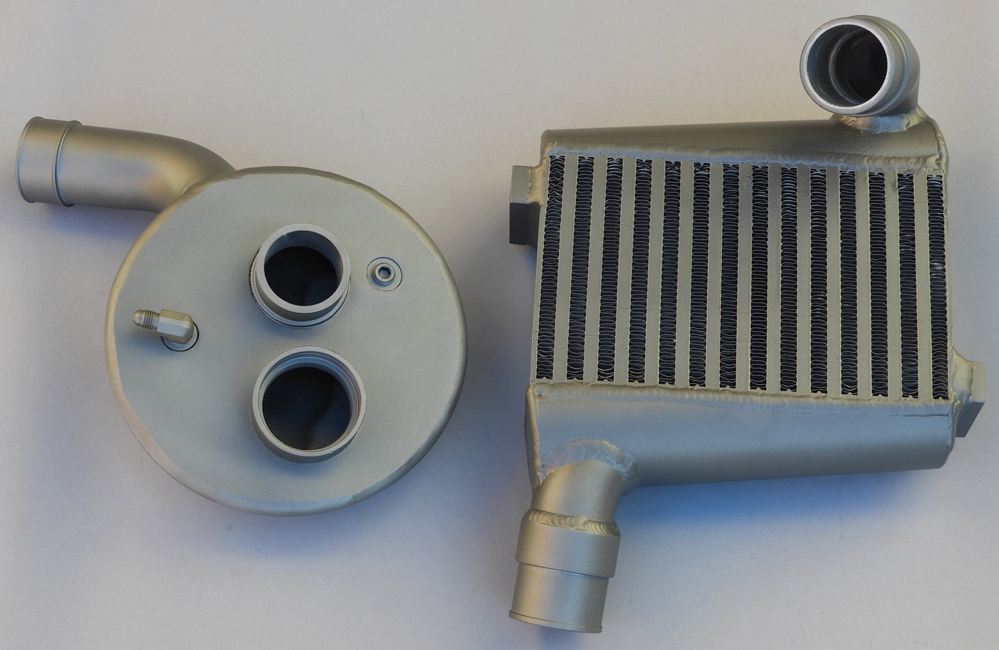
The power went up so the charge cooling had to keep pace. In the center is one of our 10 year old designs flanked by the newer, larger cores. In case you didn't realize it, compressing air (boost) makes it hotter. The hotter it is going into your engine the more prone your engine is to detonation. At higher race levels the compressed air can reach 300 degrees F. Employing a larger intercooler allows us to drop charge temperatures 75 Deg at lower boost levels and 150 Deg F at higher boost levels. Combined with our RSR Water Injection you will make more power without engine destroying detonation.

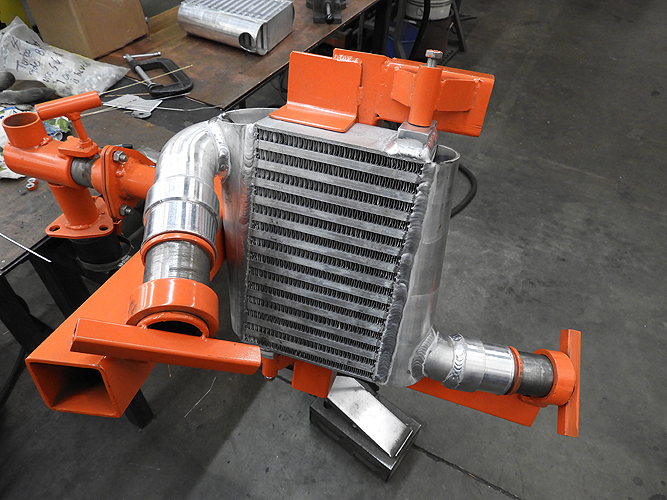
The intercoolers either twice or four times as big as we used 10 years ago depending on the application. All new turbos are double ceramic bearing. All turbos are capable of way, way, past 200 horsepower. Racing turbos are rated at 600 hp. Center mount intercooler prototype for center-mounted turbo in raked frames pictured above.

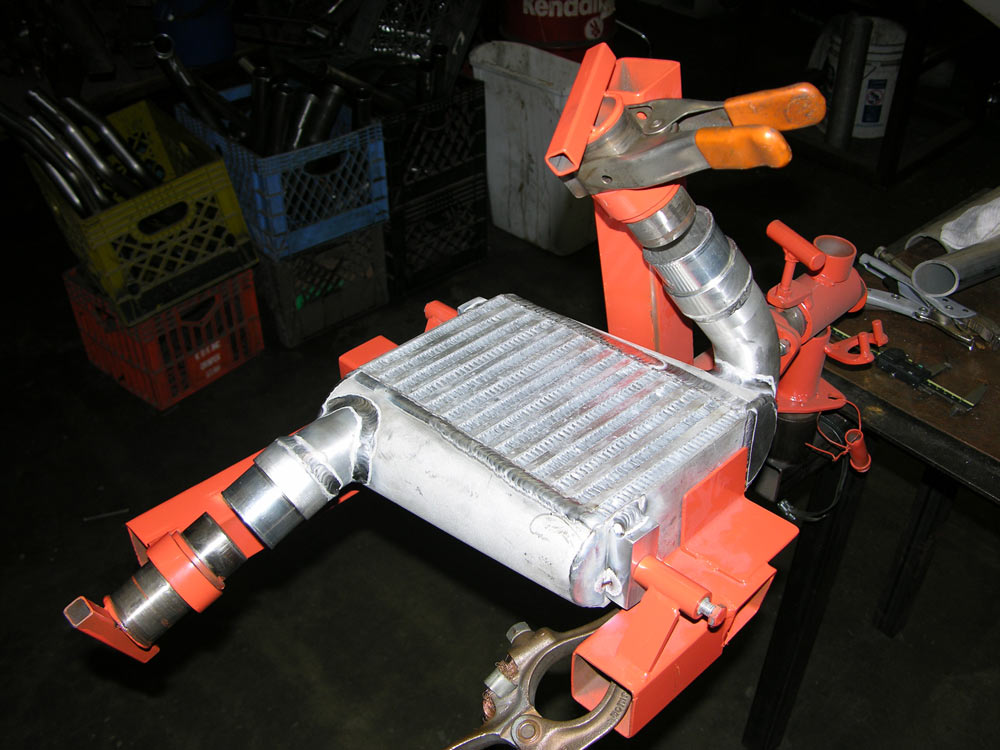
All systems use RB Racing's proven RSR Closed Loop Fuel Injection system. Systems are programmed for 2 Bar or 3 Bar operation. All systems use our billet Boost Master Wastegates with pneumatic controls. Twin core charge cooler for Mike Geokan's Bonneville Bullett pictured above with rubber isolation mounts top and bottom.
We have finished up new instrumentation packages, the most advanced in the industry, to support our turbos. New digital displays. New Boost Gauges. Waterproof, Harley-proof. All to provide vital information. Orca Turbo Dash.
We can provide Turbos Pods with ORCA engines in custom frames. We also provide Pro Gas systems for big displacement drag racing, speed, and dyno contest engines. We have engineered out seven new systems. One hell of a lot of work.
Water Injection

Hard anodized water injection reservoirs with our integral 230 psi "RSR Pro-440" pump. Sophisticated two stage RSR Water Injection is standard with our kits. Even with large capacity intercooling you need to reduce inlet temperatures and increase charge density to keep your motor alive and to keep you in front of anything you come up against.

Sight tube for fluid level and stainless quick release filler neck. License plate mounted so you can fill the container easily....Also there are no places to tuck a large reservoir on Willie G creations. Compatible with water, water-alcohol or water-methanol mixes.
We now are now making Water Injection mandatory with all Turbo Kits and ORCA Turbo motors. We have always run water injection on our Bonneville bikes and since people always want more power, water injection is the only safe method of running more boost. Our new RSR Water Injection Calculator shows you how it works.
We only do it the right way. There is no other way. The way we do it at Bonneville.
Peripherals

For things like fuel pumps, we have sorted through various suppliers looking for the best pumps for our applications. Some were smaller than others, which was a plus, but the quality varied and formed metal nipples or plastic casings could crack...and some had shitty push-on blade connectors that, while they worked, were questionable. Water proofing these tended to be a hassle.
Pumps have to be of very high quality and are typically rated for about 3,500 to 5,000 hours life...assuming you don’t try to pump even microscopic grit through them...and if you don’t run them dry. We sorted though many manufacturers and tend to use pumps that have a German accent...pumps which have weather seals on the connectors, screw-on terminals, banjo fittings, and a distinct lack molded plastic parts. We make sure you filter the gas before it gets to these expensive items.
Powder coated mounts, rubber isolated and stainless steel hardware. Different pumps for different horsepower ratings. The German pumps we use are static @ 400hp and 550hp....We like to see at least 30% bypass fuel at peak numbers so we use these pumps for applications up to 307.7 hp and 423hp respectively.
For larger applications, like Big Inch Pro Gas Turbos, we use larger pumps and regulators from SX Peformance.

These allow the use of 600+ hp capable turbochargers and remove restrictions that would occur in regulators with less bypass area. It all gets expensive. The pumps are $346.95 and the regulators are $149.95. Then you get to go buy some expensive pretty fittings to complete the ensemble.
Big Air

We have a completely integrated inlet system with a 56mm (2 3/16") throttle body with intergral stepper motor Idle By-Pass, and ball bearing shaft support with shaft seals. Combine this with a full 1/2" fuel by-pass fuel rail and port injection in either 2 bar or 3 bar systems with up to 6400cc/min delivery capability and you have the ultimate turbo package. Fully engineered and proven.

The throttle body incorporates push pull cables, screw adjustable idle stop, vacuum/boost port, TPS mount, Idle Air Bypass circuit, and a two bolt flange using 7/16" Allen Bolts that hold the fuel rail and throttle body to the inlet manifold. The TPS is bolt-on and forget. There is no need to "set" it. The throttle shaft rides in sealed ball bearings.
Killer Wire

Water-proof, abraison -proof, Harley-proof wiring. Never a wiring failure since we started doing them in 1989. Automotive grade high temperature wiring with waterproof connectors, gold plated and silicone sealed Deutsch ECU 40 pin connector, Weatherpack silicone sealed sensors, and fused peripherals, all sheathed in fiberglass wrap. Very professional. There is also a waterproof tuning switch that allows programming with the ignition "off".
IBM Thinkpads...Autocal.V6

We hate PCs and supply you with a used IBM Thinkpad Laptop preloaded with all our software for both serial Fuel communications and Autocal.V6 prediction and analysis. The units are tested on the RSR ecus we send out so you can get going right away. We have decided not to spend hours on the phone diagnosing computer or software installation issues. For $600.00 you get a fully functional laptop with over $600.00 worth of software already installed.
With Autocal.V6 you can write a program for any engine in a few minutes. With our Fuel serial communications software you can edit your RSR ecu and maintain all of your ecu calibration files.
The Thinkpads come with either 12" or 13.3" lcd screens. All software is preloaded and tested. The laptops come with AC power supplies and our special serial communications cable that attaches to your RSR ECU wiring harness.
Turbo Pods / ORCA Pods
We offer turbos for both EVO/TC88 as well as our 113/132 ORCA motors already installed in a custom frame that we supply or you supply us. If the frame has a typical 40 degree rake then we have center mounted turbos for 350 hp as well as 500 hp models both with large capacity intercoolers.

For example a customer had a 131" Merch engine so we prototyped up a 350 hp kit for him. We zapped up a quick set of headers to get our locations and mounts and then built a righteous set of gear. Frame has a 40 degree rake and the usual set of $3,000.00 forks that we aren't supposed to scratch. Customer finally decided to go ORCA and sell the 131 Merch.

Other customers send us FXR frames from companies like Chopper Guys. This one's getting a 113" ORCA 350hp engine.
In any case we have to have the engine here, in the frame. Typically we supply a 113" or a 132" ORCA motor with a charging system set up for our RSR Closed Loop Fuel Injection system. We put on the tabs, brackets and make sure the plumbing fits perfectly. We don't do any painting, transmissions, final drives, wheels, tires, gas tanks and the like. We're turbo and engine people, the bike building is up to you.
Basically give us a call to arrange the power part of the equation. Get the main part done correctly.
Orca Turbo Dash

We got sick and tired of non-zeroing, non-lighted, leaking, liquid-filled boost gages and lighted mechanical gauges that have needles that vibrate off, so we made our own. The result is the Orca Turbo Dash, a sophisticated machined from billet dash that dispays 30" Hg to 30 psi (3Bar) as well as dual egt displays (Deg C or F selectable) and RSR Water Injection activation L.E.D.s.
Mandatory on all RB racing Turbo Systems it allows you to monitor and record boost and exhaust gas temperatures as well as provide alerts for staged water injection activation
Boost Master Wastegates

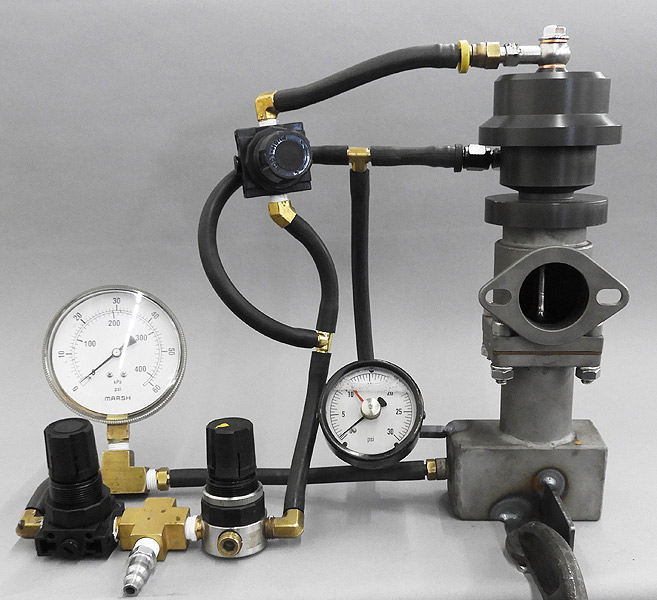
We make the best wastegate that can be bought. Boost Master. Investment cast stainless steel valve body and CNC aluminum construction with capacity for 500hp. We do not use cheap integral wategates. We only use rider adjustable pneumatically controlled wastegates.
V-Rod Pro Street Turbos in 2009...Well, Maybe 2010

Watch for the development of the V-Rod Pro Street Turbo at RB Racing . We have had to delay the introduction of these due to our Bonneville Bullett project and our on-going BMW turbo projects.
We all know you can't beat torque and the V-Rods have been short in this department. We'll show you how to torque your V-Rod past those other pesky two wheeled vermin! It doesn't have pushrods, but there is hope for it. No, we aren't going to do something stupid like try to build a turbo that blows directly into the engine without any intercoolng or water injection. And no, we aren't going to heat soak the intercooler by placing it underneath the phony gas tank cover. We are not plumbers...there's more to it than that.
At a couple of the AHDRA we've seen a few of the available V-Rod Turbos. When you run slower than the 70 or so V-Rod Destroyers that shown up it's pretty embarassing. We don't do slow. Running in the high 11's in the quarter mile is downright embarrassing when Destroyers are running in the 9's.
If you think we're going to tuck a turbo by your feet or inside your right leg you are dead wrong. These damn Metric fighters start out with 115-130 hp...if you think we're going to build some stupid, non-intercooled. $5,000.00 "160hp turbo system" that runs 11's in the quarter mile you don't understand what we do. If it isn't faster than a V-Rod Destroyer then there is no point in doing it.
V-Rods are not selling well and Harley's sales are way down so we use caution in our development dollars.
History Lesson....Dyna Turbo Down Under

A long long tine ago (2002) Jeff Richardson took a ride on one our turbos and forgot about the 131 Merch friends were telling him to buy. A few years later and a lot of effort transformed his Dyna into a unique one-off custom. Passion is strong in Australia...It took a lot of determination and hard work by Jeff, Andy McConnell (Fireball Customs), Frank Lee (custom paint), and a host of others to pull the project together. Sep-Oct Issue Heavy Duty.
First Fuel Injected Harleys in the 9's, 8's and 7's

We've been at this for awhile from our early 80's 150hp Shovelheads up through our specialized 300+hp Turbo ORCAS. We put the first fuel injected Harleys into the 9's, 8's and 7's at the drag strip and are looking to put one into the sixes in the near future. The only fuel injected intercooled Harleys that hold national drag racing championships or Bonneville records come from one place..RB Racing.
Whereas people love to talk about about turbos and, if they have touched one once in their life they become experts, we have been at this long enough to know what should be done and what the difficulties are. It's always amusing the see the poor engineering that comes and goes in this market.
RB Racing Turbos Since 1979
From our first draw thru carbureted Harley designs in 1979 (See photo below) to the first blow thru carburetted designs in 1985 and on to the first fuel injected models in 1989 there has been a constant progression to improve and advance the art. We were pumping out 150 Hp Shovelheads in the first successful "draw-through" carb design in the late 70's and early 80's. See photo below. Some backyard garage types are still trying to market "draw through" carbureted systems but they aren't nearly as sophisticated as what we did over 20 years ago.
Some people claim they have been doing turbos since 1977 and that they were the first to do all sorts of things. We sort of remember them buying parts from American Turbo Pak, spending lots of money with Orient Express and bugging us about how to do remote oil systems. American Turbo Pak went out of business in the 1980's and one of it's founders, Bill Hahn Sr., a real turbo pioneer, passed away in 2009. It sort of makes you wonder why someone would use the initials ATP some 20 years later. Still clinging on coat tails.
1980 RB Turbo Shovelheads.... Click on photos to enlarge
Blow Thru Carb Designs SUCK!
Don't confuse or even try to compare RB Racing Turbos with other "Harley Turbos" such as Aerochargers which are a simple copy of our "blow thru flat slide carb" design of 1985 to 1989 that reached a high point with Joe Walker's famous show-winning "Jap-Zapper" Turbo/Nitrous 1989 Springer Softail that won 1st place at the 50th Sturgis Rally (See Photo below). Blowing through a carb not designed for pressurization is an invitation for disaster due sealing problems, backfires, lack of float capacity and possible overflow problems not to mention no one ever tells you they can't possibly get it "correct" for all the different motors out there. We know, we've done it, we've been there and we dropped the deal after four years of seeing the good and the bad side of blow thru designs.
Joe Walker's famous "Jap Zapper" our last "blow thru" design (1985-1989)

Aerochargers

Typical E-Mail..."I am a EX-Areocharger turbo freak. I love turbos. But after tearing the variable vanes out of 3 Aerochargers, I decided that they are worthless if they can't hold up. The last one only lasted about 2500 miles. Too bad someone doesn't make a self lubrication turbo without them variable vanes. So for the mean time I am going back to natural aspirated. But I know I am going to hate only having only 90-100 HP and not having my close to 200 ft. lbs of torque. So I am looking at the conventional turbos. I wish I had found RB Racing first!."
Not Ours...Beyond Stupid

Anyone who hangs a turbo on the right side of your big twin and blows it directly into your inlet manifold without some plenum or an intercooler is an idiot...we won't go into the reasons why. There are still one or two cavemen trying to do it this way. The bike pictured was offed on E-Bay after the owner dumped $11,500.00 into trying to make it work. Nothing fit, nothing worked, and it was a total disaster. The owner called us up several times and was really pissed off about ever getting involved in the deal. He spent $5,500.00 for a few ill-fitting tubes and a turbo...and another $6,000.00 in shop time trying to re-engineer the disaster. We spend a bit of time listening to these tales of "woe and no go".
If you wish to check these out:
http://www.turboyourharley.com/
110 Horsepower...Can You Handle It?
These tubing vendors and pseudo turbo people give you no fuel control, no boost control, an integral cheap wastegate, ask you to drill and tap a regulator in your fuel tank running a 1/8" plastic tube to it and shuffle you off to Power Commander land. No one tells you 110 horsepower coming from a hair dryer tucked next to your leg makes less power than your standard big bore hop up. Hell you can drop in a bone stock 124 S&S engine and get 130 horsepower and not have to deal with chicken shit engineering.
Stick on a set of S&S SA B2 heads on the 124 and get 150 horsepower. Put on one of our turbos and get 300 horsepower...or 200 horsepower with moderate boost.
Why in the hell would you put on a turbo to get only 110 horsepower? These people will tell you " Extensive engine damage may result" if you go above 8psi and 110 horsepower. Like we said...no fuel control, no engineering. Hell, we made more than 110 hp just using a standard 96" S&S engine a long long time ago.
No Turbo...Think about it

Hers's a perfect Video example of one of our customers with our LSR 2-1 Pro Stock pipe and no turbo. If you think one of the "in your leg turbo" vendors can outrun this bike think again.
Black Strips Lasting Longer Than 6 Miles

If you experience black strips lasting longer than six miles seek immediate mechanical attention and replace your RB Racing components with stock ones. Continued use can cause loss of licenses, premature tire wear, and infuriate your competition.
Tales of Woe...Not Ours!!!!
The usual story is: " Nothing fit. The things that fit broke. My motor broke virtually every time I rode it. The manufacturer worked on it three times...I finally took it to my Harley dealer to fix the motor etc, etc." We listen to this and simply tell the people..."You wanted a turbo and you got one i.e. a few tubes and a turbo". There is a lot more to it than that. This isn't plumbing.
This is dumbass engineering at its worst. Designs like these are worse than we did almost 25 years ago with Shovelheads. They will quote you numbers but the designs are so limited the real world catches up with you quickly. Don't try to go racing at the track unless you want to get embarrased by some guy running an S&S carburetor and no turbo.
These people buying turbos for under $600.00 and giving you a few tubes and selling it to you for $5000.00 to $6,000.00 If they offer you an intercooler it doesn't have enough heat-shedding capacity to cool your tennis shoes. We would not even give you something this stupid more than 25 years ago.
Mike Geokan's Bonneville Harley

Can you take your 250 hp Harley race bike and cruise around to thank the people who have helped you set records? It takes a lot of people to build a bike from scratch and to support a race effort.... Painters, welders, fabricators, engine specialists, fellow club members, and even professional dancers like Salina. You never do it alone and if you don't take the time to thank those who helped out it's going to be a cold lonely night with you and your time slip to keep you warm.
Mike was running 199 mph in Bonneville Slush with 22 lbs of boost and 275 horsepower way back in the 1990's.
Salina, pictured on Mike's bike has lent her support to Mike's effort. You have to join some Yahoo group to go directly to her fan club which has links to other pictures.
http://groups.yahoo.com/group/OfficialSalinaUnzippedFanclub/
Mike Geokan's world record holding RB Racing Turbocharged Harley Davidson is featured in a new video. For more pictures on Mike's bike at Bonneville and for pictutes of his new bike go to our Hot News section.
The best advice we have to offer are our three new designs (Blackbird, Pro Street, Pro Gas) which represent over 25 years of experience in turbocharging the Big Twin. For those who have purchased other designs or have made, or are trying to make, their own turbo kit please understand we are not in the telephone or e-mail engineering business. We get calls requesting engineering assistance on cams, intercoolers, pistons, turbos, oil systems etc with people wanting hard advice on how to solve their problems or wanting to adapt our parts to other designs.
Most of the time the caller is attacking his "problem", say in the area of camshafts, when he doesn't realize he has a turbo, a turbo inlet, or fuel delivery problem that he will not be able to overcome. The parts we make for our turbos are very specific and were not meant to be adapted to other systems.
Wastegate: $10,000.00 down and many more dollars to go


Pictured above are some of our investment cast stainless steel wastegate bases. The first one costs $10,000.00 but they get cheaper after that. The wax pattern is to the left.
It's a complete system
A complete systems approach is why our RB Racing turbo kits produce so much power at low boost levels and why they work so well in day to day operation while giving excellent fuel mileage and driveability. More often than not people come to us after spending some astronomical sum of money on their engines only to be disappointed in the result. When we tell them they have to start over with different pistons, cams, gaskets etc they reply that their motor will be just fine turbocharged at 10.5:1 compression ratio and 15 pounds of boost. Since everyone is an expert we no longer try to advise them differently if they so object...Everyone has to learn sooner or later. We do recommend 8.5:1 if anyone wants to listen...of course this all depends on cams but that is another story all together.
For those who are in the planning stages we can offer complete 113/126/132/139" Turbo ORCA motors that have all the right stuff in them. When you purchase an RB Racing turbo system we ask what your intended use is and structure our advice based on the latest information we have. Look at the early RB Racing turbos above and the pictures in this section to see how far we have come in nearly 30 years.
Harley Motors and Turbos
Can I put a Blackbird 250hp turbo on my stock 80" or 88" TC88?...hell yes! Will it make 250hp and be reliable?...hell no! What should I do if I leave my motor stock?...Well, if you run around 8-12 psi with our Blackbird system you will outrun about any big inch mega motor you come up against...for less money.
Keep in mind we use only high output 350 to 500hp turbochargers that move twice as much air at lower pressure ratios that other firms. We do not use small cheap turbos.
1. Cams: Stock Harley motors don't have enough "cam" for turbos as they are basically short duration next to nothing in the overlap or lift department. The stock cams will boost if you look at them but they just don't breathe well enough...Remember we are going to run at least twice as much air through your motor even at low boost. Best use some drop-in cam...just don't tell anyone it's for a turbo! 135hp should do the job in most cases. If the need arises up it to 175hp. We use specialzed turbo cams in our ORCA motors.
2. Cranks: No one tells you the Twin Cam engines are dumbed down Evos and will twist their pressed together cranks when you abuse them stock. Guess what happens when you turbo them? If you buy Harley's 110 Kit the want you to bore your cases and put in a Timken bearing and weld your crankshaft. When the crankshaft twists it takes out your tricko gerotor oil pump and lunches your motor. Twin cam engines need Timken upgrades and welded crankshafts. No one tells you this.
Evos require special setup with additional clearances. For extreme racing we use 1.500" crankpins with press-in and welded components with stronger rods and .927" heavy wall pins.
3. Clutches: Most clutches are marginal after about 125hp. All the Kevlar wazoo plates won't save your ass and in most cases are worse than oem clutch plates. Increased frictional area and pressure are the answer in the form of Rivera Pro Clutches or Bandit clutches. Lockup clutches are suggested for higher output but they add complexity to the mix and may require $1,000.00 billet primary covers to fit in wet primary systems.
A word of warning in this area...for you horsepower freaks don't forget you'll need heavier clutch springs than these people normally supply to the non-turbo crowd. For you killers out there go directly to sintered iron, outboard support bearings and centrifugal lock-ups.
4. Rods: OEM connecting rods are ok but not for high horsepower. If you are a racer you already know this. Go directly to S&S Supreme rods for most stock applications if you are going to run high boost. S&S Supreme rods shown below.

Shaver Carrillo 8" Nitro Evo Rods...139" ORCA

On our 139" ORCA Turbo motors we use special Shaker Nitro Carrillo Rods. Big strength equals big money. We had these custom made for our engines after it became next to impossible to get the McClure rods we used in earlier engines.
5. Pistons: OEM cast pistons are weak. No turbo motor should be put together without forged low compression (8.0:1) pistons.

OEM pistons run tighter clearances and have excellent rings but being pressure cast they can crack whereas a forged piston will deform. RB Racing carries specialized turbo pistons....the ones pictured above are for our 113" ORCA motors.

The typical path to power is compression, represented by the center piston, which in this case is 10.5:1 static. You reach a limit quickly which, depending on other modifications, leaves you stuck in the 1, 1.125 or, if you really push things, 1.25 horsepower per cubic inch. An 80" engine pushing 100 hp (1.25 hp per c.i.) is really edgy. Switch to an intercooled, RSR Closed Loop Fuel Injected RB Racing Turbo and add water injection and you can go right past 200 hp. The forged low compression turbo pistons replace the high dome, high compression normally aspirated pistons.
We offer turbo capability for all forms of Harleys from 80" up to 160". Turbo pistons are a must with all systems whether you have an 80" Evo or a big inch Twin Cam. OEM cast pistons will break.
If you think you can get 3 hp per c.i. with the center high compression (10.5:1) piston we wish you luck. With a turbo you just run around with a low compression, easy-starting engine that gets great fuel economy and you dial up whatever power you need. You have to do it right, however, which is why our kits involve forged turbo pistons, closed loop RSR Fuel Injection, water injection and intercooling.
6. Cylinder Sealing: Another weak point are the cases and cylinder heads. If you push past 200hp the stock cases won't be too happy. Sooner or later something will let go. Better off with S&S, Delkron or other race proven items. Below 175 hp and without banging speed shifts at 7000 rpm the stock cases are reasonably good items. The cylinder heads have excellent valves, guides and seals, but once again get too greedy and sooner or later you will probably find a crack around a spark plug thread. Keep the power reasonable and things will be fine. Use OEM Harley torque specs on your cylinder head "nuts" and check them periodically or you will pop a head gasket.
Cylinder Top End Sealing

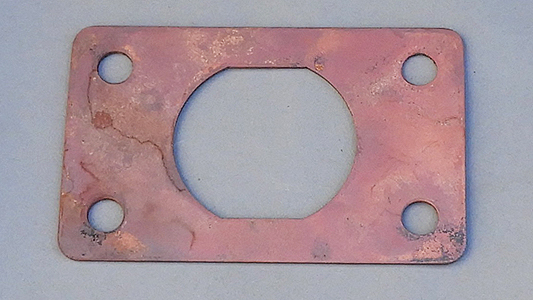
Copper head gaskets are a waste of time as they are certain to weep oil, even if a stainless wire is used as an "o-ring". Our ORCA motors use special seal rings and no gaskets, either base or cylinder head. Better heat transfer and no leaks.
Click on photos to enlarge...Our Older designs Late 90's

Three systems are available: the 250+Hp Blackbird, the 350+Hp Pro Street, and the 500+Hp Pro Gas Systems. All three systems are available for the Evo Big Twin and certain year TC 88 and Evo Sportster models. All of the systems are RSR 400i Closed Loop fuel injected and come standard with intercoolers. Both the Blackbird and the Pro Street are standard bolt-on items for all the O.E.M. and after market chassis, both rubber mount as well as rigid.
Life in the Harley world is a bit more complicated these days, so we offer a wide range of turbo configurations depending on the frame and engine. We have systems for Softails, FXR's, Dyna's as well as both EVO and TC88 engines. Systems for FLH/T Road Kings are a bit different as the floorboards are in a different location. Then there are the raked custom frames with either single or double downtubes that we have center mounted turbos for. We also build the systems with either 1 3/4" or 2" primary tube exhaust manifolds for the wide variety of engine displacements.
Depending on your drivetrain, your frame, and your motor, not to mention your own goals we configure the systems with either 2 or four injectors, with or without water injection, and with differing size intercoolers and actual turbo sizes.
If you have a FLH series bike with a stock engine then our Blackbird is the choice...8 to 10 psi will double the stock horsepower. If you have a larger engine or are intending to build a larger motor we will steer you to the Pro Street system which offers more power potential but even at low boost will produce gobs of power...at 12 psi it's way, way, past 200hp.
FLH/T systems are a bit different as the floorboards are further forward than on Softails etc. Keep in mind that we have seven different combinations of headers and turbos to fit both oem, aftermarket, and racing chassis. You tell us what you have and we tell you what your options are.
For you big inch fans that simply want to have something beyond kill we offer our Pro Gas systems that pump out 550hp worth of air. Now, Harleys are lousy air pumps so don't think they are going to reach this figure but 400+ hp is there depending on engine displacement, valve size and rpm potential.
All of these bikes have been turbocharged using our systems. Some people did custom ones using our components like the TC88 pctured above, but we basically have something to fit everything.
Blackbird systems are capable of putting out in excess of 250hp so don't think this is some sort of lower level. There are no low level deals at RB Racing. Turbos are meant to kill, not to be politically correct.
When you go up to the Pro Street level this is usually bigger engines, typically 113", 120", 124", 131" etc. Pro Street systems use bigger turbos, bigger headers and larger injectors. Don't call us up wanting to put a Pro Street system on your 1200 Sportster...those damn things won't stay on the ground with smaller turbos. If you have an S&S big inch Sportster then the Pro Street is the way to go.
TC88 motors and Evo motors are similar with minor differences with the edge going to the Evos because of a long list of well developed parts available for them...and they don't have some of the complications that Harley addded to the TC88 to civilize it ( balancers, extra chains).
Sportsters and Buells are pogo sticks when turbocharged. If you like wheelstands, then turbos are your breakfast lunch and dinner. Weak clutches are the Sportster engine's worst point.
Pro Gas Design...

The Pro Gas 500+Hp system is custom built for race application and involves fabrication for intercooler mounts etc. at the builder / fabricator level. Pro Gas Systems are quoted on a case by case basis. The Pro Gas system pictured below was built for National Modified Champion Wayne Pollack of Fuquay Varina, North Carolina. Wayne wanted to build a sophisticated Turbo bike but when some of his sponsors cut the purse strings Wayne sold the parts to Ken Browne, who continued with the project, but cut up the parts and left off the 500hp intercooler. There went 1% in hp for every 11 degrees F the charge cooling would have provided. Those of you unfamiliar with how much air heats when you compress it...at 22 psi the discharge temperature can be 265 degrees F. Ken still managed to run 7.55 @ 173mph (176mph best mph) in the quarter mile and 4.80 @ 147mph in the eighth mile, and built a new bike with a bigger tire!
Ken's new bike is (2002-2004-2005...) was further away from "what should be" and didn't work well. More weight, poor turbo location etc. Ken is a nice guy, but bad ideas, no matter how nicely executed, simply won't work. We talked to Ken, hoping he would just execute our original design, but everyone wants to do "his own thing". There is always a price for this. Hey! It's not death..It's a hobby!. Hey, he's even building a third one for 2009!
Wayne Pollack went on to wrench and ride the beautiful Majestic Turbo bike, initially with twin turbos (didn't work well) and later on with one very large turbo similar to the one pictured. We sent Wayne the turbo specs and a new design so he could shit-can the two turbo deal that Kevin Draper and Don Vesco cooked up. Wayne got to deal with methanol and hilborn injectors with nitrous added to the mix. Boom! Blow up an Overkill Engine.
Wayne was always straight with us, he's a hard-core racer and like Wayne, we think there's nothing much better than kicking ass and trying to be the best at what you do...Wayne went off to ride Ray Price's Top Fuel Harley and to stay in shape just ran a 242.587 mph World Record ( Sept 2003) on Rich Yancy's turbo Hayabusa at Maxton. In 2005 Wayne upped the Maxton record to 258mph on Rick Yancy's Hayabusa.

Here's Wayne on Ray Price's Top Fuel Harley (Oct 03). Ray got a bit banged up and Wayne was tapped for the ride. In August 2004 Wayne retired with back problems...no more spine crushing acceleration. Wayne went on to set a speed record of 258mph on a Hayabusa at Maxton in 2005.
We get a few calls each year about Pro Gas systems. We suggest you call us before you start building. Everyone wants to do their own thing but decisions can haunt you and they get expensive. If you're already far along we'll sell you some parts and keep our mouth shut in the advice department because it will already be too late.
Click on the below pictures for more details on these parts and people.

Ken Browne's original record setting 120 cubic inch 4 cam Pro Gas bike. RB Racing Pro Gas Turbo / RSR 400i Fuel Injection System. Best 1/4 mile E.T. 7.55; best mph 176. This gives you and idea of how much power is hiding in our street Blackbird and Pro Street systems.
Practical / PC Programmable / Upgradeable
All RB Racing Turbos are reliable enough for daily use and cross country touring and have the capability to run from 2 to 22 psi (or 8 to 35psi with heavier springs) of boost with the twist of the Dial A Boost mounted on the handlebar. The Closed Loop EFI system will give you 50 mpg at cruising speeds and 40 mpg in city driving and features automatic preprogrammed features such as automatic altitude compensation, idle air(speed) control, automatic warm up enrichments and air temperature compensations. Ten years and 1,000,000 miles of testing with zero failures.
All RB Racing /RSR Fuel Injections are PC Programmable. Should you change cams, engine displacement, upgrade from Blackbird to Pro Street or whatever, your system can be reprogrammed in minutes with RB Racing's Autocal Software.
A final note: Blackbird systems can be upgraded to Pro Street specs simply by programming and injectors and MAP sensor (3 Bar) upgrades. Everything else stays the same! Simply reprogram. Larger injectors will need to be matched to your new horsepower levels. Autocal.V6 Professional software can be used to write a new program in minutes.
Click on photos to enlarge
Designed For All Big Twins

This is a Confederate with a 120 Cubic Inch Merch with one of our Pro Street Turbos bolted in place. We didn't run the bike, we just checked the components to see if they would fit. We were asked by Confederate to do so but they never ordered anything. This particular engine wasn't set up for turbocharging so we would have had to put in some premium forged 8.0:1 pistons, a turbo camshaft, special gaskets and all the stuff we usually do to our 113" ORCA Motors.

You might ask how much horsepower this 120 Inch motor might put out...Well, Ken Browne also has a 120 Inch V-Twin with one of our Pro Gas Turbos ( a bit larger turbo) and runs the 1/4 mile in 7.5 seconds @ 176mph! On a 66 Cubic Inch ZX-11 motor the same turbo as we have on the Confederate pumps out 280hp @ 12 pounds of boost at 9000 RPM. The RB Racing Pro Street turbo will put out over 30 PSI!
What the hell is all of this technical crap without a little mathematics...throw in a few fractional exponents to complicate matters and slice and dice a few rough approximations...Voila! equisite turbo planning. Turbo and Supercharger maps are avaiable for the technically inclined.
Click on the title above to go to our RSR Boost Compression Ratio Calculator. This allows you to run scenarios of how boost affects your effective compression ratio as modified by altitude considerations. It will give you a good idea as to why turbos go so fast and also how to plan your motor for your particular circumstances. Knowledge is power.
When you are planning an engine you need to understand the relationships that exist between cam timing, static compression, rod length, bore, stroke, altitude and in the case of RB Racing Turbos, boost pressure. We have created a calculator that lets you play around with design parameters and have a good idea of how the engine combination will wok out for your intended usage. By focusing on the dymanics we avoid the trap of looking at fixed or static values which can often be misleading. Plug and play before you buy and try!
To see what happens when you compress air check this out. Of course, if you were holding on to your bicycle pump a long time ago you are well aware of what happens. Turbos are really good at heating things up and intercoolers are really good at getting things back to normal.
Special frames don't necessarily work with our normal Blackbird or Pro Street turbo kits. Things like expensive billet forward controls and other non standard items get in the way. This complicates our life but doesn't stop the show...so far all you raked out, low riding, billet bandits in boulevard or trailer queen mode we have more specialized items. Check back for new photos on this 131 Merch in a German low-slung Softail frame. This one gets a 350hp center mount turbo. Customer finally decided to go with an ORCA motor instead of the Merch.
Final Point

People who don't do this for a living have all sorts of advice. They specialize in being "persons of authority" even though they have not done the work. They give advice about cams, turbo design etc. and they can't walk the walk. There is more bad, incorrect, crap floating about turbocharging around than there are turbos running. We've been at it for over 30 years and, since we actually make the stuff, we know even how little we know...which is a lot more than those who don't do the work. We aren't here to correct misconceptions, only to support the art.
Make no mistake about it, when you deal with the big twins you are dealing as much with art as with science. Everything is hanging out in the open for everyone to look at and it is extremely difficult to blend function with aesthetics, especially in this era when every other bike is a "show bike" with every piece of billet trickery and chromed what nots glued or bolted to every exterior surface. We think our new turbos will meet the most demanding needs of any big twin whether it is trailer bound for the next show or caked in wet salt on its final record pass at Bonneville.
We will not compromise functionality however...so don't ask.