









LSR 2-1 Supercharged
No 1950's megaphones, No
Aluminum Butt Plugs
Three Finishes
1. Show Chrome:
The brightest chrome, the "Hexavalent" process, has been
outlawed in California since January 2024. Chemicals in
the Hexavalent process can be cancerous to chrome
shop operators, not the end consumer. The currently legal "Trivalent" chroming
process has a darker hue and does not visually "pop".
Our chrome shop of 26
years finally shut down their Hexavalent plating line in
2024 in spite of having a two year extension to operate.
We are working with a new chrome plater, in
business for many decades, who still uses the Hexavalent
Show Chrome process and understands motorcycle exhausts.
All LSR 2-1 Exhausts and
heat shields are mirror polished and plated with
Hexavalent Show Chrome.
2. Silver Ceramic:
Looks like polished aluminum, Can be re-buffed with
Mothers Magnesium & Aluminum Polish. Will not "blue"
and will not come off or rust. Holds in heat. Usually
used with chrome or silver heat shields. Fired twice @
600F. Zero problems in more than a decade.
Welded Non Removable Baffles
All LSR 2-1 designs, with the exception of Pro
Stock part numbers, have a welded-in, non-removable, baffle.
Our 00-1306R
Pro Stock Resonator designs have a welded-on non-removable
Db reducing resonator / baffle.
Purchasing the LSR 2-1Exhaust
1. Go to the Partnumbers Page to Locate your bike
2. Systems come
complete with
a. Included in price: Look Up Heat Shields to see what comes
with your exhaust: Heat
Shields
b. Included in price: 00-1000 / 00-1001 / 00-1002 Flanges
/ Clips / Nuts
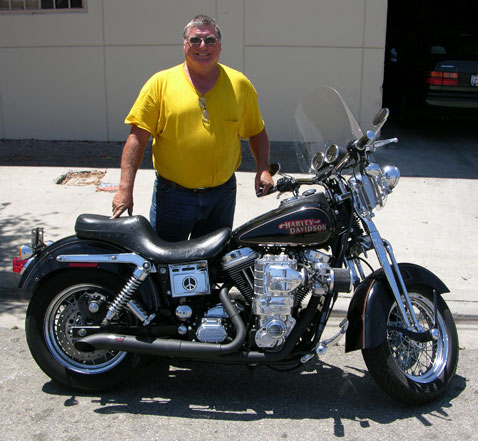
Those damn Magnacharger castings get in the way of a lot of exhausts so we bent up some that would actually fit.
00-1290, LSR 2-1, C Style, in Black Ceramic, Turn Out Rotated 45 degrees on a Dyna FXDWG. Dave runs to the pulsations of the mothership and has plans for a Diesel powered motorcycle. Dave will have us all running on Veggie Oil or at least he will be when the ice bergs melt and we all sprout gills. Dave put a Springer front end on just because someone told him he couldn't. Dave's a Vet....Freedom.
System Approach to Tuning
1. LSR 2-1
Exhaust... Proven performance gains.
2. RSR Air Fuel
Ratio Gauge...Observe in the real world. Dynos are great
but we don't ride them.
Soot
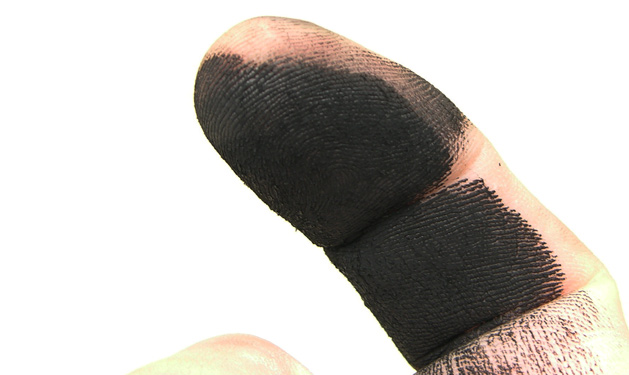
Whenever you look at an exhaust and see it caked in black soot you know the bike is not running or tuned correctly. Back in the mid 1980's we did a carburetor development program for Keihin Corporation for their 41mm CR Race carbs on both Shovelheads and the new Evolution motors. When we were finished the bikes got 56 mpg cruising and 46 mpg if you ran them harder...and after 500 mile tests the pipes were perfectly clean inside and the exhaust ports were dead clean.
If you take
the exhaust system off a modern Closed Loop BMW, as we
have, you will find them dead clean or whitish inside.
Harleys should be the same.
We always ask
what mileage people get from their "tuned" or modified
Harleys after "Dyno tuning"....The universal answer is
37 mpg or less. If they don't know, we ask them if
they have to gas at 100 miles. Most do.
Once a customer bought an exhaust from us and took his bike to two different dynos in search of the "117 Hp" he was looking for for his 103...He got 110Hp. After pissing and moaning we told the guy to give us our exhaust back and we found it caked in soot. So much for tuners and their tail pipe sniffers that see lean reversions...They just kept adding fuel. You tell the customer to put on our RSR Air Fuel Gauge to monitor the mixtures F/R in the real world...No, they want a "Dyno Tune". We have dynos...we know what they do and can't do.
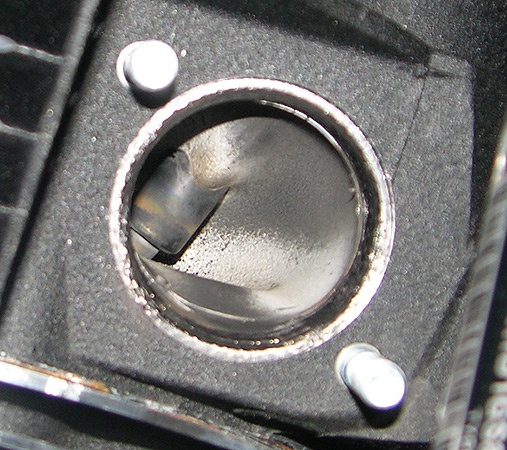
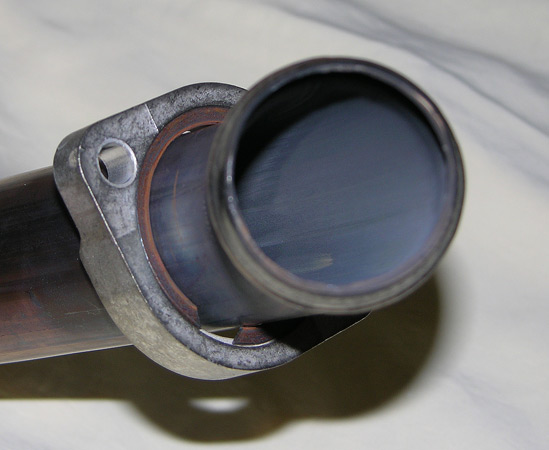
Pictured above is the exhaust port from a 2017 Dyna Low Rider S with about 100 miles on it. No soot. Delphi engineers seem to have done a very good job. Looks like the port you would see on a BMW. Now, when your "Tuner" gets finished with it, it will most likely be full of soot. Logic plays no part in people and their toys. EFI is complex...put in different cams, change air cleaners, port the heads and all this goes out the window. Brave new world.
No soot.
RSR Air Fuel
Ratio Gauges...Dyno on your Bike
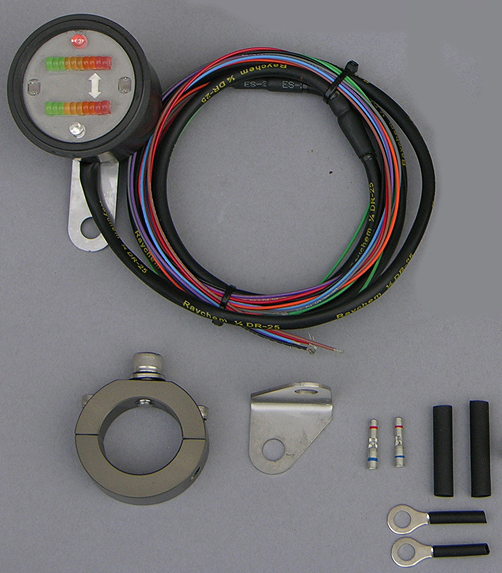
The Mother of all gauges! Not a gauge, but a precision tool that will tell you exactly what your engine is doing in real-time. Gives you instantaneous read-outs of air/fuel ratios from 17:1 to 10.5:1 and indicates maximum power ratios. Four color display is easily read in direct sunlight and automatically dims at night. Waterproof, billet aluminum construction. Your significant other will cheat on you but this gauge will never lie! It won't keep you warm at night, but a perfectly running engine will look and sound the same when you wake up next to it the morning after.


Single RSR O2 Gauge: Reads the front cylinder in non-efi models. It is simply the best way to evaluate the tune of your motorcycle and saves expensive and often inaccurate dyno time. Real world tuning while you ride...Observe and then make adjustments. Mounted permanently. Waterproof.
Mounts....Roll Your Own or Buy One
The gauges have a center back mount 5/16" x 18 x 1/2" Stainless Socket Head Cap Screw and stainless lock washer. You can fab your own bracket for this or use the 06-1025 hard anodized Billet Mount System for either 1.00" or 1.25" handlebars $49.95. Optional is the 06-1024 two piece laser cut 304 Stainless Steel mounting tabs for either near handlebar clamp or up the handlebar mounting: $9.95.
Since we have
been doing closed
loop fuel injection systems for Harleys
for more than 30 years and have been putting O-Sensor
Ports in our exhausts for the same amount of time, we
have both single and dual O2 ports for our full range of
exhausts. Our RSR Air
Fuel Ratio Gauge is the best
investment you can make for monitoring and optimizing
your engine tune.
All LSR 2-1
exhausts come standard with one or two O2 ports
(Sequential EFI models)...18mm or 12.5mm. O2 or Lambda
sensors are a necessity for either carbureted or non
closed loop efi (Weber Marelli and Early Delphi)
Harleys. We should know, as we have a lot of experience
with them and have been doing Closed Loop EFI systems
since 1989.
The Single and Dual gauges ship with six feet of MIL-W-22759/32 wire. The first 24" is Raychem DR-25 sealed on both ends. If you wish to have a connector at the 24" point there is a $50.00 charge to install either six position (single gauge) or eight position male/female Deutsch DTM connectors with Raychem DR-25 sleeving.
The gauge is housed in a hard anodized round enclosure in a standard 2" format with a 2.250" bezel, center back mount, with a 5/16" x 18 stainless socket head cap screw. The gauge will show fuel ratios from 17:1 to 12.0:1 (or richer). The gauge is visible in daylight and automatically dims for nighttime operation. Only a single L.E.D. illuminates.
Very easy to interpret at a
glance. Scale is, left to right, lean to rich: three
greens, three yellows, two orange and two red l.e.d.s.
You simply cannot "read" spooling digital numbers.
The white arrow indicates the maximum power mixture, the second orange light, which is 13.2:1. Transitory enrichments should not, if the engine is warm (>200F Oil temp), go past the first red light. Readings at the far right side of the scale, the second red light, are simply too rich. Proper closed loop operation will cycle back and forth from green to orange around the center of the display.
It is simply the best way to evaluate the tune of your motorcycle and saves valuable dyno time. Mounted permanently. Waterproof.
Whether your
bike is carb or efi this is the best way to tune...By
riding and observing, not on a static dyno. Dynos are
not exactly real world in terms of loads, airflow, or
transitionals, and even if you had a million dollar AC
Transient dyno room, you would still have to do real
world testing. The gauges are dead accurate and are
millisecond fast responding which makes it very simple
to interpret or remember, even at a glance, while you
are dodging cars watching for cops. We have a Superflow
CycleDynwhich gives a better real world
correlation than other dynamometers but we still
evaluate air fuel ratios when riding.
Anyone who tells
you optimizing tuning is easy is full of shit. Engineers
at Ford say they spend two years just perfecting tip-in
or initial throttle openings. Ride, observe,..then
change or edit. Real world.
Pretty soon Harleys will all be watercooled then you really won't be able to tell the difference between Milwaukee and Hammatsu. "The Man" will be sniffing your butt and planting microchips and gps modules up your ass so they can mail you a speeding ticket and keep track of your movements. They already have data recorders on your car so they know what you were doing when the biggie happened. Brave new world. Monitor your engine to get the most out of it before the NSA monitors your tail pipe.
Customer Comments
Customer writes: "When the gauge arrived I knew it would be of a very high quality, it has far surpassed my expectations. I was very eager to get this installed and take a look at my tune. Amazing to see how little adjustments on the carb effect the AFR. As a result of this gauge, I have dropped one size on the low speed jet, raised the clip on notch and confirmed the main jet on my Mik48. Thank you, I really like this gauge. Ed"
Digital Gear Indicator and Dual Air Fuel Ratio Gauges
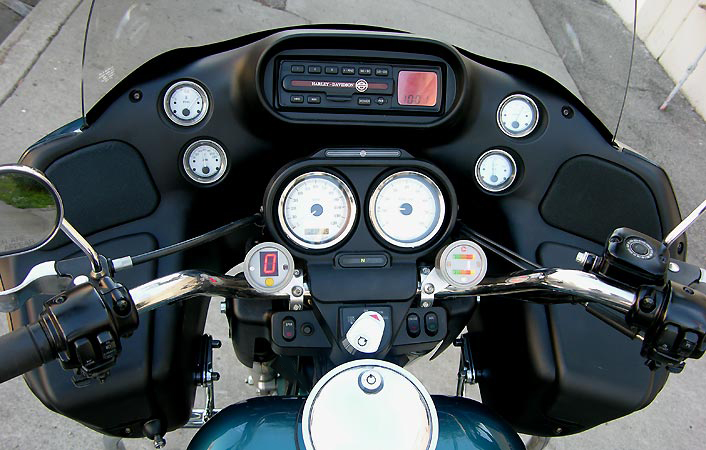
A useless air temperature gauge and tiny warning lights...whatever happened to black and white gauges? Well our RSR Bonneville Digital Gear Indicator and our Dual Air Fuel Ratio monitor actually do provide useful, easy to read, information. Knowing what gear you are in and what your engine is actually doing in front and rear cylinders is a lot more important than knowing what the air temperature is...After all, you are sitting directly in the airstream so the air temperature is no mystery.
Road Toad...The Movie
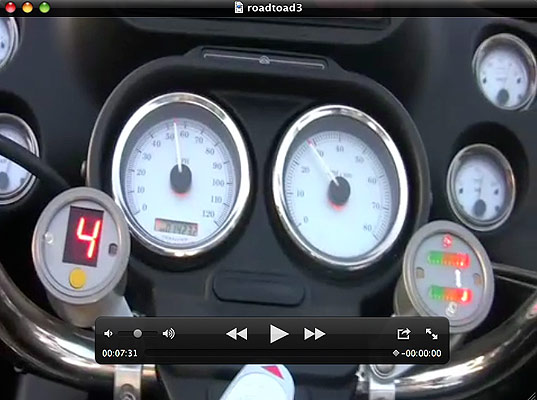

Harleys vibrate. Next time we'll make a better camera mount. Video shows the gear indicator in action on a 5 speed 2004 Road Toad as well as our RSR Dual Air Fuel Ratio Gauge. We made a few edits to the TC88 ECM for our LSR 2-1 Pro Stock Spyder exhaust. Gives you an idea of how we tune things by actually riding them and how useful the Bonneville Gear Indicator is.
Get a tub of popcorn and a six pack and watch a 2004 FLTRI find happiness going through the gears. Make your own movie and get some more popcorn and beer and show your friends how you hit redline in sixth gear. At Bonneville we run five gears but we have a 425 hp Harley...and a lot of beer.
Do Not Use OEM Gaskets
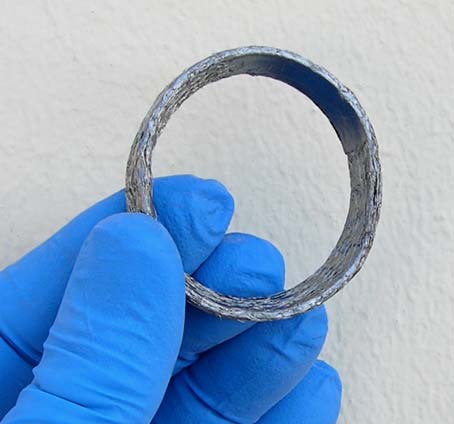
LSR 2-1 Exhaust Systems must use our CNC Machined Billet Gaskets (part number 00-1000) and our close tolerance aircraft exhaust nuts (part number 00-1001). The above OEM woven gasket will not work with our machined Turbo Venturis. Four special aircraft exhaust nuts come with the system but you must order four extra ones for $3.00 as they are easily dropped and the OEM 5/16" x 24 hex nuts will not "turn" on our machined Turbo Venturis.
We also offer machined from billet exhaust flanges. If you have a 2004 or later bike it will probably have the thicker exhaust flanges which are not compatible with our Turbo Venturis. Early style OEM Evo chrome die cast flanges and clips or our billet parts are called for. Our Chrome Billet Flanges and clips are $29.95 per set and are stronger than any oem part.
We have had several instances where people encounter "difficulties". Invariably, it is traced to someone not using our billet gaskets. The billet gaskets insure proper fit of the LSR 2-1 system and are designed to work with our Turbo Venturis to increase exhaust flow.
Dave Part Two
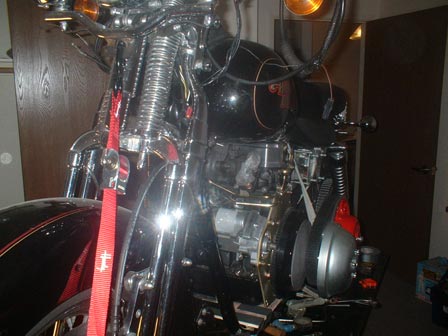
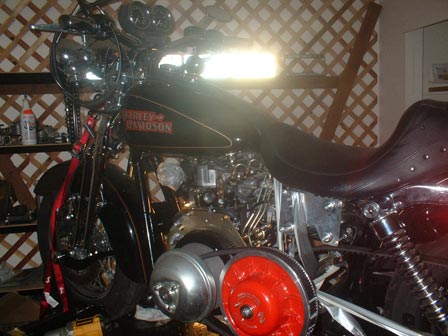
Dave is a determined sort of guy. Here's his progress on his diesel powered motorcycle. He's pretty far along.
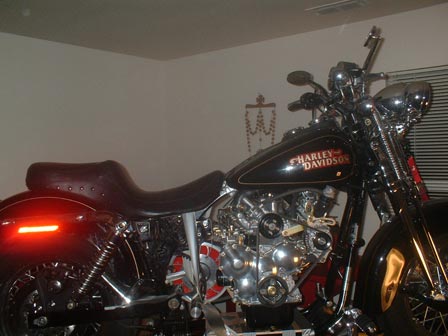
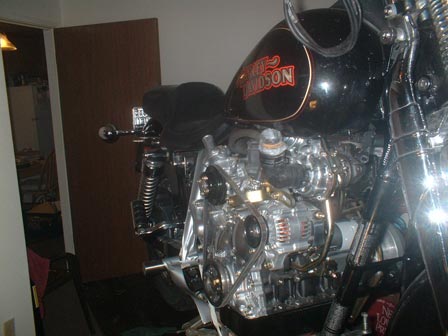
Dave says "I will run rice oil to begin with so I can have an American made rice burner. I hope to get more than 100mpg." Dave is working on his new project and if he updates things we will post the info.
Dave Update Part 3
Well Dave offed the Hog and went whole hog with a righteous Diesel Military scooter, a Russian Dnepr. Dave is not one to be discouraged...he's riding around on his Veggie oil and doing everything he can to keep Petro executives from getting 400 million dollar retirement packages.
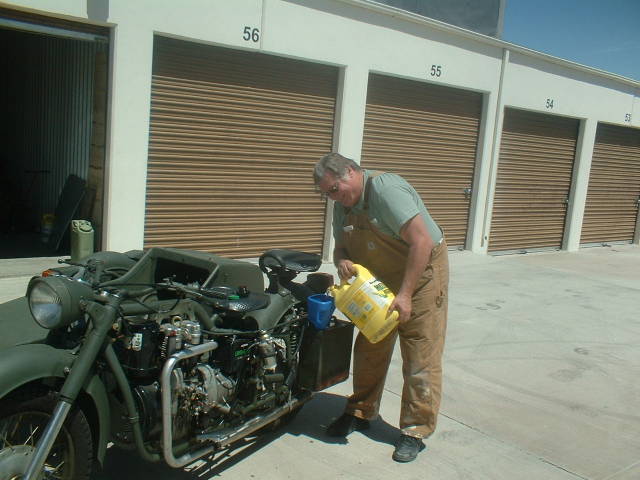
This is a picture of a happy camper. Nothing stops Dave once he gets going...and with 10" of ground clearance he will drive over whatever is in the way anyway. The world needs more Daves.
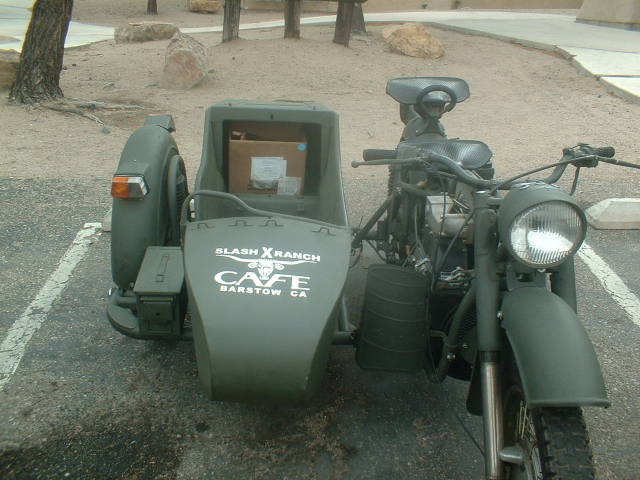
Dave Reports "Hello all, just checking in. I went on a 94 mile round trip yesterday (Barstow to Victorville via old Highway 66) with the side car and I filled up with petro diesel (to blend with the corn oil have have been using), to top it off after the trip I took .96 gallons. That figures out to just under 98mpg. I dropped off the side car today, I was going to start tearing the bike appart for a ground up rebuild. I just wanted to ride her without the sidecar and what a difference, I'm selling off the side car or making it into a very large Webber BBQ grill. I'm going to do a milage test without the third wheel, and I'm hoping 110-120mpg. I stopped at a truck stop after riding around and handed the teller $2, told him I want a fill up, they all laughed, you should have seen their faces when I came back to get my 57 cents change back.
If your pretty toy runs out of gas, your left with a pretty paperweight, "I don't push paperweights, no matter how pretty it is".
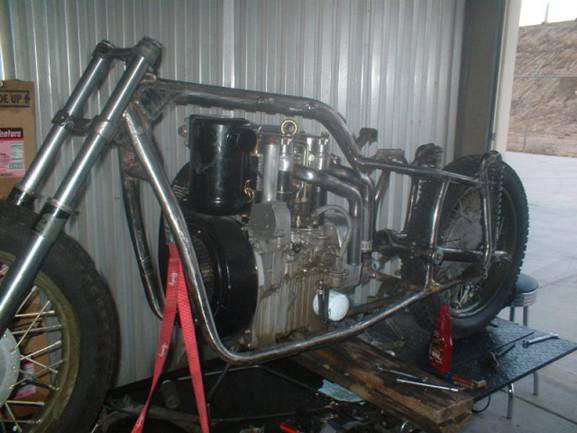
Like we said...nothing stops Dave on his mission to save the planet from ourselves. Bye Bye sidecar.
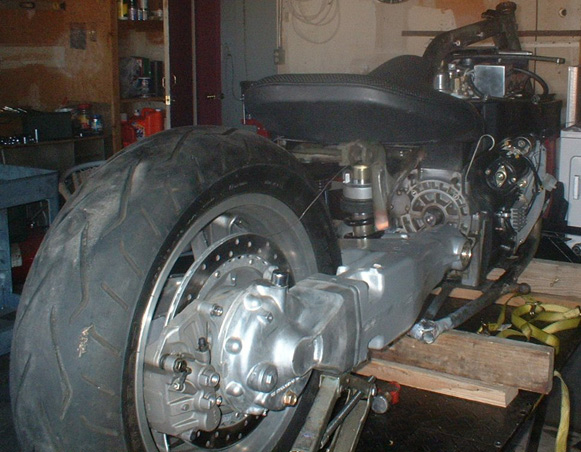
Dave took a liking to a GL1800 swigarm. This brings new meaning to hybrids, Glasnost and whatever. Veggie Oil, the Iron Curtain and Japan. Wild Bill and the Roadog are gone...long live Dave.
Dave Part 4
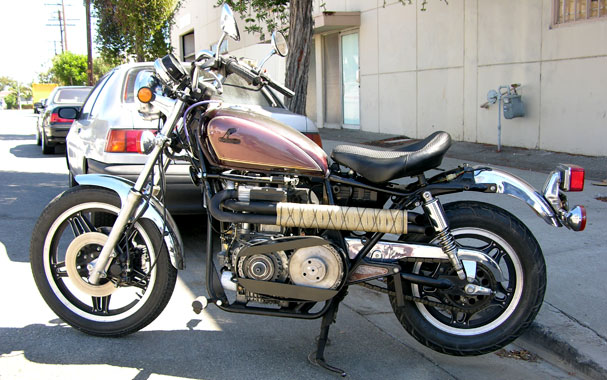
As you may have guessed right now this doesn't have much to do with supercharged Harleys...although Dave is working on a supercharged diesel. This is Dave's new ride while he's working on his other Diesel motorcycles...Yes, it's a diesel.
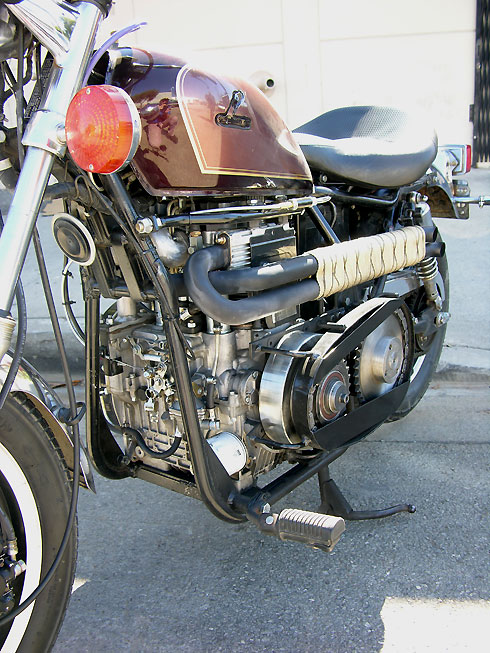
Dave put this one together to shuttle about on various oil burning substances...A mere 200 mile jaunt to stop by and see us. He keeps up with the insane California drivers and bypasses all the gas stations. Some people dream. Some people do things. Then there are some people like Dave who dream and then wake up the next morning and actually do things. Like Dave says when he rolls in on his oil burner and people ask if they can buy one..."Get busy" is Dave's answer.
Test Rides
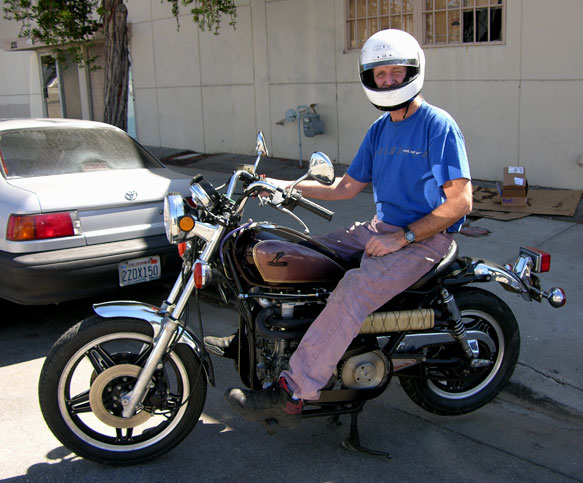
How does it ride? Well, once the centrifugal clutch locks up, it goes pretty good. At 45-50 mph it's dead smooth. At 65-70 the bars vibrate a bit. Like we said, some people dream, but this is reality. Dave's out front in his own way. Do you really need to go 0-60 in 3 seconds or do you want 100 mpg...The world is going to change. Dave's got bigger plans..not for the rest of us, just for Dave. Mountains to move.
While you're porking over some
fool who can't read the fine print so you can get that new
toy, Dave will motor on by on walnut oil with a smile on his
face. Will you be as happy as Dave? We doubt it.
Dave Part 5...Silent Running



LSR 2-1's Bonneville,Dyno &Track Proven
If you want to make power on a multi-cylinder engine you have to use a collector system. Whether it's a V-Twin or a V-8 it's the same, and no less an authority than the famed engine builder Smokey Yunick will tell you that. Not using free exhaust energy to help your engine breathe is downright criminal. No matter what the conventional wisdom is, staggered duals on a Harley will not make more power. You simply cannot escape the fact that a properly designed 2-1 will give you more useable torque where you need it, in the 2000 to 4000 rpm range, which means less downshifts and less rpm to get the job done.
A set of short staggered duals at peak rpm can be made to produce good power but they will be dead on their ass until they get there, whereas an engine developed around an LSR 2-1 exhaust can be made to perform from the bottom up with no dips in the torque band! If you don't believe this then why is it always that the top Pro Stock bikes, cars etc. end up running collectors systems? Damn right they work! If you don't think torque between shifts or when you roll the throttle on, then buy those long sewer pipes or some short curly drag pipes you saw on the Discovery Channel.
Check out our new Exhaust Technlogy Section for information on how all this works.
Flanges for 2005 and later Models
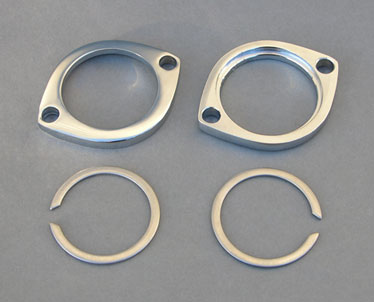
The Harley part numbers for these flanges and clips are: 65328-83 (exhaust ring clamp) and 65325-83A (retaining ring). RB Racing has cnc machined and chromed flanges in stock, per pair with spring clips Part Number 00-1002, $29.95. 2005 and later models need to order these flanges or their equivalent at your Harley shop as the oem flanges may be too thick for our Turbo Venturis.
S&S
Four Bolt SA B1
and SA B2 Heads
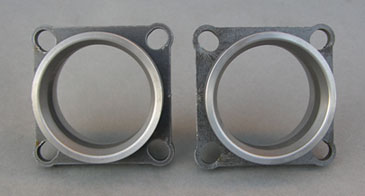
We have been asked by customers to provide LSR 2-1 systems for S&S SA B1 and B2 four bolt heads as well as for the 126" and 145" S&S Tribute engines. Pictured above are our laser cut flanges and cnc machined venturis that we heliarc to the 2" primary tube for the S&S Racing heads. We make exhausts for both the S&S SA B1 and the S&S SA B2 four bolt cylinder heads with raised ports.
The 145" Tribute engines are 1" taller than stock and have special fixtures.
06' Dual O2 Sensor Systems / RSR Air Fuel Gauges
Since we have been doing closed loop fuel injection systems for Harleys for more than 15 years and have been putting O-Sensor Ports in our exhausts for the same amount of time, we have dual O2 ports for the 06 models for our full range of exhausts. Our RSR Air Fuel Ratio Gauge is the best investment you can make for these.
All LSR 2-1 exhausts can be ordered with two O2 ports. Actually O2 sensors are a really neat item. We should know, as we have a lot of experience with them. Tuning strategies are different and there are a lot of things that can go awry if you forget about temperatures, pressures etc.
Pretty soon Harleys will all be watercooled then you really won't be able to tell the difference between Milwaukee and Hammatsu. "The Man" will be sniffing your butt and planting microchips and gps modules up your ass so they can mail you a speeding ticket and keep track of your movements. They already have data recorders on your car so they know what you were doing when the biggie happened. Brave new world.
New Cloisonne Tags
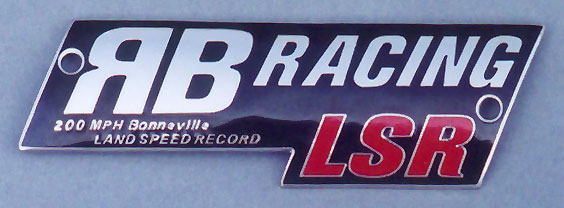
Like in the adage "The relentless search for perfection" we have upgraded the logos we put on our LSR Exhaust Systems. Previous tags were stamped and formed aluminum with silkscreened details. The new cloisonne tags are a precision die struck brass, nickel plated, with powdered glass fired in an oven then polished to a jewelry finish. These are direct replacements for our older tags and are available for US $25.00 postpaid via US Global Express (foreign) or Priority Mail (domestic US). They come with black headed rivets and are riveted in place with a light coat of high temperature silicone (Permatex 598B) behind the tag.
Baffling
Alien Discs and Aluminum Butt Plugs 
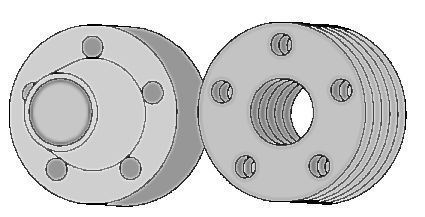
Our testing has shown that the Harley V-Twin is extremely sensitive to back pressure which is why 2-1's that use small or restrictive collectors don't breathe well, and why restrictive baffles shut the motor down. Disc type baffles are good for spark arrestors on dirt bikes but they have no place on a big inch V-Twin. You don't make power by adding restrictions to your exhaust system whether it's a bunch of stainless discs or some damn piece of aluminum billet machined into a Harley butt plug! Ever wonder why they had to put a hole up the center of the discs? Well, one reason was the discs are so damn restrictive you have to have several pounds of them to get enough flow through their waffle shaped passages. Good mufflers, but they have nothing to do with performance and they sure as hell do not create vacuum as has been claimed. When you get confused by all the bullshit simply ask the following question.." Do they run them in NASCAR or in Formula One?". Nope, they run straight pipe collector systems without any stupid discs or aluminum butt plugs.It's always funny how when the money is on the line, all the little things like discs, billet caps, anti-reversion flaps, reverse megaphones and other such nonsense somehow don't make the field.
Turbo Venturis
All RB Racing LSR Exhaust Systems feature our "new" (we've been quietly doing it since 1985!) CNC machined Turbo Venturis that actually "scavenge" to help your motor breathe. Machined from billet, these allow full 2" flow and eliminate the phony restrictions that other 1 3/4" to 2 1/4" pipes have at your exhaust port. We supply special close tolerance aircraft nuts for your exhaust studs because our machined venturis are too wide for a standard hex nut.
Our CNC machined Turbo Venturis are not compatible with the "bowl-shaped" late model OEM exhaust port gaskets or early style "flat" gaskets for the LSR Exhaust Systems to both fit and seal properly. The narrow machined flat face of the Turbo Venturi must seat against a flat surface, not the bowl-shaped late model gaskets. Using the LSR Exhausts in combination with the wrong gasket will cause misalignment, inability to tighten the provided close tolerance aircraft nuts, and will force the bowl-shaped gasket into the exhaust port.
Mandatory for a nominal charge of $9.95 are a pair of our LSR CNC machined gaskets which mate perfectly with our Turbo Venturis. These are proven in over 16 years of use on our race and turbo applications...the only gaskets that will stay in a turbo bike for 25,000 miles! These gaskets prevent any gasket "creep" into the exhaust flow and are one more thing that will give you "an edge" on the competition. We always wondered why people would port their heads, put in bigger valves and then squish the gaskets into their exhaust ports. We bet you never paid attention to what was going inside your exhaust ports for one very simple reason...you can't see what's going on in there once the pipe is tightened! The LSR CNC machined gaskets also insure perfect alignment of the exhaust system. Most fitment and alignment problems are traced to using either the wrong type of gasket or using old gaskets that have taken a "set". We've always used these on our race applications and it's time everyone who's concerned about performance should do the same.
Nuts
All LSR 2 into 1 exhausts require special close tolerance aircraft nuts to bolt the LSR Turbo Venturis to the exhaust port. Standard 5/16" x 24 hex nuts will not fit. Each exhaust comes with the required four nuts. It is recommended that you order an extra set (4) of these nuts, part number 00-1001, when you order your exhaust.
STD Cylinder Heads
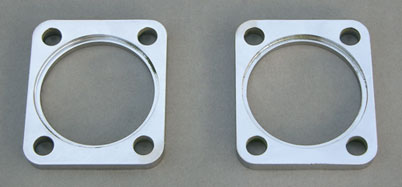
We make special flanges for STD heads that match the rectangular bolt pattern that STD machines. If you order a RB Racing LSR 2-1 Exhaust you can order these flanges which have been designed to fit our standard turbo venturis. RB Racing Part Number 00-1003. Sold per pair $29.95. When you order a RB Racing LSR 2-1 Exhaust system we either polish and chrome these or bead blast and ceramic coat them.
Goo
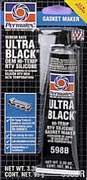
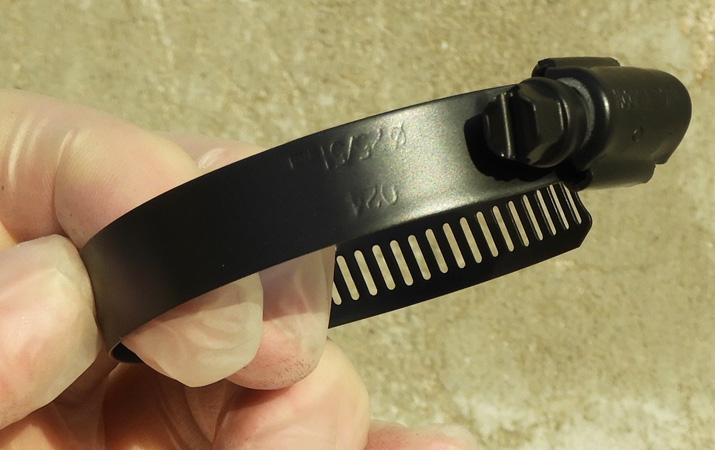
RB Racing LSR 2-1 exhaust systems use either one or two slip joints depending on the model. We suggest you put a coating of Permatex 598B ULTRA BLACK in the slip joint. None of our slip joints use any clamps because then they wouldn't be slip joints anymore. The inner pipe gets hotter that the outer pipe and they grow into each other and form a tight seal. The 598B is a non hardening gasket material and will prevent any leakage from condensation that forms in the pipe and, with the usual carbon particles, will actually seal better over time. It also makes the pipes easy to take apart later on. Get a tube before you install your RB racing exhaust system.
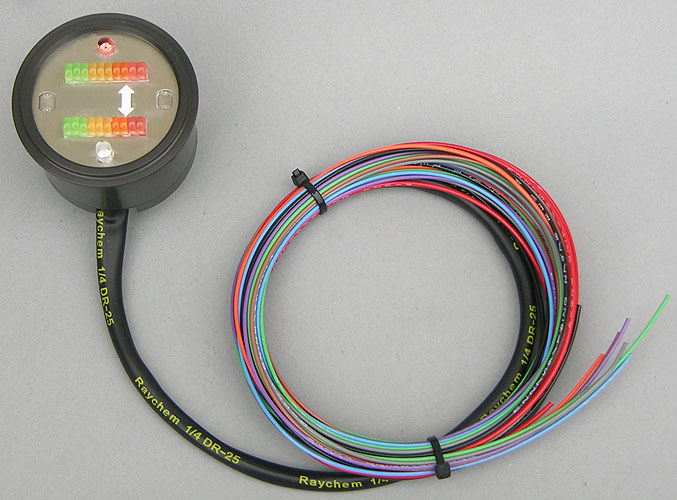
All RB Racing LSR exhaust systems come standard with a machined and heliarced 18mm oxygen sensor boss just below your front exhaust port for carbureted models. This port is designed to accept and oxygen sensor (18mm x 1.5mm) which will allow you to use our RSR Air/Fuel Ratio Meter to tune and monitor in real-time your air/fuel ratio. Fuel injected models use our Dual Gauge.
New "Double Coat" Black and Silver Ceramic Finishes
We have a lot more people
looking for durable ceramic finishes and
we think we have the best finishes on
the market. In the late 70's and early
80's we tried all sorts of coatings and
paints and even used porcelain on some
of our products in the late 1980's. The
newer ceramic finishes are tougher and
we use both Polished Silver Ceramic and
Ceramic Black to complement our usual
chrome offerings. The newest "Double
Coat" Black finish is a double coat
process that gives additional protection
against scratches and nicks, providing
two barriers against corrosion...Silver
then Black on top of it.

In 27 years we have tried all sorts of black finishes: Kal Gard, VHT, Techline, and others. We also, in the mid 1980's, even tried porcelain for awhile. It chipped and the heat distorted the parts. Most finishes will not survive over a long period unless they have a base coat to cushion rock strikes, moisture and scratches. The surface has to be perfectly prepared and most applications can fail if run too soon at elevated temperatures as they are typically baked at 450 to 500 deg F whereas the cure takes place at around 750 deg F. Lower temperatures will not cure the resins and they will fail once the bike is run. To get around this dilemma for Black Finishes we have found the best solution is a Silver Ceramic cushion base coat and a secondary Black Semi-Gloss finish on top of this.
"Double
Coat" Black Ceramic finish is the most expensive as
it involves a triple process. First the parts
are polished to remove any tooling marks.Then
the parts are zirconia media blasted to
prepare the surface. Then parts are cleaned.
The parts are base coated with a Silver
Ceramic ceramic base coat and then a second
Black coating
on top of this.
The Silver Ceramic finishes can be cleaned with soap and water and scuff marks can be removed with Mother's Aluminum and Magnesium Polish.

800 Horsepower LSR 2-1 Slash Cut
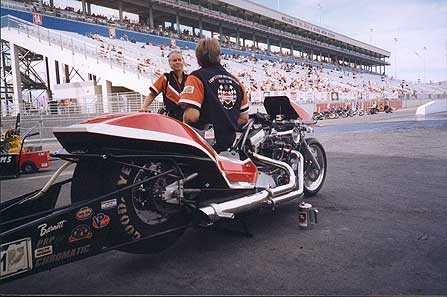
We're not really sure what a 2-1 has to do with Top Fuel Nitro motors but when Carl Pelletier asked us to make a collector for his top fuel 175c.i. PRP motor we whipped up a 4" diameter collector and sent him the tooling. Take a Tour of what it takes to run a top fuel bike. Doug Vancil's hard running Top Fuel Harley sponsored by Vance and Hines has a 2-1 that looks like one of their Pro Pipes so when Carl asked us to build one we made sure the collector area wouldn't restrict each of the 400hp explosions that were coming from each cylinder. Carl qualified 8th out of 32 bikes at the final Las Vegas meet and ran in the sixes at over 200 mph so the 2-1 probably didn't hurt anything. His best speed is 214mph with the 2-1 so it didn't seen to hurt anything. Top Fuel is pure insanity and is addictive as Heroin for those involved. Like they say " Gasoline is for washing parts...Nitro is for Racing!".
The 175" PRP motor has 4 cams just like your Sportster engine.
14.7 / 13.2 = 1.11
People take their perfectly good Delphi electronics and swap them for a self-tuning "Wide-Band" system. The "Wide Band" manufacturers tell you to run their systems at an air/fuel target of 13.2:1. This simply puts 11% more fuel through the engine, i.e. if you were getting 40 mpg @ 14.7:1, you are now going to get 35.6 mpg. You might as well go get a carburetor.
The objective of closed loop and narrow band sensors is to get the most efficiency out of your engine by targeting 14.7:1 except in warm-up, sudden transitions, and wide open throttle, as well as hard decelleration and or fuel cut-off. Ratios as lean as 17.0:1 can be run under decelleration and certain no load situations.
FYI maximum constant torque occurs around 13.2:1, whereas sudden transitions can be anywhere from 12.5:1 to 10.0:1 depending on temperature conditions. It isn't simple. EFI isn't Linkerts, Bendix or S&S simplicity. The closest carb you can get to efi fuel control is a CV Carburetor.
Phone Sex and Remote Tuning

In some sort of logical disconnect a few customers call us up wanting us to tune their bike over the phone and then become increasingly indignant when we tell them it just doesn't work that way. Now, we spent the better part of 14 years, starting in 1976 working on carburetors, jetting, needle design, and even designed and marketed a flat slide carb for the Harley market. Thousands of man hours representing about 5 months out of every year were devoted to jetting issues. It got to be a real issue i.e. it was an interesting experience to define what the correct air fuel ratios should be, experimentally figure out how to measure them, and then deal with tuning die cast critters, often modifying them with extra circuits etc. but, in the end, it was temporal and an endless loop that did not exactly pay the bills.
We did learn how to make things run well, not that anyone appreciated it. It was fun to watch people try to beat you when they couldn't. Knowledge. Hard work.
For the last 18 years we've been working on and manufacturing closed loop fuel injections systems for Harley Davidsons and have set numerous Bonneville, El Mirage and Maxton speed records and won drag racing championships with them. We spent over 3000 man hours writing and perfecting Autocal.V6 prediction and analysis software for our RSR Fuel Injection systems. Why did we spend 3000 man hours? Well, we didn't plan on it, and it's a good way to flirt with insanity, but we saw no other option as digital efi requires hundreds of decisions, all of which are intertwined. No more brass jets. Exponential combinations. Changing points, one at a time is sheer insanity. Progress comes with increased complexity.
These days all Harleys are closed loop fuel injected with a single throat throtttle body and are speed density Delphi systems, all very complex. It's the same formula we decided on 18 years ago. The only thing we suggest is that you use O2 signals to monitor and tune the system as the sensors are millisecond accurate and must be monitored at the exhaust port where temperatures are high and as far away from the outside oxygen rich air as possible. We suggest you use software, not hardware, to adjust your system using our RSR Air Fuel Ratio Gauges and keep your bike off of the dyno until the lights in these displays tell you your mixture is correct. Engines operate in a very narrow realm of air fuel ratios. If you want to go to the dyno after this...fine.
Just don't call us breathlessly demanding we tune your bike over the phone.
These days people have all sorts of expectations. They want to be loved. They want to be admired. They don't want their chrome to turn colors. They want "numbers". They want assurances. They want guarantees, warranties, trial periods, and return policies. They don't want the part, they just want everything that goes with their household baggage. It's all part of keeping everything nice and tidy and "best". Fear of rejection. Fear of making any decision.
We just come in and make the best parts we can and that's all there is to it. The rest of the equation is too complicated. There are plenty of people who will assure you till hell freezes over. We don't have time for this.
For those of you who do not understand that 1450 Deg F of exhaust flame front will discolor chrome don't order the parts, or just leave the bike on the trailer..or order the heat shields to cover up the underlying discoloration. Ceramic or chome the pipes get really hot and heat shields provide an air gap to protect and hide things.... Melted tennis shoes, burned pants. Air is the perfect insulator.
It isn't the old days anymore. People with $35,000.00 toys roll up in the screaming fetal position. Joy used to be a basket case that you could get running. Brave new world.
Angst

The agony of decision making can drive a poor consumer insane..."What is the best?"...".."How does it compare?"..."What will I get, what will I gain?"..."When can I get it?"..."Should I get a 2" or a 1 3/4" pipe".."Will the chrome blue?"..."Can I talk to someone who has one?"..."How long have you been in business"...""I've never heard of you"... "How black is the black?"..."Why haven't I seen these before?"..."My bike is at the builder and he has to have the pipe by Friday or I lose my slot!"..."Is the silver as shiny as chrome?"..."I have a wazoo998 cam and billet rocker boxes and a 280 rear tire...will your pipe work?"
Right brain, left brain. Fear of rejection. Fear of being different. Social standing. It's all too much for most people to deal with.
Look at the pictures, take the Red Pill, and start your journey. It's that simple.
Remove the Angst


If you wish avoid any decision and stay right where you are, just take the Blue Pill. If the journey for truth and power excites your spirit, take the Red Pill.
No Limp Dick Designs
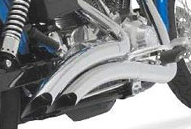
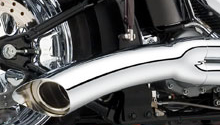
Ever since Jesse James did his original Hell Bent pipes people have either copied them or tried to make whatever they were doing swoopy. If you are a slave to fashion then these might just suit your fancy. At RB Racing we build logical designs that work and leave the limp dick fashion trend to those who love to park and talk.