LSR Pro Stock "Spyder" 2-1's
Bonneville, Dyno,
& Track Proven Since 1978:
No Stupid Megaphones , No Stepped Headers, No
Aluminum Butt Plugs
The Questions Everyone Asks: "
What is the best 2-1 Harley Touring Exhaust" &
"What is the quietest 2-1 Harley Touring Exhaust"
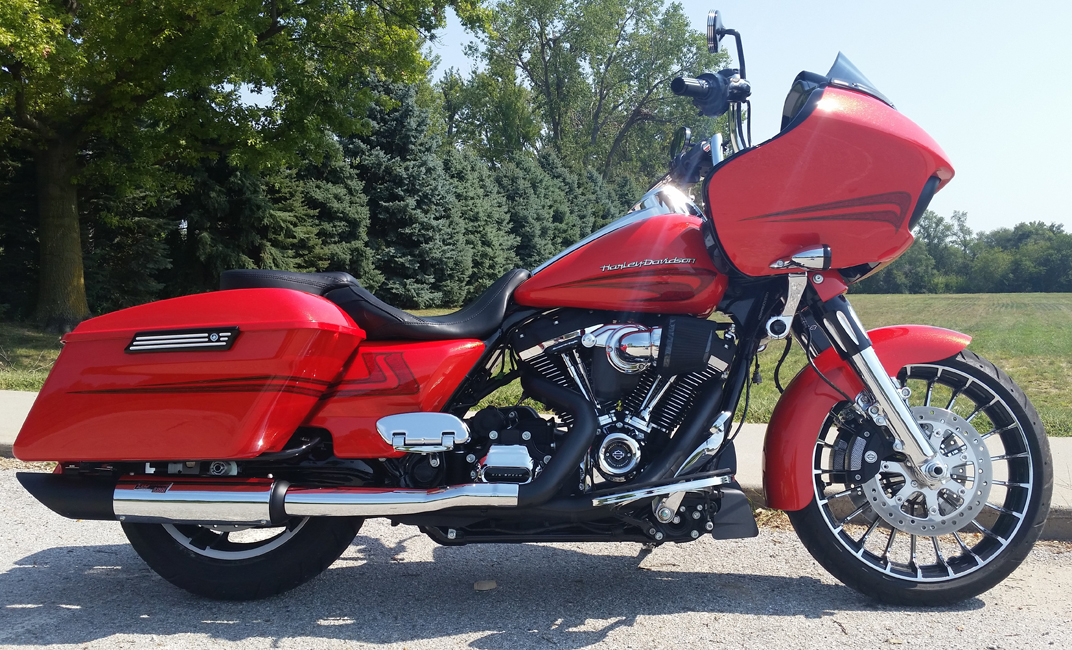
1. Go to the Partnumbers Page to
Locate your bike
2. Systems come complete
with
a. Included in price: Look Up Heat Shields to see what comes
with your exhaust: Heat
Shields
b. Included in price: 00-1000 / 00-1001 / 00-1002 Flanges
/ Clips / Nuts
Three LSR 2-1 Finishes
1. Show Chrome:
The brightest chrome, the "Hexavalent" process, has been
outlawed in California since January 2024. Chemicals in
the Hexavalent process can be cancerous to chrome shop
operators, not the end consumer. The currently legal "Trivalent" chroming
process has a darker hue and does not visually "pop".
Our chrome shop of 26
years finally shut down their Hexavalent plating line in
2024 in spite of having a two year extension to operate.
We are working with a new chrome plater, in
business for many decades, who still uses the Hexavalent
Show Chrome process and understands motorcycle exhausts.
All LSR 2-1 Exhausts and
heat shields are mirror polished and plated with
Hexavalent Show Chrome.
2. Silver Ceramic:
Looks like polished aluminum, Can be re-buffed with
Mothers Magnesium & Aluminum Polish. Will not "Blue"
and will not come off or rust. Holds in heat. Usually used
with chrome or silver heat shields. Fired twice @ 600F.
Zero problems in more than a decade. Not internally coated
and no internal media contamination as exhausts are sealed
during the process.
3. Dual Coat Black Ceramic: Silver Ceramic base with secondary coat of Black Ceramic. Fired three times @ 600F. Only black Finish that will hold up. Zero problems in more than a decade. Not internally coated and no internal media contamination as exhausts are sealed during the process.


Born Every Minute As They
Say: LSR Pro Stock Spyder
Versus $3200.00 Black Burns
Stainless 2-1
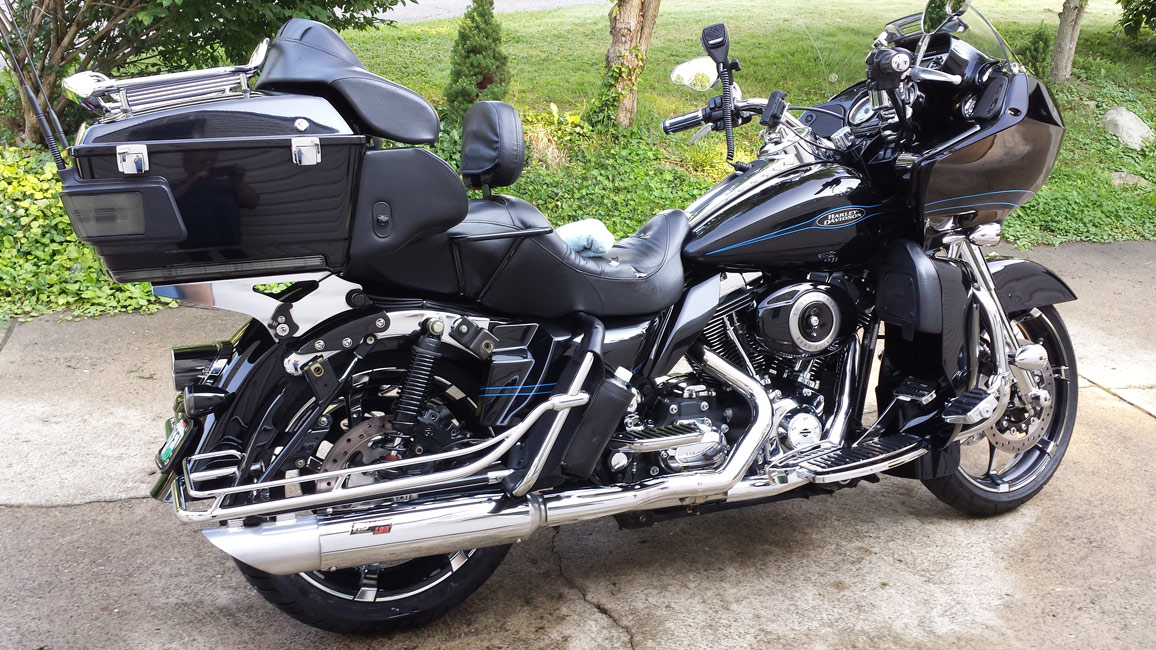
Above: LSR 2-1 Pro Stock
Spyder 00-1367 in Silver Ceramic with full coverage chrome
heat shields.

You can spend upwards of $3,200.00 for a, new to the market, Burns Stainless black megaphone 2-1 exhaust with only an abbreviated heat shield ($185.00) and no long term history in terms of pipe mounts or over the road long term durability. Whoever chose that bend radius flunked aesthetics 101.
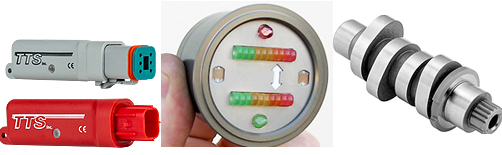
For about the same money you can get a
competition and dyno proven LSR 2-1 Pro Stock Spyder in
dual coat black ceramic, silver ceramic, or full chrome, with
full coverage heat shields, a TTS MasterTune, a TTS Camshaft
and a RSR Dual Display AFR Gauge for, as you ride, monitoring
to perfect your tune. Full 1 3/4" or 2" primaries, billet
gaskets, and CNC machined turbo venturies. No flat gaskets
that mush into the port.
We tried
megaphones 30 years ago. They are a waste of time. It's
old tech for Norton Manx's and pukka 1950's English bikes.
There are no megaphones on any race cars...formula, GP,
WRC Rallye, NASCAR...Nowhere. 47 years of this shit. We've
seen it all. Stepped
primary tubes are for clowns.

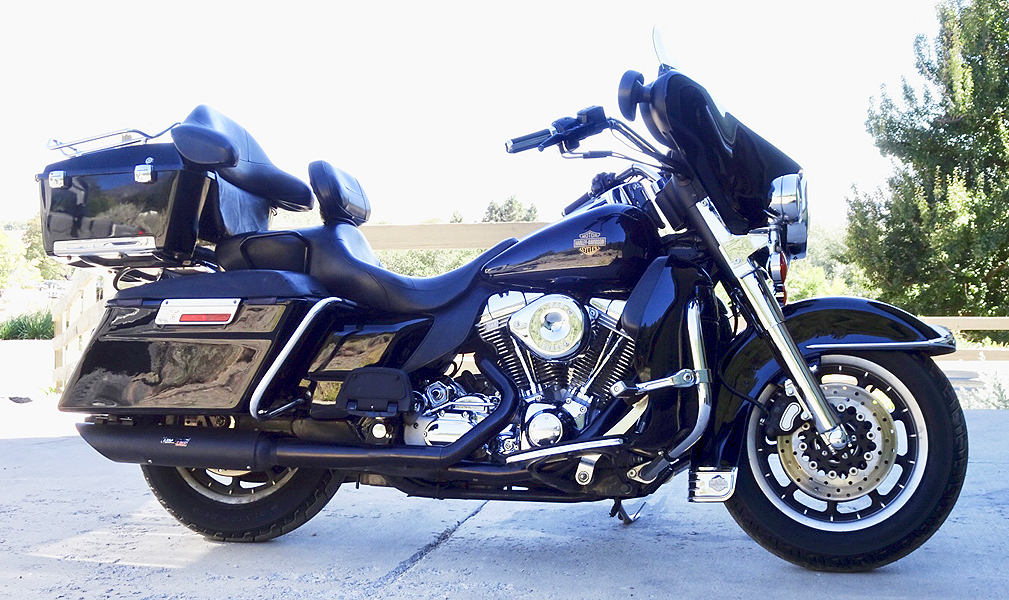


No Leg Cookers
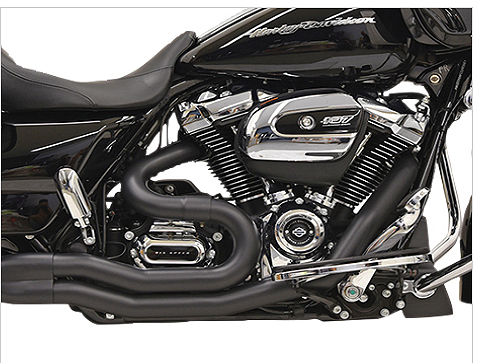
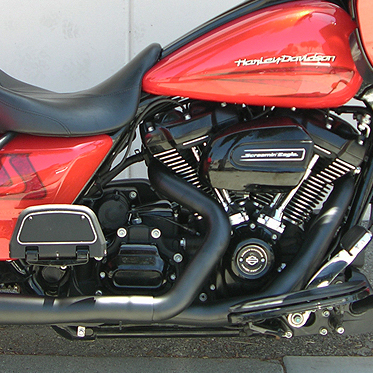
We don't build "Leg Cookers" that will roast your thigh on a long ride. They might be helpful on a frigid Winter's ride but defintely not for the other 99% of the time. Leg cooker to left LSR 2-1 on the right.
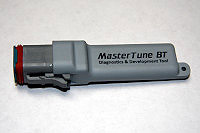
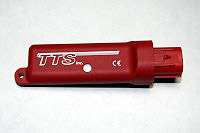
When you order the TTS MasterTune, a
LSR 2-1, and our RSR Air Fuel Ratio gauge, and a TTS
Camshaft (see below) there is a $100.00 discount. Real world.
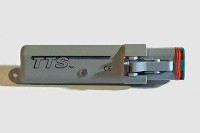
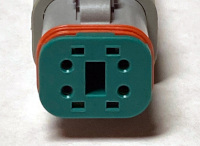
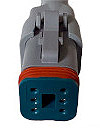
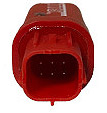
MasterTune BT Communications Interface - J1850 4 Pin
When used for calibration development, this interface marries to the ECM during the first ECM flash and further calibration development can only be performed on that ECM.
When used for vehicle diagnostics and data logging, this interface can be used on any compatible vehicle, even if already married to an ECM.
Mastertune BT Interface communicates to the PC via a wireless Bluetooth connection. Also includes a support loop to attach the interface to the bike via a wire tie.
Compatible with the following Delphi equipped Harley-Davidson Motorcycles:


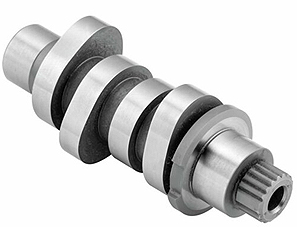
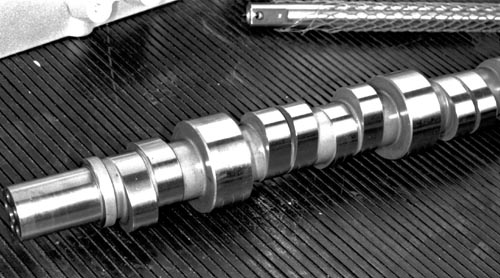
TTS M8
Camshaft left above. Mercedes / Illmore pushrod V8 Indy winning
265E camshaft to the right. Pay attention to the lobe design.
Ilmore found that with a pushrod design there was so much monkey
motion going on between the camshaft lobe and the actual valve
opening that it made more power and torque to gently (preload if
you will) open and close the valve. Slamming the valve open
introduced disastrous harmonics and accelerated valvetrain wear.
Steve Cole designed his TTS 100/150/175/200 camshafts plotting the
acceleration rates contrary to what others did i.e. banging the
valve open and shut. Years later Steve finds others are copying
his designs even if they do not know why he designed them that
way. Camshaft
descriptions.
If you actually ride instead of parking and talking about your
dyno session you will find the TTS cams will outperform all others
in the vital roll-ons in the 1000 to 4000 RPM range.
TTS M8 cams are priced at $275.00. $358.00 for Twin Cams. In stock
at RB Racing to pair up with our LSR exhausts and our RSR Air Fuel
Ratio meters.
When you order the TTS MasterTune, a LSR 2-1, and our RSR Air Fuel Ratio gauge, and a TTS Camshaft there is a $100.00 discount. Real world tuning.
S&S T143 with B3
Heads
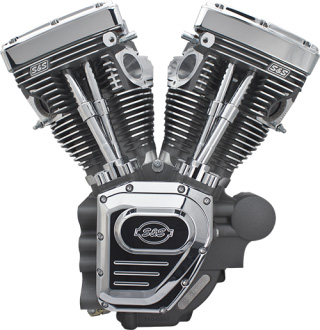
S&S T143 for your
Twin Cam Dresser. Another way to spend $10,000.00 to
$15,000.00 to climb the Horsepower mountain. We are making
exhausts for these with our integral two bolt B3 flanges. The
exhaust port dimensions are not OEM Harley. There are slight
variations between the earlier B1/B2 and B3 S&S heads.
S&S T143

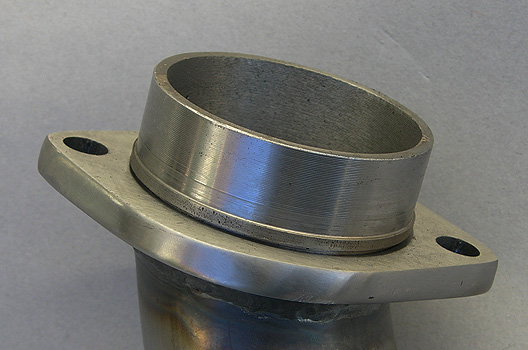
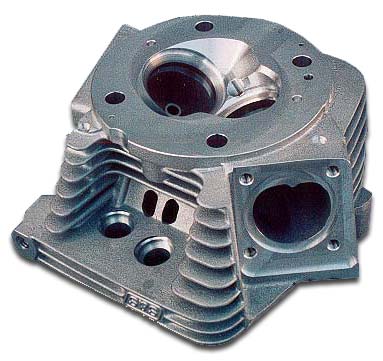
We have made custom
parts for these two bolt T143 B3 cylinder heads. Available for
the four product ranges we manufacture...(1) LSR 2-1 Turn Outs
and Slash Cuts, (2) Quiet (LSR 2-1 Black Hole); (3) LSR 2-1
Pro Stock Spyder; and (4) Full Race LSR 2-1 Pro Stock: 00-1306
and 00-1306R. All use 2" primary tubes.
The new two bolt LSR
2-1 B3 Flange is integral, free rotating, to the exhaust port.
Full tapered cnc machined venturi for 2" primary tubes.
Uses a machined 1.875"
I.D. Billet Aluminum Gasket.
S&S SA B1/2/3 Heads
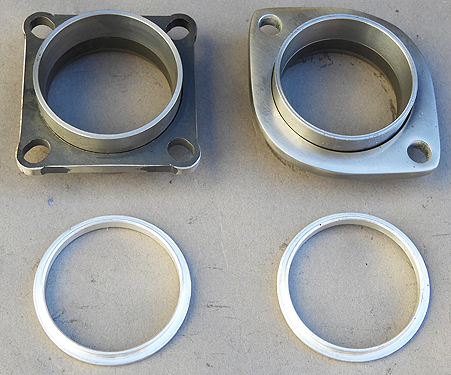
We have been asked by customers to provide LSR 2-1
exhaust systems for B1 / B2 / B3 heads originally found on EVO
and 145" S&S Tribute engines and later T143 engines. Early
B1/B2 four bolt flanges. Later B3 use two bolt flanges.We make
both. The diagonal dimensions are the same two to four bolt
patterns.
We have LSR 2-1, LSR 2-1 Pro Stock, LSR 2-1Pro
Stock Spyder and LSR 2-1 Black Hole designs for these three
S&S cylinder head variations.. Pictured above are our laser
cut flanges and cnc machined hour glass shaped venturis that we
tig-weld to the B1 / B2 / B3 LSR 2-1 exhaust systems.
We have a specific fixture for the 126 S&S and T143 SAB2 / SAb3 Twin Cam Dresser systems as the billet cam cover is not OEM.
Milwaukee 8 Pro Stock
Spyders in Production
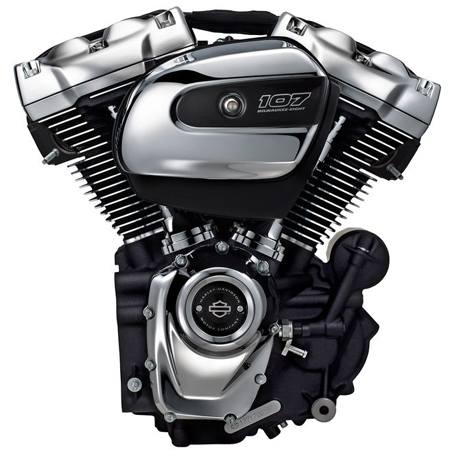
People keep asking about RB Racing
releasing LSR 2-1 exhaust systems for the new Harley Motor. Well,
we are fixtured for them with a new
muffler design that takes into account the increased
compression and displacement. No matter what people say, this is
an emissions-designed engine with a lot of compression, locked in
place valve adjustment and camshafts that are simply going to give
you limited gains for your hard earned money in just changing the
exhaust. Every exhaust manufacturer wants your $$$. We don't.
Testing has shown cam changes need to
be made along with a 2-1 exhaust to make any appreciable gains. Go
ahead buy your $500.00 air cleaners and your $700.00 Monster
Slip-Ons...keep the economy going. Won't do much except to help
your park and talk routine.
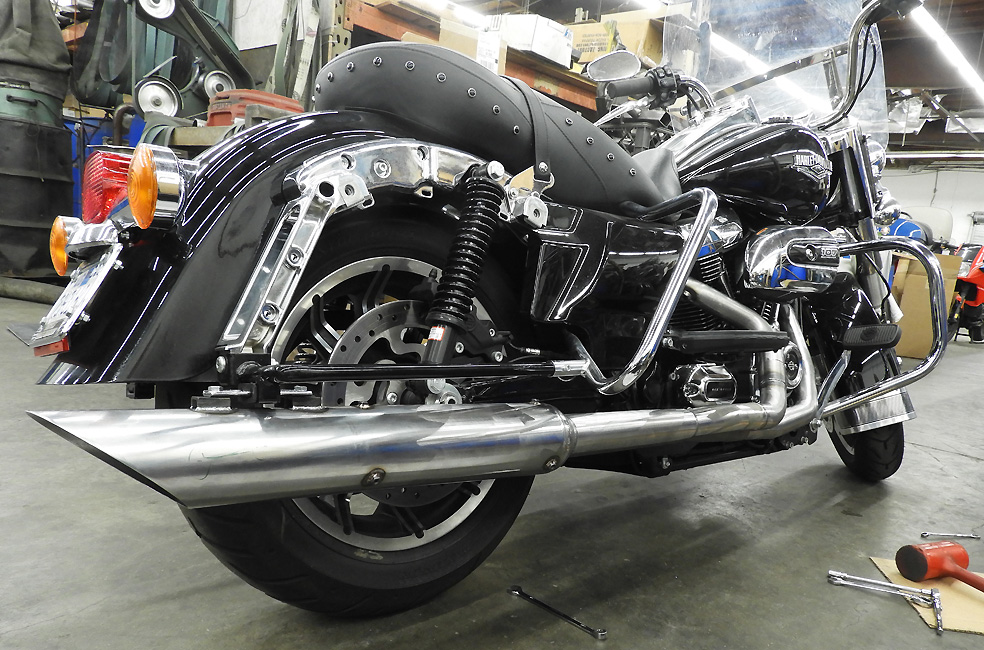
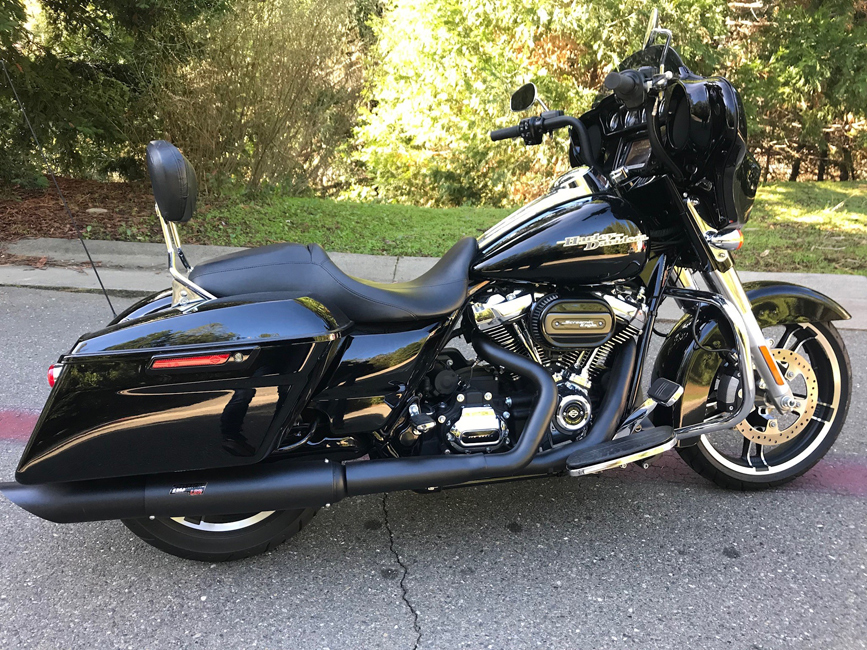
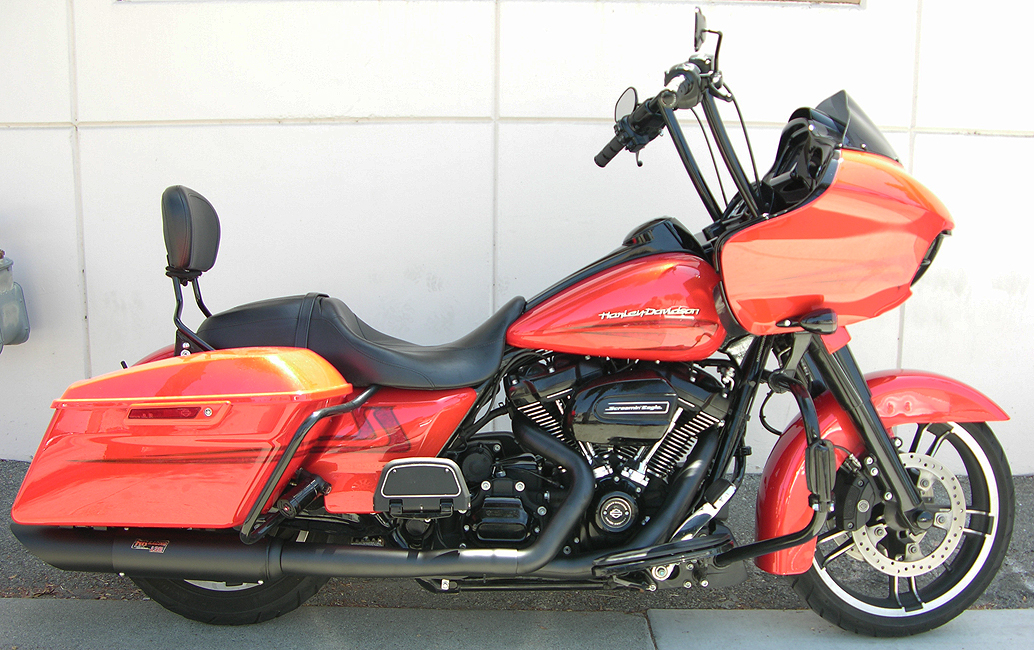
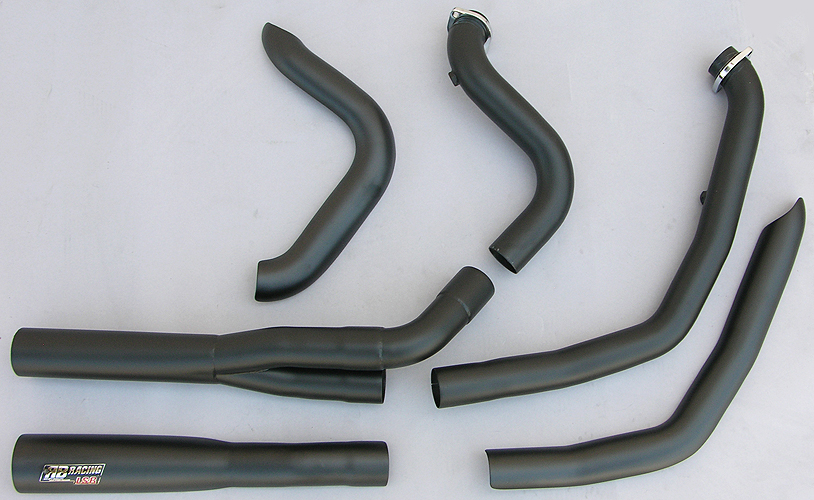
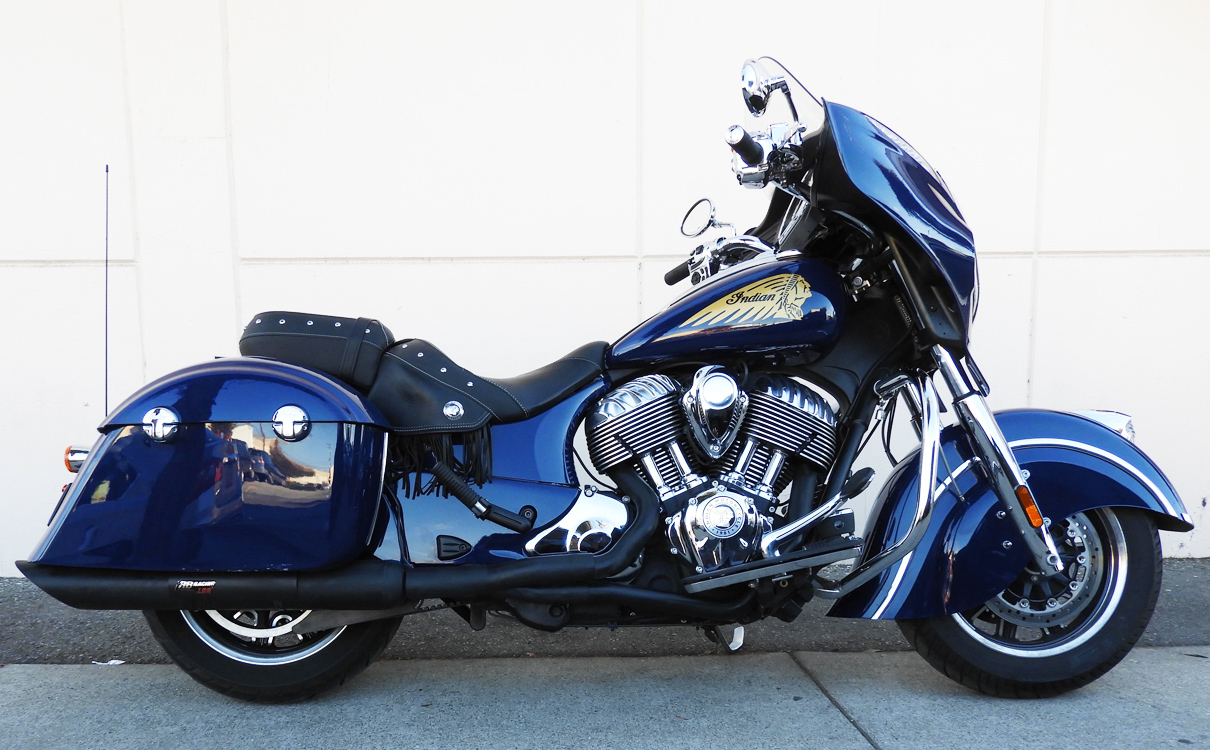
The Indian Chief is a "from the
ground up" interpretation of the classical V-Twin, kept alive
for over 100 years by Harley-Davidson, the sole survivor. In
111 or 116 cubic inch formats it's short on horsepower and
long on clean sheet engineering. Indians are here to stay this
time around after several aborted attempts to revive the
marque.
Beautiful paint and chrome and true
"Indian Heritage" styling it's a more modern interpretation of
the classical V-Twin...This time around with three camshafts
and some pushrods as straight as an Indian's arrow .
The OEM exhaust has little in the
way of performance tuning. We've got that covered with a pure
merge collector LSR 2-1 design.
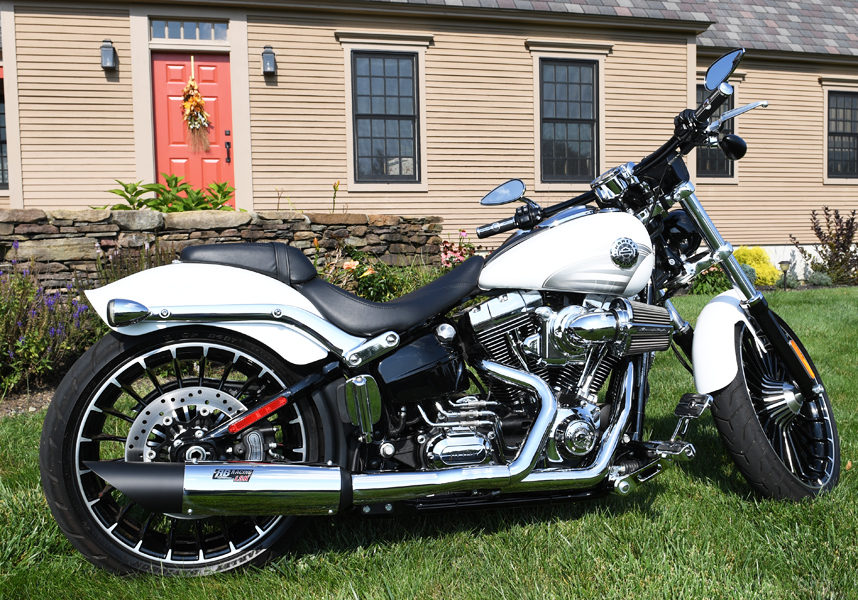
95" 5000 Miles later
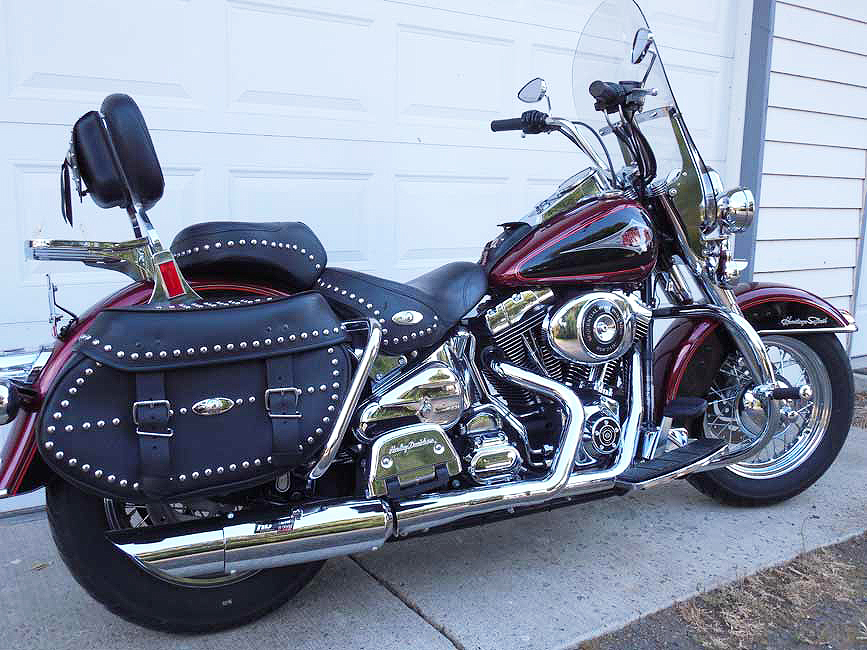
Customer writes:" Here
is a photo of my 2001 Heritage Softail with your (00-1371) Pro
Stock Spyder 1 ¾, C Style with 3 shields. The bike is a 95 CID,
with SE 204 cams, Branch O’Keefe PT heads, one tooth added to
the tranny sprocket then tuned with TTS Mastertune. I kept the
torque and horsepower events in the low to mid RPM range and
settled on a compression ratio below 9.8 because I ride 100
miles every day on open country roads using 91-octane pump gas.
I have taken your advice on several products and they have all
worked very well for me but I believe the Pro Stock Spyder is
what pulled everything together to achieve impressive gains in
performance and produce a far better sound. I have 67,000 miles
on the bike including the last 5,000 with your pipes so I can
tell you with confidence the changes in performance due to the
Pro Stock Spyder were very evident particularly when hitting it
hard on open road.
As always, the fit and finish was perfect, the slip joint,
billet gaskets, and special nuts made the system easy to
install, and it looks way better than the other exhausts I have
seen. I am very satisfied that I bought your exhaust system and
I recommend them to anyone who values performance and good
looks.
Thank you for building a truly excellent American Made product.
Ray"
113"... All Black
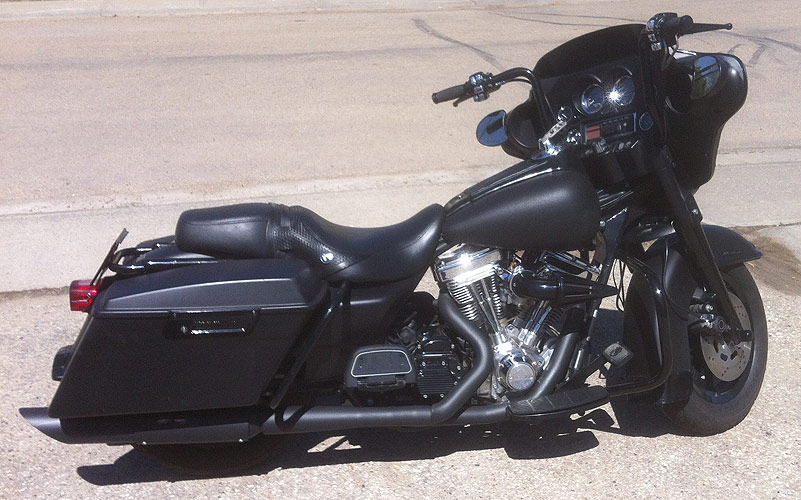
Customer writes:" Here
is Pic of Simply the Best Exhaust System ever installed on my
custom bike. LSR Pro Stock Spyder 2-1, 2" Black Ceramic w/ Black
Heat Shields. My bike is a Lowered 1998 FHL Ultra Classic, It
Had a 80" EVO Fuel Injected, But was replaced by S&S 113"
EVO Carburated. Install and pipe finish Excellent. Little louder
then stock at Idle. Pipe makes bike rev out quickly through all
gears, & Therefore makes gear shifting much quicker now.{
Good thing bike has Avon tires or would break loose } Quiet
enough to listen to stereo at Hi-way speeds & Acceptable
through town with moderate throttle use.
The Mid-range and
Top-end Passing Power is INCREDIBLE. This thing just pulls, and
pulls, with simple roll on throttle in 5th gear. But Drop a Gear
at Hi-way Speeds, Hammer Throttle Open. Hang the " Fuck On ",
Hits 190 KM in seconds, Plenty of power to pass anything on road
in front of you and very quickly. Bike gets average 39 miles /
gallon at 70 MPH. I've tried other pipes on this motor, they
were just pipes. This is a complete exhaust
system.
Thank you RB Racing for
a Excellent Harley exhaust system. From one HAPPY CANADIAN CUSTOMER.
P.S. Made call before
order, was in stock, took approx 3/4 weeks to get. WORTH THE
WAIT PERIOD .....!!!!!"
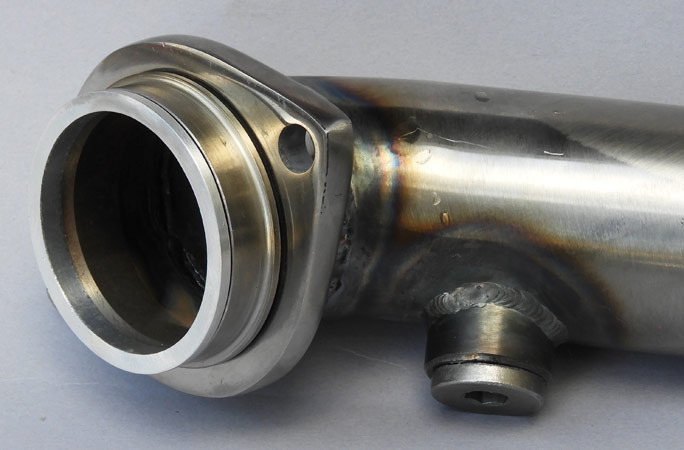
S&S T143 with B3
Heads...1.875" ID
143 Cubic Inches for
your Dresser. Another way to spend $10,000.00 to $15,000.00 to
climb the Horsepower mountain. We are making exhausts for these
with integral B3 flanges. The exhaust port dimensions are not
oem, not S&S SA B1 nor S&S SA B2. Go figure.
Bye Bye Dyna
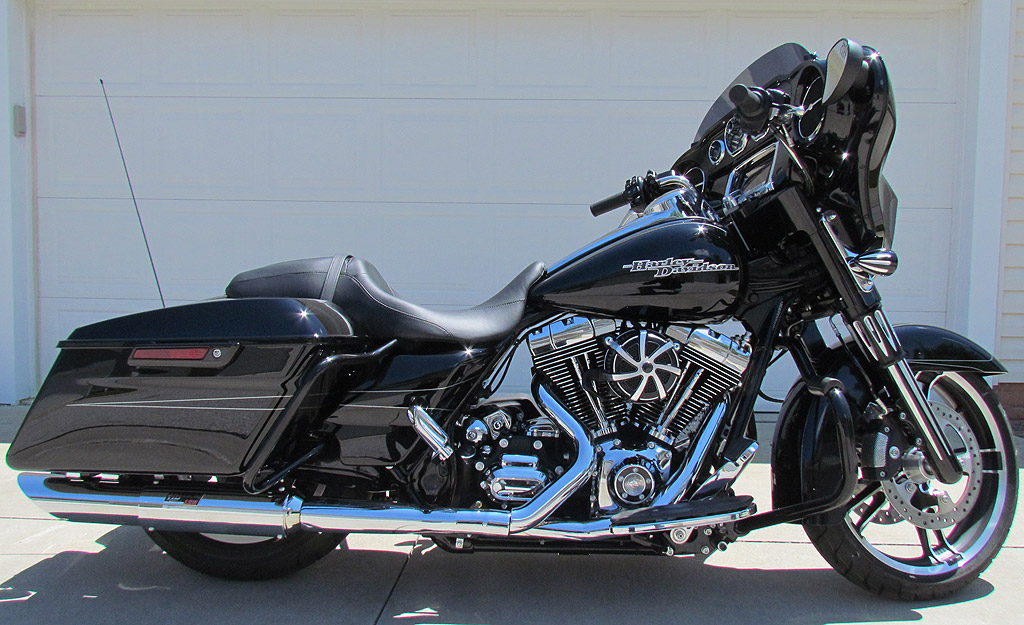
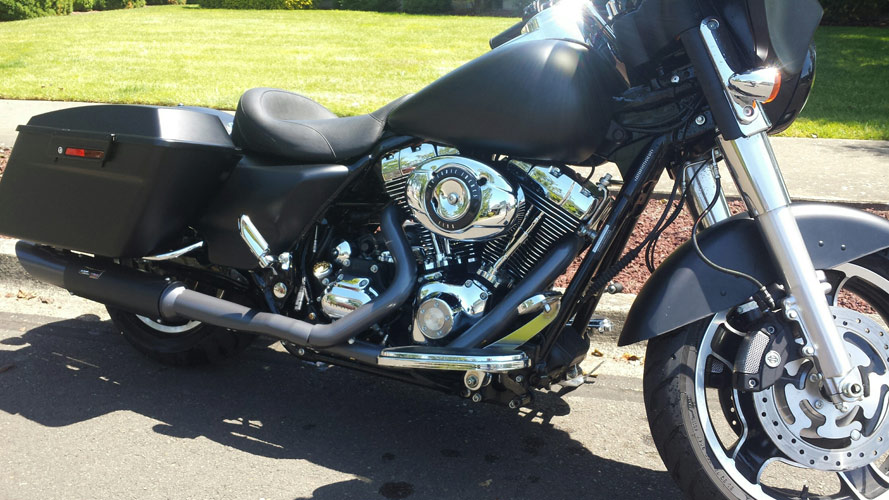
Customer writes: "2014
FLHXS Street Glide Special, 551 S&S cam, Legend Aero-A Air
Ride, Pro Stock Spyder Chrome. Bye Bye
Dyna, Hello Street Glide! .…Work in Progress...PS. This Dyno chart is my bike vs
an identical 2014 Street Glide with the same cam but with
inferior 2:1 exhaust. Picked up 12 horsepower. Cheers to all at
RB Racing. Richard"
He Picked up 12 horsepower and 6 foot pound of torque. We're not
big on dyno charts. We ride bikes not dynos...but more power is
always good...and more torque. Good move to off the Dyna.
Many Miles Later
Customer writes: "Just
so you know, I really like the RB Black Hole Spider exhaust that
was installed on by bike at the dealership at about 3K mi. The
pipe has about 105,000 miles on it now and as you can tell by
the pictures it looks as good as the day it was installed.
The shields look good after a buffing job, even though the rear
one had oil dripping on it for the entire time it was on with
the other intake that was on the bike. Word of caution,
the Screaming Eagle Ventilator intake from HD is crap, nothing I
tired would stop the flow into the air cleaner element and then
out the bottom onto the pipe. The final fix was a new intake,
(not HD).
I put a new 2011 stock 103 motor in the bike in April and while
it was down I sent the Spider to an outfit in WI
(http://www.classiccoatings.com/ceramic.html#satin) for ceramic
coating inside and out and it came out great. The heat
reduction really surprised me but I can't really attribute it
all to the coating because it's not the same motor, I can't be
positive how much it really helped, I just know it doesn't seem
as hot now and the gauge doesn't go as crazy in stop and go
traffic.
Your product quality and performance far surpasses anything else
on the market and cost recovery, if used for any length of time,
makes it a bargain. This is my second LSR and when I sold
my '02 Ultra it had 105K on it and the Black Hole system had
over 50K on that bike and I bought the LSR system used!
Anyway; you produce a fine American made product and I commend
you and those that work with and for you.
Now if I could find a way to get one of those Orca motors stuck
in that place under my seat I could keep those pesky goldwings
at bay.
A satisfied customer,
John"
Thailand
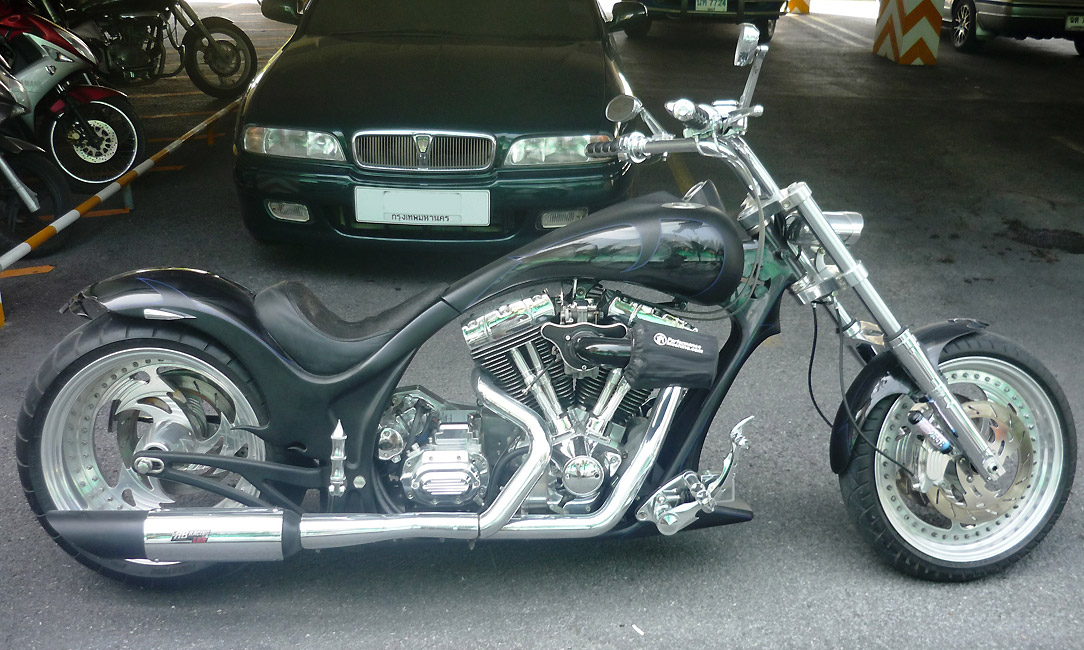
Customer writes:
"Hi See attached my recently built scoot, running Merch
bottom end, Evo top end, Jims six speed transmission, S&S
Oil pump, Primo Rivera open drive, Ricks wheels and Penz frame,
built in Jomtien Beach Thailand by Swiss Chris of East Coast
Choppers Pattaya. Don". 00-1345 LSR 2-1 Pro Stock Spyder...Slash
Down.
Pro Stock Power... Black Hole Technology
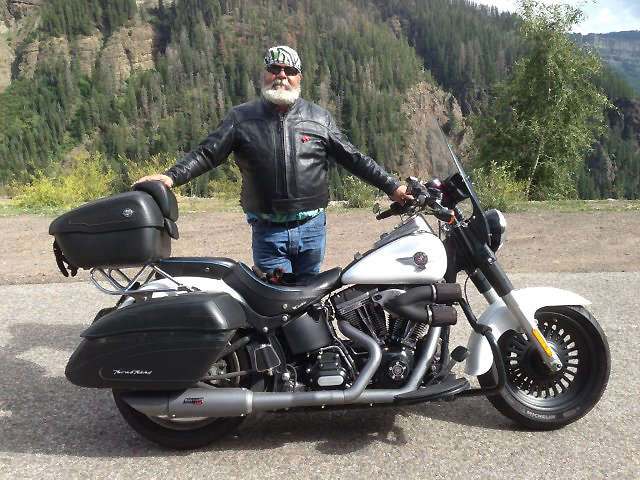
Customer writes: "To the
Lady that answers the Phone: Here’s the pic of the pipe you
asked for. The 124 S&S motor purrs with this pipe and it’s
so much cooler on my right thigh I’m a happy camper. Took
off from Alaska after the last bolt was torqued on my new engine
and here I am on Wolf Creek Pass in Southern Colorado.
Pipe is quiet when loafing along but has a good bark when I get
it on. Worth the wait. Thanks, John."
00-1372 in SS Titanium
finish (finish since discontinued RB Racing).
Bye Bye Dyna
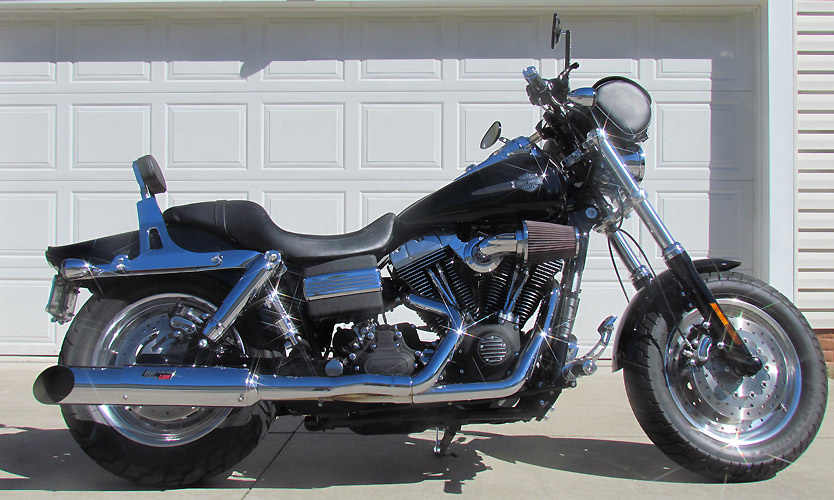
Customer writes: "Hi
Folks, I thought I would send you an updated pic of my FXDF with
a few more accessories added. Your Chrome LSR 2-1 Black Hole
exhaust is a real head turner! Everywhere I go, people will stop
and do a double take at the bike. Your quality is second to
none. I've had the bike (and exhaust) going on 4 years now and
the pipes look just as nice as the day I put them on!
The sound is awesome and indeed gets quieter the faster the speed. I'm upgrading to the 2014 Street Glide Special and can't wait to put another pair of Black Hole Spyder pipes on it as my 1st add-on. I'm sorry to see my 2009 FXDF Fat Bob go but the new owner will be able to appreciate the excellent exhaust as I do ...Besides I'll be able to spot my old bike anywhere at a glance riding around. Keep up the great work! Rick"
00-1375 LSR 2-1 Pro
Stock Sypder.
2013 CVO 110" Breakout
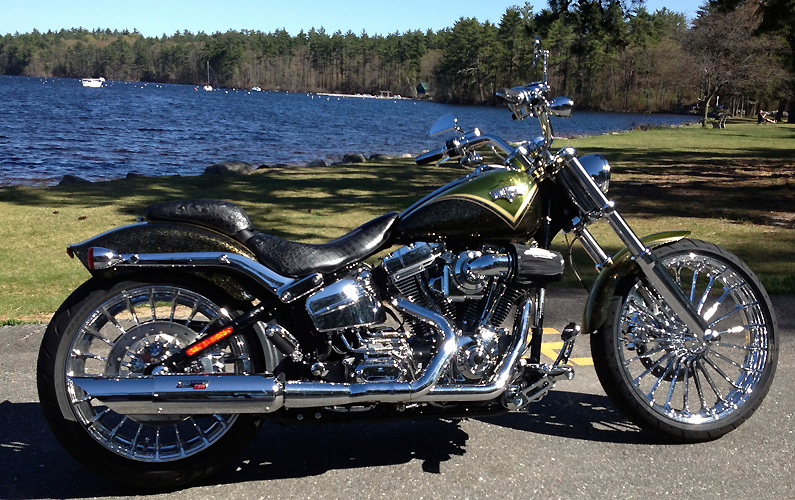
Customer writes: "MY 2-1
SPYDERS ON 2013 110 SE CVO BREAKOUT (LOVE EM) IS THIS BIKE A
CANDIDATE FOR AN ORCA TURBO? OR SHOULD I WAIT UNTIL THE NEXT
ONE? "HURRY UP AND SLOW DOWN." 00-1371 LSR 2-1 Pro Stock Spyder.
Runner
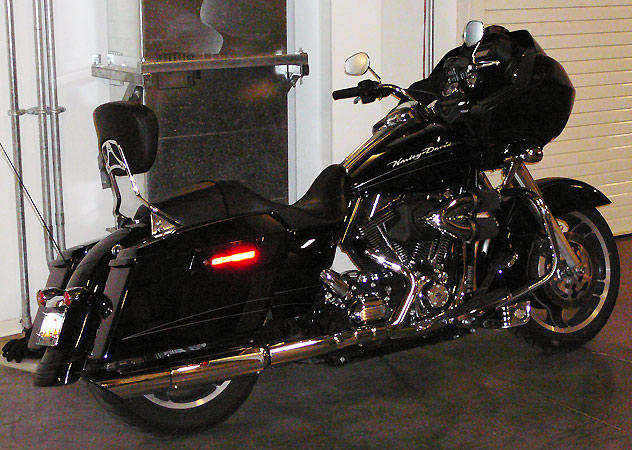
Customer writes: "Happy
New Year!
My apologies for waiting so long to email you some pictures of
my 2012 Road Glide with your AWESOME 2-1 Pro Stock Spyder Pipe.
Man RB RACING ROCKS! This pipe has given my bike so much
performance, especially on the bottom end. I still had factory
exhuast with some crappy Screamin' Eagle slip-ons, I installed
the S&S Stump Puller Cams (551), S&S heavy breather air
cleaner, then I flashed the ECU with the TTS MastertTune and ran
it that way till I got my RB Racing Pipe.
I put the 2-1 Pro Stock
Spyder Pipe on, ran the TTS Mastertune V-Tune a couple of times
with my little fox on the back up and over the point on I-15
here in Utah a couple of times. Then went for a ride by myself
and Holy Shit what a difference. Haven't put on a dyno and
probably won't because of the great job V-Tune does. But I can
tell by my Butt Dyno, I've got some substantial horse power
increases and a ton of torque compared on a before and after
comparison. I've had it on a couple of loong cruises riding 2
up, and it just pulls!I've gotten a lot of compliments for looks
and a ton of compliments for sound! Really happy with your hand
made by Americans in AMERICA products!
Thanks for the awesome 2-1 Pro Stock Spyder Pipe, Mike."
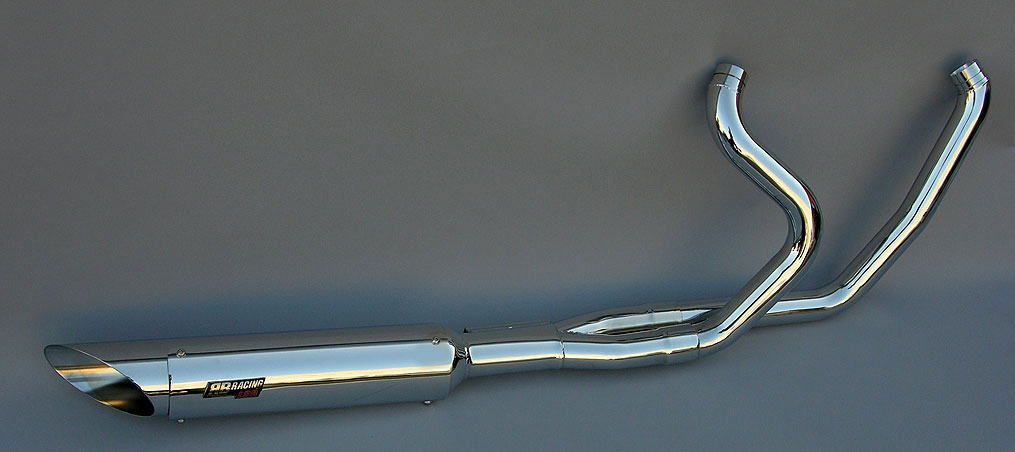
Bigger engines, more compression, radical cams and the never ending search for power and individuality have exponentially raised decibel levels and eyebrows. The men in Blue have their orders and are now listening for you. Reality TV shows are edited and condensed for consumption. Strife, tension and open exhausts are good entertainment. Nothing has to actually have to work beyond the last commercial. Hit the road with your dream and collide with reality. You can't park and talk all your life...or maybe you can.
Performance and a mild dose of acceptability can coexist but it requires original thinking. RB Racing has married their race winning LSR 2-1 Pro Stock exhausts and their silent running LSR 2-1 Black Hole systems to engineer a solution to kicking ass in a society that looks askance at the outlaw.
00-1345 LSR 2-1 Pro Stock Spyder, 2" Style C. This system headed for a 124" S&S motor.
Typical mounting instructions for Evo/Twin Cam Dressers.
V-Rod Pro Stock Spyder Exhausts
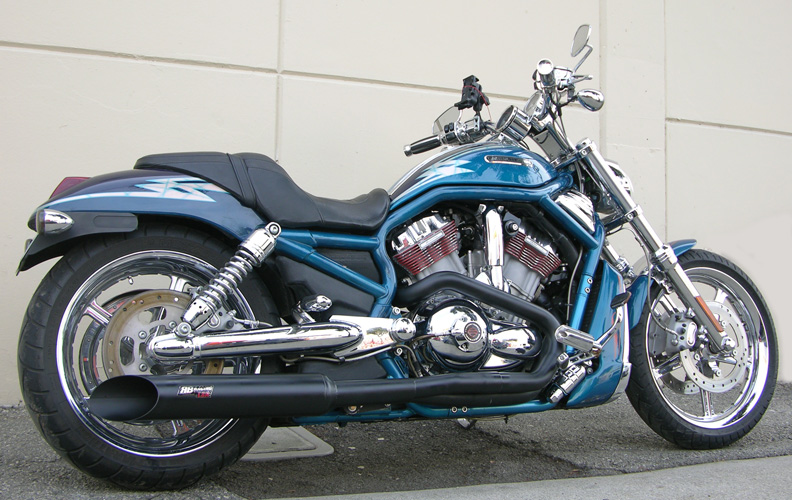
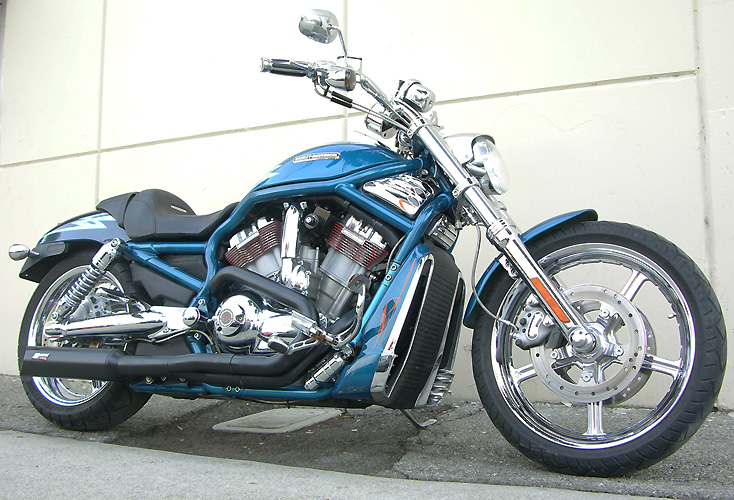
V-Rod LSR 2-1 Pro Stock
Spyder. Sound cancelling Black Hole Technology married with our
Pro Stock race design for a 10 decibel noise reduction. We had
to develop the Pro Stock designs first and then we added our
proven Black Hole technology.
Vet
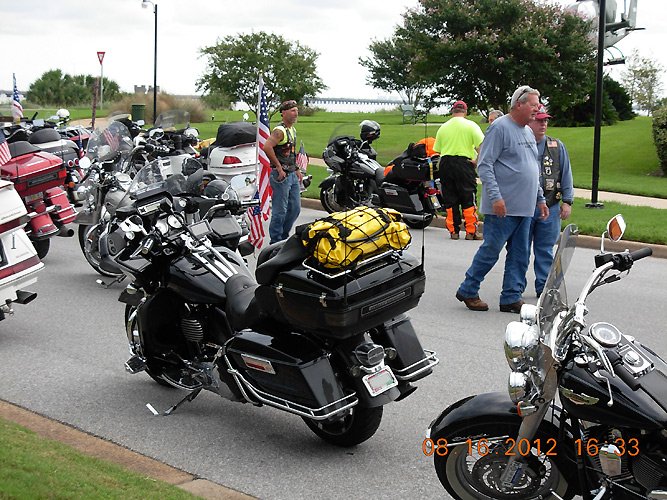
Customer writes: "Thank you for your excellent service and immediate delivery of the parts I needed to get back on the road!! I got the gasket in record time and put everything back together and away we went. Again I compliment you on your product, I have a little over 72,000 miles on Black Hole Spyder pipe and the only thing that is wrong is I can't seem to keep my boot off of the shields.
I have use other 2 into 1 systems and none have lasted over 55K miles, the Thunder Header welds fell apart and the mount broke (yep, broke!) at 55K and the damn Screaming Eagle burned through at 35K. I'm dealing with health problems now and do not get to ride as much as I would like but I really don't want to have to work on a bike every time I take it out of the county.
Our Ohio Patriot Guard Riders escorted the Marine Aviation Memorial Tower from Cincinnati, OH to Pensacola, FL last week and I came right back home. I didn't even ride down the coast or through any of the historic sites in Georgia and Virginia, this getting old isn't for the weak! Old injuries just keep reminding me that I should have had more respect for my body as a younger man.
Anyway I have great respect for your operation and products, if I ever see my way clear to upgrade to a monster engine it will be a turbo Orca for touring and distance riding. You have copies of my bike when I first put the header on it, the only things I have changed are the wheels and painted a few of the exposed black plastic parts and used smoked lenses on the lights. It draws attention almost everywhere we ride and the Road Glide people especially like it. They almost all ask about the pipe and a few of my riding buddies have purchased them they all have positive comments about the craftsmanship and and performance of your products.
Thank you again, John."
SE 120R Engine
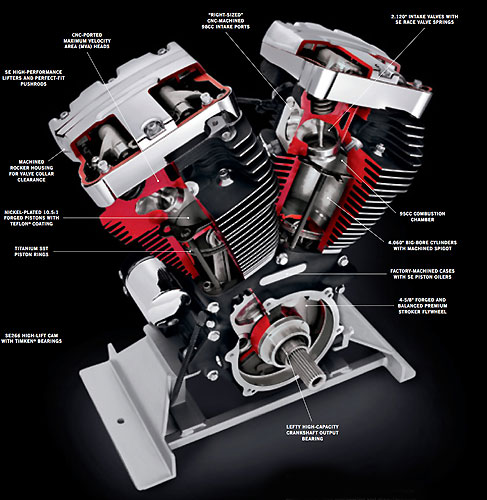
120R Engine for Twin Cam Baggers and
a new AHDRA racing class...another way to get your money now
that V-Rod Destroyers are old news. Think of all the early
adopters who went 95/103/110 and now they can go 120". Stimulus
money! If you want one in your bagger and want a full race
system then our LSR 2-1 Pro Stock Spyder is about the only way
you can get your power and have sound attenuation.
These days (2023) it's now 135 crate
engines for M8's. 121" M8 CVO's and 136" S&S motors. $$$$
Proper part number is 00-1368, a 2" primary design. You will also need our billet gaskets, billet flanges and snap rings, heat shields, and an extra set of our special exhaust stud nuts. 135 claimed hp is nice but the noise gets old...unless you only want to run your sled on a dyno. In the real world the man is waiting for you.
As all the mythical lemmings head off the cliff we might remind them that a S&S SA B2 126" engine is rated at 154 hp and John O'Keefe at Branch O'Keefe has been working SA B2 heads for big inch Sportsters, S&S 124" motors and getting 166 to 200 hp depending on compression. Of course you could get one of our turbos but the extra 100 to 200 hp might be too much power for you.
Bye bye men in blue 00-1416 Quiet
Baffle Option
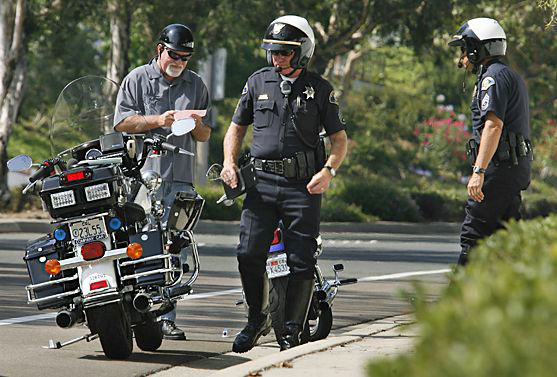
The highway is for gamblers, better use your sense. The blacktop, too, is moving under you. Yonder stands the man in blue.. all ears and waiting for you. All your straight pipe friends are coming through...music for the man in blue. Free tickets for the courtroom door... Twist the grip and start anew, the man won't be stopping you. Spyders pass straight on through. Your friends will meet the man in blue, but the road ahead calls out for you. And it's all over now for the men in blue.
Black Hole technology with 00-1416 Optional Quiet
Baffle... Pro Stock power. 2.5" Internal Bypass...2.250" final
exit. No packing, welded-in mechanical core.
Trap noise, not power...00-1416
QuietBaffle

Black Hole technology traps noise but offers little restriction to exhaust flow. Spin your web of deceit and go quicker, faster, with less wear and tear on your ears and your wallet. Noise is still equated with power but we are striking a median between our silent running LSR 2-1 Black Hole systems and our pure racing, championship winning LSR 2-1 Pro Stock systems.
As engine sizes grow to 95/103/110/113/124 etc. and you add compression and cams the man is simply waiting for you. True Duals, Pro Pipes, Thunderheaders, Big Radius show pipes are all loud, straight though, designs. All are way past 100 Db. Marketing 101 meets the road. 300 series tires with matching love handles, open, rock-catching belt drives and billet grips that were designed for that cold winter morning. And it looked so cool on TV.
Fast and torque remain the constant where the rubber meets the road. Roll out to pass that semi or peg the throttle while leading the pack. Some things don't change. We try to keep it that way. Artistic expression is more fun when it works. High heels and a killer omelette.
On the Road
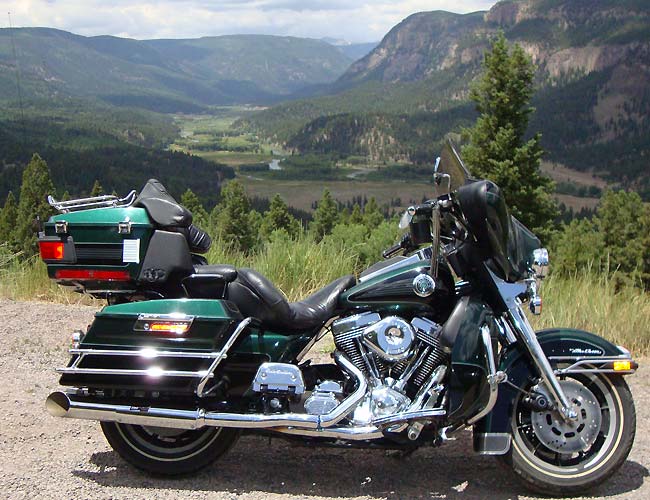
Customer writes: "I will call you and visit about the great pipe you built for me....thanks Carl." 00-1367 LSR 2-1 Pro Stock Spyder...On the road.
2007...Bye Bye Duals
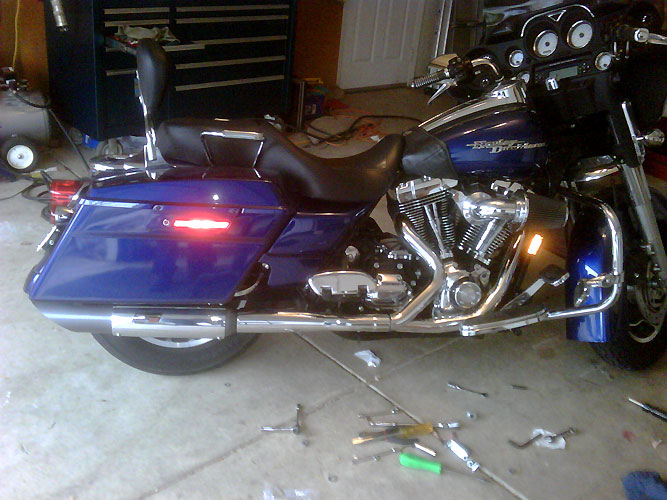
Customer writes: "I just wanted you
guys to know, you have one awesome product. I "had"
Rinehart slip ons on the factory headpipe. The problems
with reversion are certainly nothing to laugh at. I have
wide band O2 sensors and you could see the false air on the back
cylinder at low throttle openings. Scavenging
sucked. I got all of the problems with true duals with
none of the benefits. After installing your great looking
product, the pull from down low is awesome, mid-range is great
with no fall off (like before) up to redline. In a couple
of weeks I'll forward the dyno pulls with the prior setup vs.
the new (yours).
Reasonably quiet during cruise (sounds great with a bit of Pro-Stock burble) and sounds Kick Ass when you get on it. My main problem is the shitty gas mileage cause I can't keep my hand out of it. Again, thanks for a great product. Mark \".
00-1367 1 3/4" LSR 2-1 Pro Stock Spyder. You should end up getting 40+ mpg...those are different issues...Just remember running 13.2: 1 instead of 14.7:1 throws 11% more fuel out the pipe. There's a reason why things are closed loop to 14.7:1
Sleds and The Man
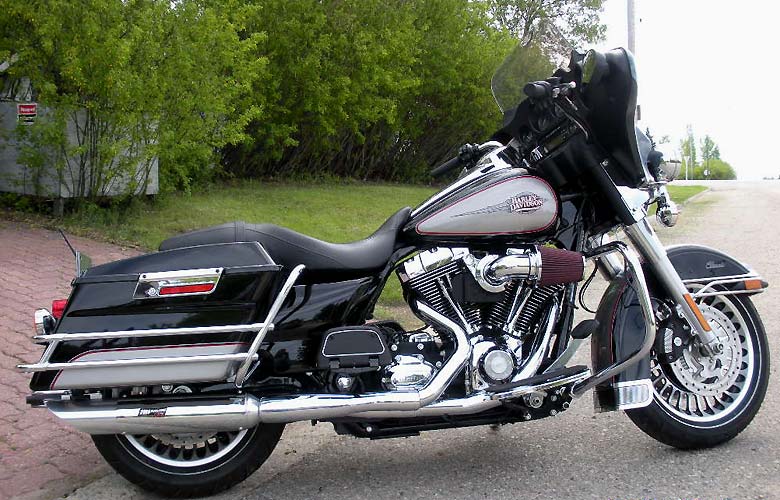
Customer writes: "Dear RB Racing. I
finally got around to sending the pic you requested! I have to
say that this is the best system I have used to date, and I
won't be changing it any time soon. The flow characteristics of
the pipe really make it wind out quickly, and the
heating/pinging issue I was experiencing prior to installing
this pipe are gone.
The sound is how I like it, and it doesn't seem to attract the attention of the law as long you are judicious with the use of the throttle. I'd buy this exhaust again, without question! Thanks for the great service and a great product! Doug and Deborah".
00-1367 in Silver Ceramic with chrome heat shields.
On the Road
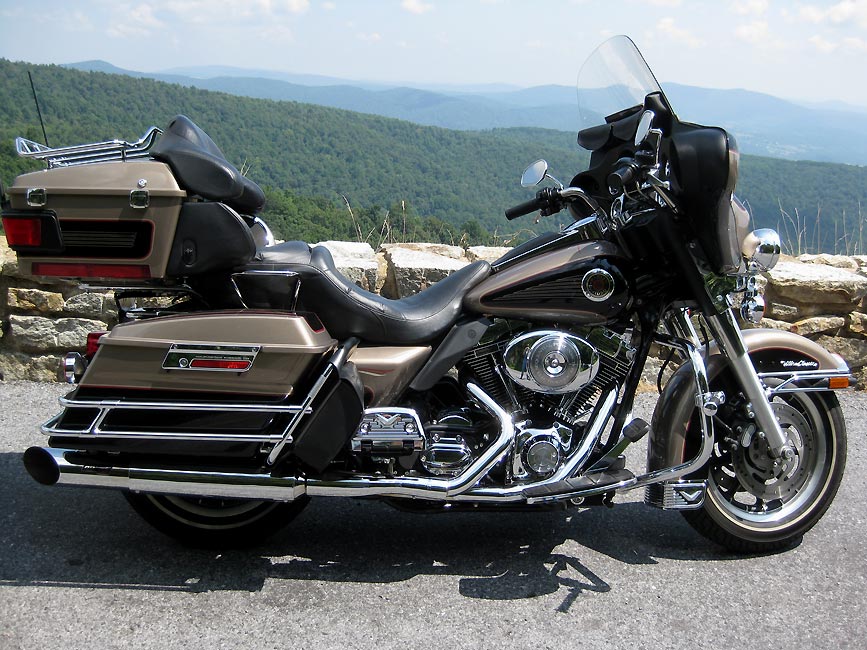
Customer writes: "To the RB Racing crew: I wanted to thank you for providing the outstanding 00-1367 Chrome LSR 2-1 Pro Stock Spyder for use on my 2004 Ultra Classic. The workmanship of the pipe is amazing and the fitment was great also. My bike has a 95 inch Stage 4 big bore engine including SE high compression pistons, heads, and 257 cams. Originally, I used the SE slip-ons that seemed to work well; but, I was not satisfied with the torque curve. The 257 cams normally started pulling hard around 3000 RPM with the SE slip-on mufflers.
After installing the LSR 2-1 Pro Stock Spyder and working closely with an outstanding dyno tune master, John Helvey, the engine started pulling hard around 2500 RPM and continued through normal operating RPM range. The engine also runs smoother and has excellent fuel economy. While the pipes represent a significant financial investment, they are worth every dollar! I attached a picture of my bike with the 2-1 Pro Stock Spyder pipes installed. My only negative comment is I would have appreciated a better powder coated rear mounting bracket since the one I received had bare metal exposed in a couple of places.
Now on to the next project. I would be interested in information on your turbo systems. I would appreciate your opinion on whether it is possible to fit a turbo on my Ultra Classic and maintain reliable street touring performance. I am interested in the turbo because there are times when I want to put the hammer down while riding with my buddies and want to make sure NO ONE will out run me! I hope this does not appear to be a strange request from a touring bike rider; but, I still have deep roots to back in the day when I would run a bike at the drag strip. Finally, will a HD SE big bore engine require significant upgrades to the lower end and drive train to withstand periodic turbo enhanced accelerations? I am running a competition clutch with medium spring tension. Thanks again for making your outstanding products available to the everyday man! Jim"
Long Ago: 2008 103" LSR 2-1 Pro Stock Spyder..Testing
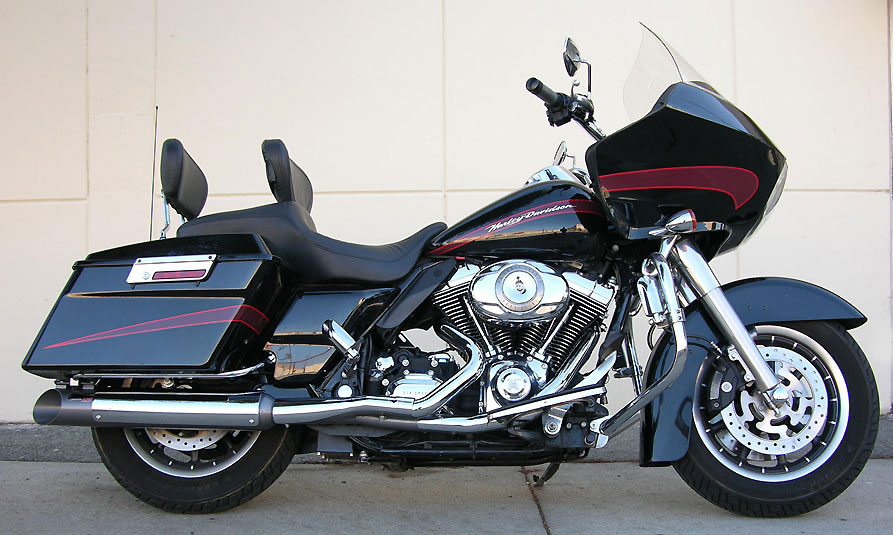
Pictured: 00-1367 LSR 2-1 Pro Stock
Spyder, SS Titanium finish (Since discontinued), 1 3/4" with
four chrome heat shields on a 103" 2008 FLH Twin Cam. Engine has
Branch O'Keefe
cylinder heads. This bike was tested with the 103 then converted
to a 110" and retested. We revised the muffling structure a bit
to get more power and not appreciably increase the sound. The
criteria was that that it could be loud at W.O.T. but it had to
be acceptably quiet at cruise so it would not bother fellow
riders and so that the stereo/radio could be heard. Leaving
black strips of rubber and dyno testing showed the pipe worked
fantastically well with the hot rodd'ed 110.
Out to135 mph.We made internal changes to increase the internal bypass by 50%.
When were happy with the 110" results with 10.5:1 compression and 58mm throttle body, larger injectors, and cnc ported 2.125" inlets, we notified several existing customers and upgraded their systems at no charge. These pipes go on anything from 68 hp TC96 engines to 120+ hp big bores. We then retested the system on a stock 96" engine, testing for sound and power and got excellent results. It's simpler for us to not tailor the muffling structure to each engine size as people keep upgrading their bikes.
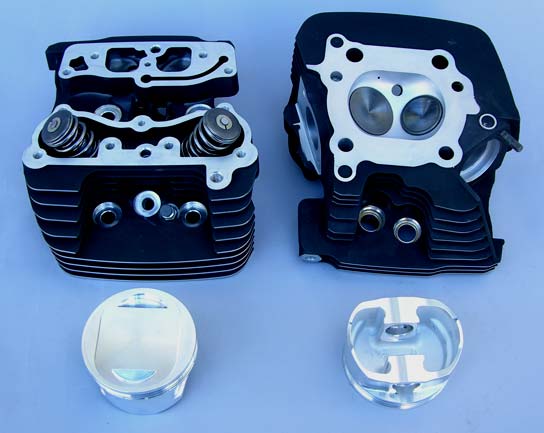
John O'Keefe of Branch O'Keefe has 103" kits for late model Twin Cam engines. Stock 103" engines from Harley make maybe 80 horsepower. This doesn't cut it with an 800 lb sled. Branch Specifications: Larger inlet and exhaust valves; .060" decked cylinder head; compression releases; new valve guides; racing valve springs; flowed inlet and exhaust ports; forged lightweight pistons contoured to match quench style combustion chamber; and BP-600 Branch camshafts. Not a bad idea to get a matched, proven, combination.
John does all our race stuff and has since 1977.
Walz Hardcore Frame
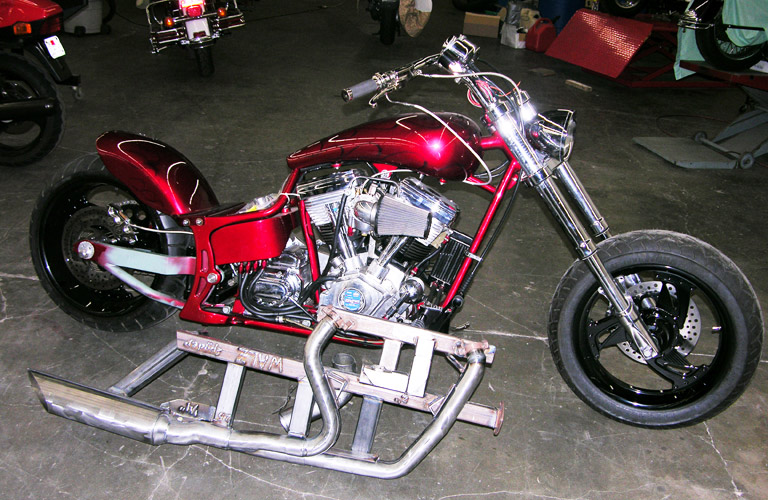
We get a few of these in our shop...Usually they are really long term projects i.e. the people buy the frame and wheels then shuttle from shop to shop trying to get things to fit and the bike never seems to get to completion. We made up a 2" LSR 2-1 Pro Stock Spyder for this one that is headed for Black Ceramic coating. As there were no frame mounts we had to machine, weld and fabricate one made out of 1/4" steel plate that hangs from the 19mm swingarm pivot bolt.
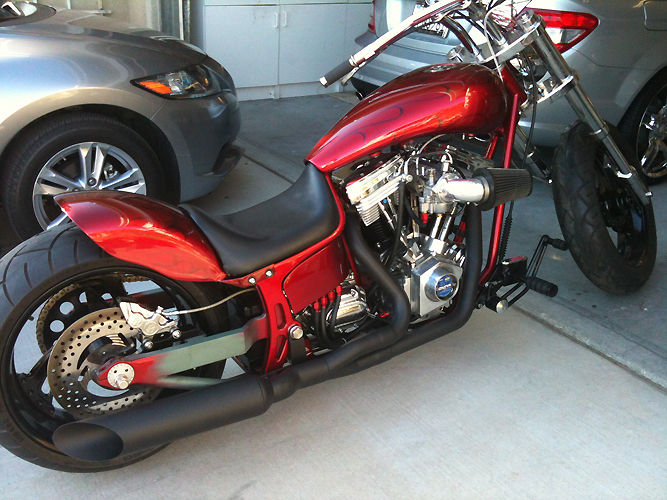
Customer writes: "I
installed the pipe the day I brought the bike home. That had to
be the easiest pipe to install. Took no time at all. Fit like a
glove. Your wife asked for pictures of the bike. Thanks again
for the pipe. I took the bike out for its first ride in many
years and sounded as good as it ran. Tons of power, I'm sure it
doesn't hurt having the correct pipe on it to make all that
power. John"
If any of you Walz guys
want one we list them on our Partnumbers page. They chew up
several days of shop time... 2" LSR 2-1 Pro Stock Spyder for a
Walz Hardcore frame. In this case with a R&R 127" motor.
Everything on this bike was non-standard. Even the stud spacing
was non-oem. It's a runner...finally.
T Sport Dyna
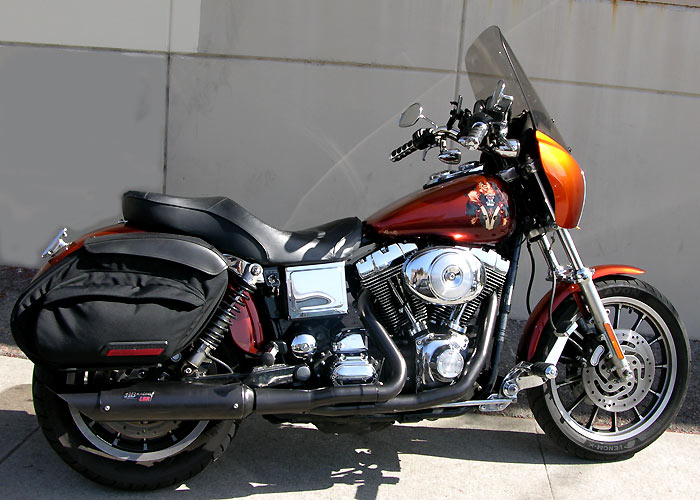
00-1365 1 3/4" C Style Pro Stock Spyder with four heat shields. 95" motor with Branch heads. Replaced a Vance & Hines Pro Pipe that broke it's spot-welded exhaust collars. This one covers a lot of miles. With heliarced cnc machined Turbo Exhaust Venturis, two slip joints, and a laser cut transmission mount, hopefully this one won't crack or break.
Pleiku/Kontum/Cambodia 69-70
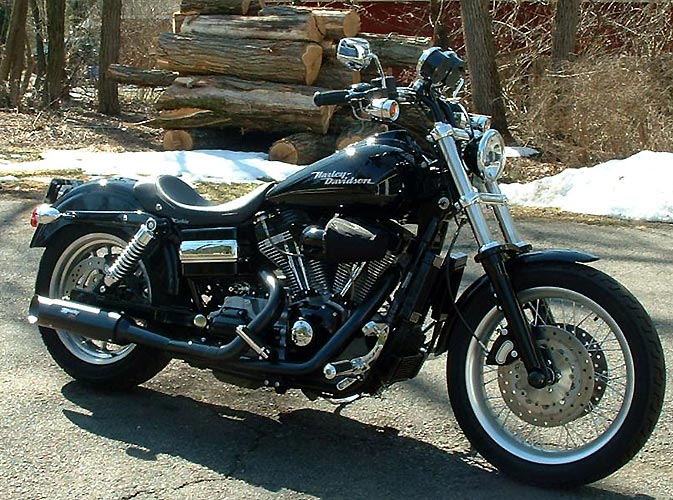
Twin Cam Dyna with C Style 00-1375 Pro Stock Spyder. Long way from South East Asian War Games. Been there done that. Rolling Thunder and Arc-Light strikes.
"Turn Down" Pro Stock Spyder for Klock Werks Extended Bags
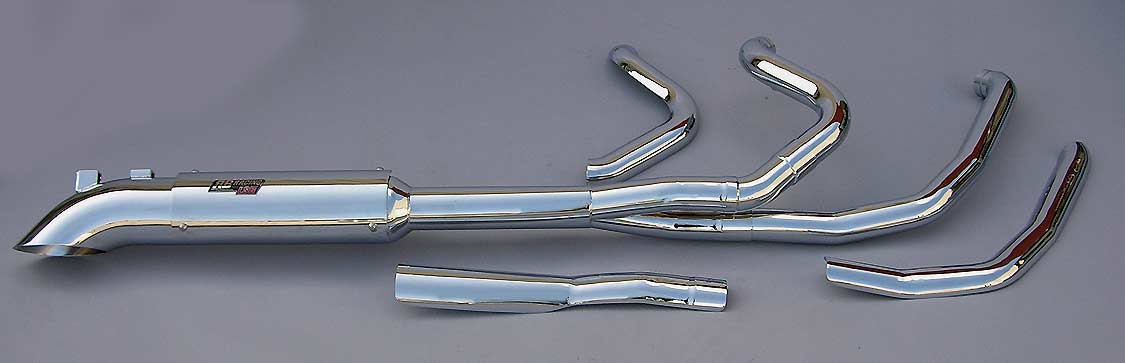
Customer with a 131" Jim's Engine and Klock Werks Bag extensions asked us to make these. Hey, if the customer is recession-proof, is building a completely custom big buck bagger, and the money is right....Well, most of the time (99.99%) we won't do it. In this case we did because the guy was super nice. 00-1368 2" LSR 2-1 Pro Stock Spyder , Turn Down, for Klock Werks closed bag extensions.
Black on Black
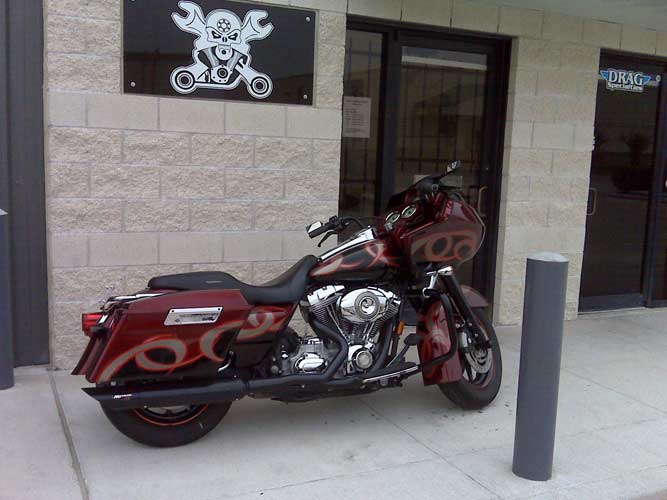
Customer writes: " I installed this exhaust system on my '07 FLTR and love the way it looks. The LSR Spider did something that I wasn't expecting; it gave me about 10hp more than the aftermarket 2into1 I had on my bike. I love the way it sounds and performs. Thanks for making a great product!! Mark". 00-1367 In Black Ceramic with Black Ceramic heat shields.
2008 110 CVO LSR 2-1 Pro Stock Spyder
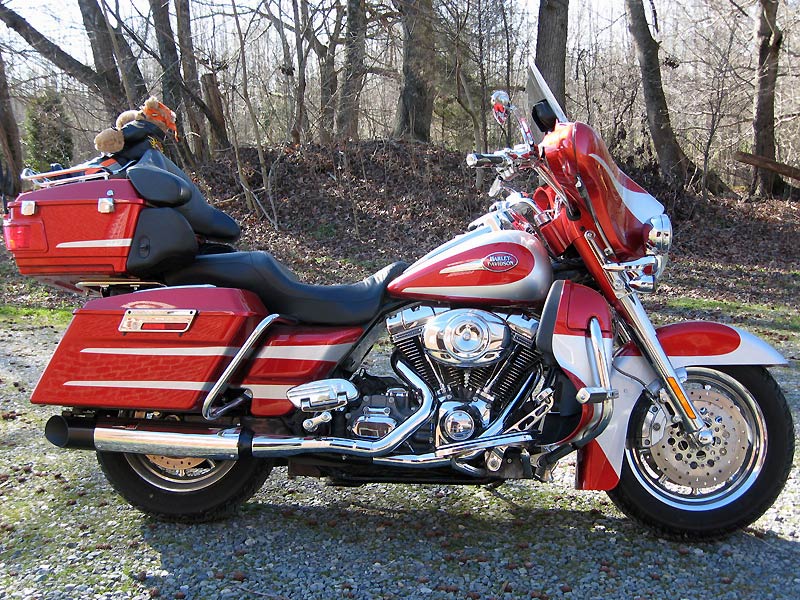
Customer Writes: "Wanted to send you pix of my new pipe after installation. Haven’t had a chance to dial it in yet, too cold for much riding! However I have done some. Fit and finish were wonderful. Already gotten several comments on it’s appearance. This system picked up the power tremendously! Really woke up all 110 CI’s. Bike runs smoother, and is very responsive. Once it warms up here to the point I can actually get the engine warmed, amazing how cool they run when it’s only 11 degrees, I’ll send you more info. Till then, thanks." Don.
00-1367 LSR 2-1 Pro Stock Spyder in Black Ceramic (Dual Coat, black on top of silver) with chrome heat shields. We kept the primaries on the 110 CVO at 1 3/4" to provide more torque.
Typical mounting instructions for Evo/Twin Cam Dressers.
Stock 103
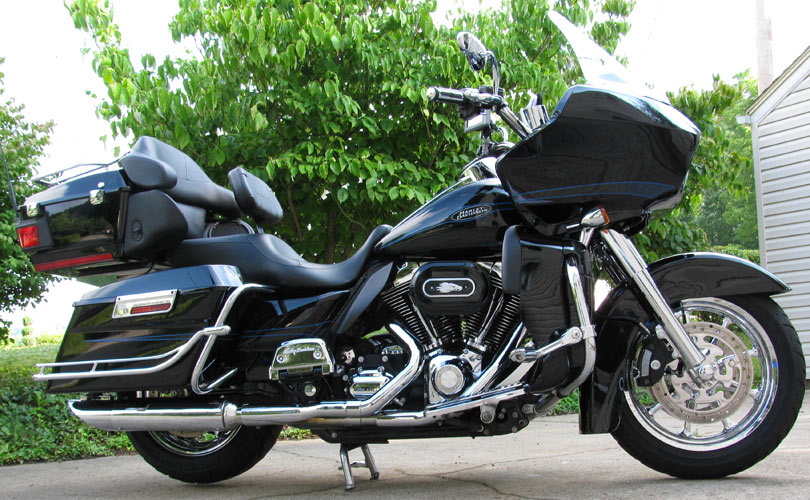
Customer writes: "There is a picture attached of the bike after the installation and it is very telling of the change. The installation dropped the weight of the exhaust system a few pounds by doing away with the left side muffler and crossover pipe and it achieved what I wanted to do by giving me better access to the Harley Davidson center stand that I had installed when I bought the bike. The system also shortened the exhaust tail section by ending at the edge of the saddle bag rather than protruding to the end of the fender, giving more curb clearance in length and height. The sound is great and it doesn’t attract the attention of the law dogs like most of the after market systems do. It looks like it is a full muffled system because of the size and shape of the can and shields and unless I’m into it hard it is grudgingly acceptable to the highway patrol (road nazis as our county sheriff enjoys calling them).
And to top it all off, it looks marvelous, pronounced MAHHHVULUS! (you know, the Billy Crystal line). I have had some of my gear-head buddies wanting to know where I got it and what it cost, kinda like having a steak sandwich at hotdog stand you know what I mean? Anyway, I'm pleased with the outcome and service you folks provide. I know I bothered the shit out of you to get this thing but you put up with it and made me happy with my big black bike again, thanks. I will send better pictures in digital format on a cd as soon as I get around to making one, I'll make a little video with sound just like the the big kids do so in case you want to use any of it as a satisfied customer statement you will have it. Yours, John "
00-1367 in chrome.
2009 and later Models Covered
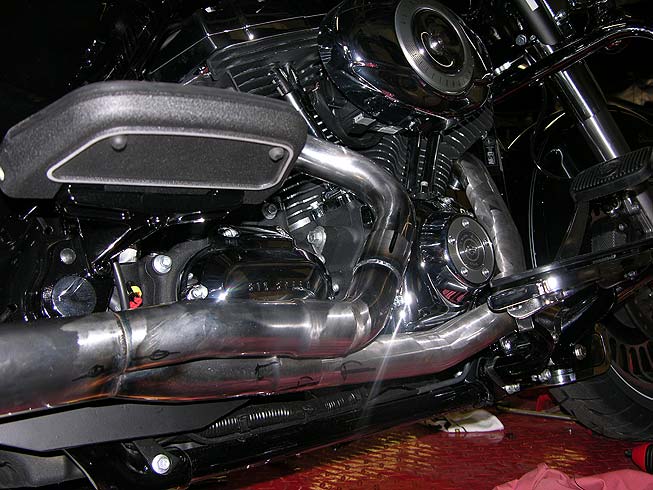
Frames are changed. Floorboards are changed. We have prototyped the 2009 models and are shipping orders. We build to order. Options on tail section and four separate finishes. 00-1367 Pro Stock Spyder shown.
Typical mounting instructions for Evo/Twin Cam Dressers.
2009 FXDF
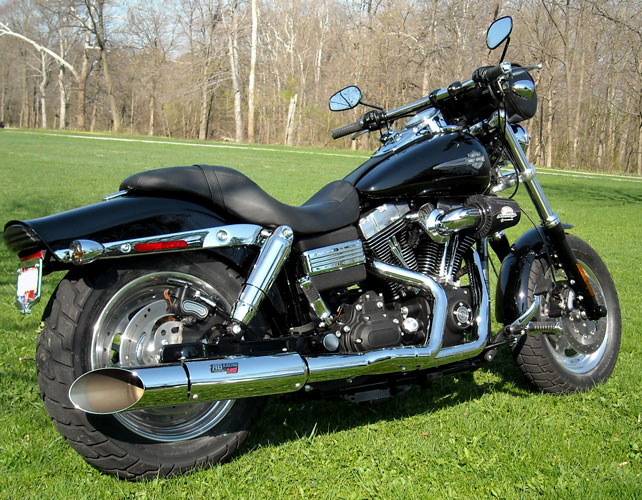
Customer writes: "RB Racing...here are a few pics. I hope to see one on your web site, perhaps a few of my friends and co-workers will see them & drum up a little extra business for you and your company. Thanks for the high quality, great performing, and sounding pipes! Rick."
00-1375 LSR 2-1 Pro Stock Spyder 1 3/4" with heat shields in chrome.
Hand Made Pro Stock Merge Collector
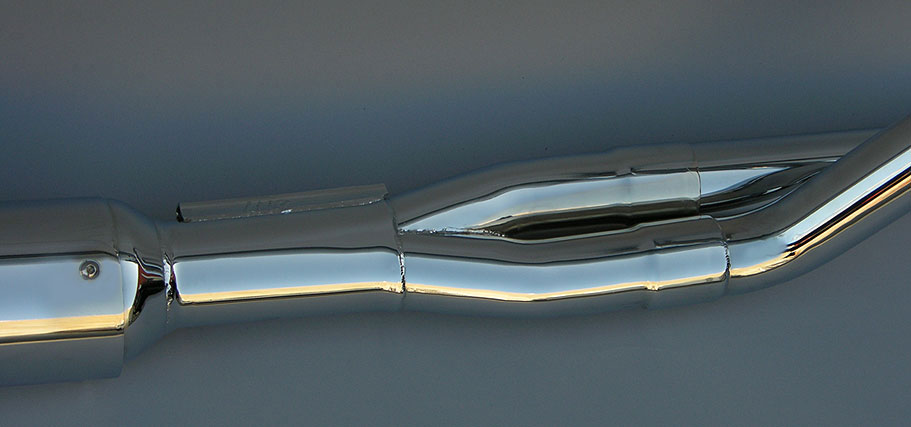
From exhaust port to the collector area this is a pure LSR 2-1 Pro Stock exhaust system for the highest velocity and peak scavenging at the exhaust valve. We mate this to a special version of our low restriction, noise-cancelling LSR 2-1 Black Hole technology. Not as quiet as a LSR 2-1 Black Hole system but a pure racing system quiet enough to get you by the man.
Softail LSR 2-1 Pro Stock Spyder
00-1345 LSR 2-1 Pro Stock Spyder, 2" Style C. This system headed for a 124" S&S motor. Bigger motors like these can use 2" primary tubes. It's all about the timing of the pulses to the merge collector.
Silver and Dual Coat Black Ceramic Finishes
In case you are interested,
here's the drill for Silver Ceramic coating. Bend the parts.
Pattern cut the parts. Polish the sub parts. Tig weld and
hand fit the merge collector. Tig weld the assemblies in sub
fixtures. Drive the parts to the coater. Coater bakes the
parts, then cleans the parts to remove any internal residue.
Coater blasts the parts, cleans the parts again and applies
a Silver Ceramic coat and lets the parts dry and bakes the
parts for a second time. Coater then tumbles the parts in
large vats to burnish (harden) the surface. Then the parts
are hand polished.
In the case of Dual Coat Black Ceramic the coater bakes the parts, then cleans the parts to remove any internal residue. Coater blasts the parts, cleans the parts again and applies a Silver Ceramic coat and lets the parts dry and bakes the parts for a second time. The next day the parts are sprayed with Black Ceramic and baked a third time.

Nightmare After X-Mas
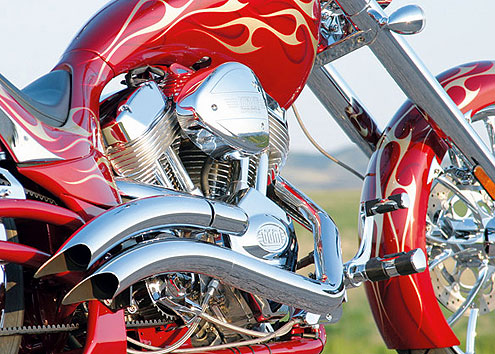
TV, Jesse James, Orange County Choppers, biker build-offs, master builders. Art is cool but when the cold winds of reality blow you get back in your pickup truck. No way to make a fashion statement quiet enough to avoid tickets and get you where you want to go. Great for the short putt to the bar or HOG meeting where you can bask in the glow of your "I saw it on the Discovery Channel and now I have one". We like art and sculpture and Dali would approve of the drooping exhausts but that's not why we build things. Noise, loss of torque, tickets...well, we make pure race pipes and will give you back your torque if you'll take take the the other two with it.
LSR 2-1 Pro Stock Spyder systems offer an alternative. Power and performance with an acceptable amount of noise. We try to factor in art as we are violently opposed to ugly. Beauty as they say is in the eye of the beholder.
True Duals and Aluminum Butt Plugs
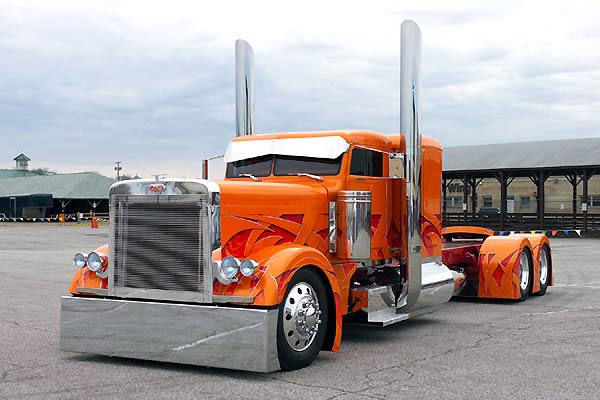
Customers ask us why we don't make "True Duals". While the name has a certain ring to it, with "True" sort of impugning everything else you might consider. Well, we won't make things that don't work, like dual pipes, dual pipes with aluminum butt plugs, or even a falsie left pipe that does nothing. Now, we like Fishtails, and all sorts of things like that which are traditional and pretty. We just aren't going to make them.
Customer writes: " Hello RB Racing ! Just wanted to drop you a note to say THANK YOU, THANK YOU, THANK YOU!!! I changed the pipe on my Roadking from a popular name brand "TRUE DUAL" to your LSR 2-1. Had the bike dyno'd yesterday and what a difference, The HP number jumped from 82 HP to 89.95 (call it 90) and the torque number jumped from 96 ft lbs to 102 ft lbs. Nothing else was changed but the pipe. Anyone know some one looking for a set of used true duals? While those numbers aren't huge or record setting they are much, much better. In addition, the bike runs tons better, no more cracks or pops and runs smooth as ever at RPM. Again , I can't thank you enough for producing a product that meets the need and not necessarily a product that boasts bragging rights that are unsubstantiated. Mike".
Baffling Alien Discs
and Aluminum Butt Plugs 
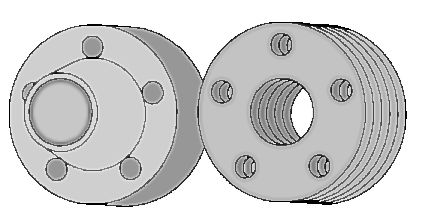
Our testing has shown that the Harley V-Twin is extremely sensitive to back pressure which is why 2-1's that use small or restrictive collectors don't breathe well, and why restrictive baffles shut the motor down. Disc type baffles are good for spark arrestors on dirt bikes but they have no place on a big inch V-Twin. You don't make power by adding restrictions to your exhaust system whether it's a bunch of stainless discs or some damn piece of aluminum billet machined into a Harley butt plug! Ever wonder why they had to put a hole up the center of the discs? Well, one reason was the discs are so damn restrictive you have to have several pounds of them to get enough flow through their waffle shaped passages. Good mufflers, but they have nothing to do with performance and they sure as hell do not create vacuum as has been claimed.
When you get confused by all the bullshit simply ask the following question.." Do they run them in NASCAR or in Formula One?". Nope, they run straight pipe collector systems without any stupid discs or aluminum butt plugs. It's always funny how, when the money is on the line, all the little things like discs, billet caps, anti-reversion flaps, reverse megaphones and other such nonsense somehow don't make the field. Black Hole technology does not involve stupid eye candy or outdated, or just pain dumb, ginger bread.
Dynos...We don't ride dynos
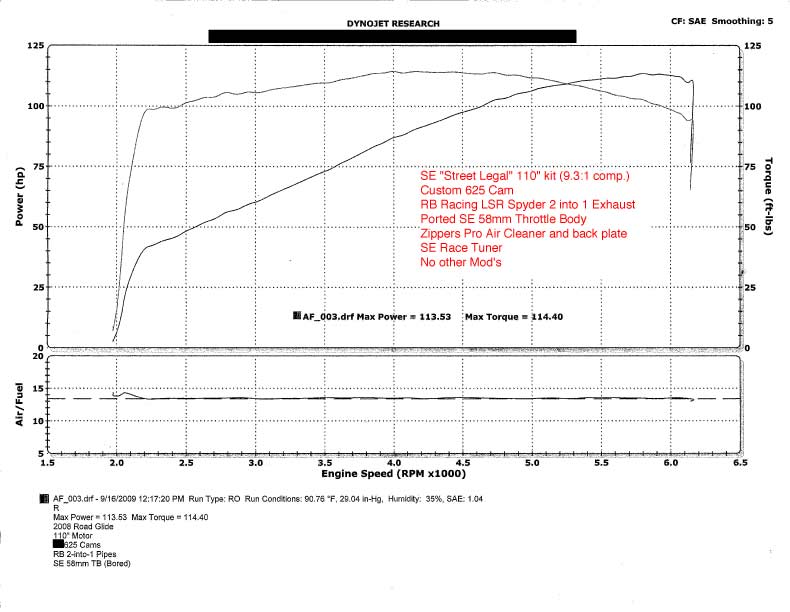
Customer was happy with these results from his 00-1367 LSR 2-1 Pro Stock Spyder. Enough power to get down the road. Not a 250 hp turbo but enough to zip a heavy 850 lb sled around a semi truck going 70 mph.
New Dual RSR O2 Meters
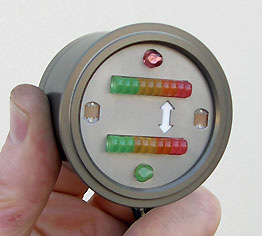
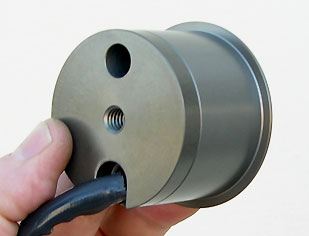
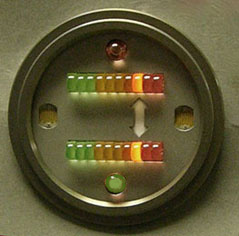
For OEM Weber/Delphi EFi sequential injection our new RSR Dual Air Fuel Gauge displays the fuel mixture in both the front and rear cylinders separately. The gauge is housed in a hard anodized round enclosure in a standard 2" format with a 2.250" bezel, center back mount, with a 5/16" x 18 stainless socket head cap screw. The gauge will show fuel ratios from 17:1 to 12.0:1 (or richer). The gauge is visible in daylight and automatically dims for nighttime operation.
Scale is, left to right, lean to rich: three greens, three yellows, two orange and two red l.e.d.s.
The white arrow indicates the maximum power mixture, the second orange light, which is 13.2:1. Transitory enrichments should not, if the engine is warm (>200F Oil temp), go past the first red light. Readings at the far right side of the scale, the second red light, are simply too rich. Proper closed loop operation will cycle back and forth from green to orange around the center of the display.
It is simply the best way to evaluate the tune of your motorcycle and saves valuable dyno time. Mounted permanently. Waterproof.
Compatible with OEM narrowband sensors. Can be supplied with new high temperature Bosch narrowband sensors. Far right photo shows gauge in dim light conditions at maximum power setting.
Digital Gear Indicator and Dual Air Fuel Ratio Gauges
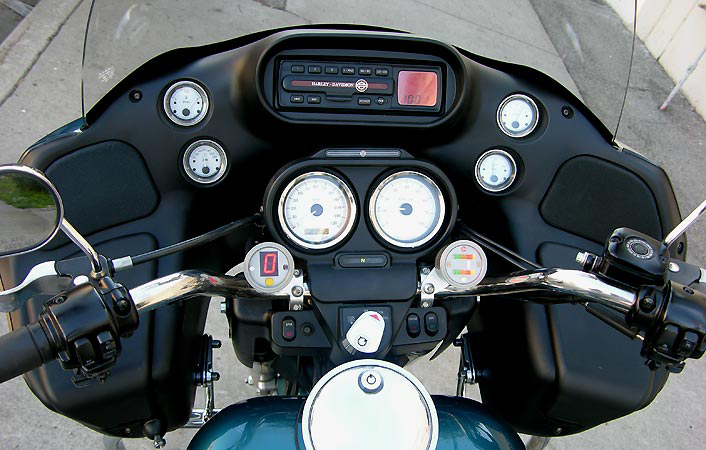
A useless air temperature gauge and tiny warning lights...whatever happened to black and white gauges? Well our RSR Bonneville Digital Gear Indicator and our Dual Air Fuel Ratio monitor actually do provide useful, easy to read, information. Knowing what gear you are in and what your engine is actually doing in front and rear cylinders is a lot more important than knowing what the air temperature is...After all, you are sitting directly in the airstream so the air temperature is no mystery.
Road Toad...The Movie
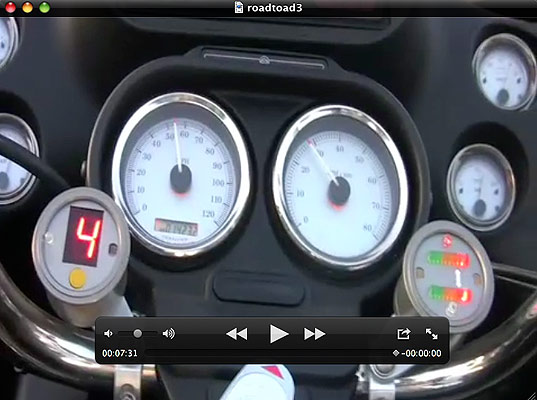

Harleys vibrate. Next time we'll make a better camera mount. Video shows the gear indicator in action on a 5 speed 2004 Road Toad as well as our RSR Dual Air Fuel Ratio Gauge. We made a few edits to the TC88 ECM for our LSR 2-1 Pro Stock Spyder exhaust. Gives you an idea of how we tune things by actually riding them and how useful the Bonneville Gear Indicator is.
Get a tub of popcorn and a six pack and watch a 2004 FLTRI find happiness going through the gears. Make your own movie and get some more popcorn and beer and show your friends how you hit redline in sixth gear. At Bonneville we run five gears but we have a 425 hp Harley...and a lot of beer.
All RB Racing LSR exhaust systems come standard with a machined and heliarced oxygen sensor boss just below your front exhaust port. This port is designed to accept and oxygen sensor (18mm x 1.5mm) which will allow you to use our RSR Air/Fuel Ratio Meter to tune and monitor in real-time your air/fuel ratio. Also, if you really wish to get 55mpg and kick ass, our RSR Fuel Injection's closed-loop heated O-Sensor will plug directly into this port.
S&S Twin Cam Oil Pump
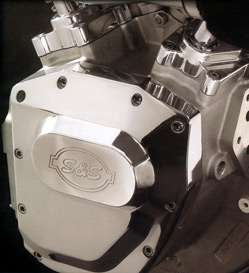
If you are running one of these and want a "C" Style Exhaust for your Twin Cam engine let us know as we have a different type "C" Style exhaust that fits these pumps. If you are running a normal cone then there are no fitment issues. Our regular "C" pipe goes up close to the original cone. In the case of the S&S pump pictured above we have to route the rear pipe differently due to the "block" shape.
"B" stle LSR 2-1 Pro Stock Spyder pipes will clear this billet parts.
New Exhaust Tech Section
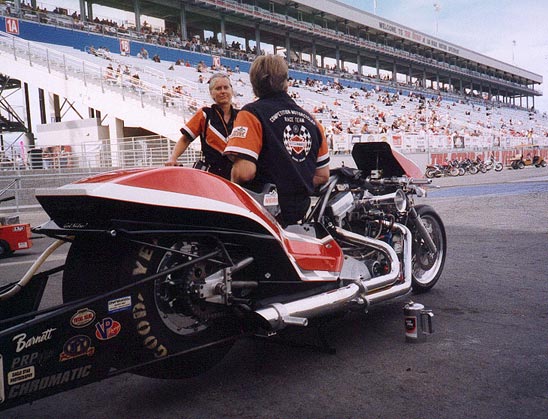
We have given a bit of an overview on the design of Harley Davidson exhaust systems for those who have questions about primary tube length, tube diameters, collector design and the pulsations and wave timing in a V-Twin engine. 800 hp 2-1 Top Fuel exhaust pictured with 214 mph in 1/4 mile results. Carl and Lesa Pelletier of Competition Motorcycles.
There is also a discussion of ceramic versus chrome finishes and what are the advantages and disadvantages of these from a realistic standpoint.
LSR 2-1's Bonneville, Dyno &Track Proven
If you want to make power on a multi-cylinder engine you have to use a collector system. Whether it's a V-Twin or a V-8 it's the same not using free exhaust energy to help your engine breathe is downright criminal. No matter what the conventional wisdom is, staggered duals on a Harley will not make more power.
You simply cannot escape the fact that a properly designed 2-1 will give you more useable torque where you need it, in the 2000 to 4000 rpm range, which means less downshifts and less rpm to get the job done. A set of short staggered duals at peak rpm can be made to produce good power but they will be dead on their ass until they get there, whereas an engine developed around an LSR 2-1 exhaust can be made to perform from the bottom up with no dips in the torque band!
Self-Tuning Myth

People have the idea that closed-loop systems are completely self-tuning and that they are going to sell you some add-on gizmo that will automatically tune your efi bike. This is a crock of shit. The truth is that every engine is different and, in the Harley world, difference is the norm as there are limitless engine build combinations.
In Detroit, Japan, or Germany, they spend thousands of man-hours developing base maps for their automotive applications. On top of these base maps goes the closed-loop feedback mechanism controlled by mathematical equations or algorithms that govern exactly how the closed loop operation will function. These base maps are not written so the vehicle will run perfectly without feedback i.e. maps are not designed for open-loop operation. The strategy for closed-loop operation is different as fuel requirements under different climatic and altitude differences can be as much as 30%. Unless the base map is constructed for the particular application, the O2 feedback mechanism will not work properly.
OEM correction schemes allow only very slight learning corrections or they will "throw" an error code. They do this for a very specific reason i.e. if things are going wrong, which is indicated by the system trying to correct out of bounds problems, then a sensor or something else is wrong. They are not designed to make large swings to correct calibrations that are way out of bounds. The base map must be designed for additive correction except at wide open throttle.
OEM Harley systems have a 15% correction ability. The trick is not that it adjusts...which it should, but that the underlying base map is correct for the changes you have made and then the system can correct within this 15% window.
Beyond Stupid
Some add-on boxes for late model O2 sensor equipped oem Harleys eliminate the O2 sensors altogether. Why in the hell would you want to take a self-adjusting, sophisticated system and turn it into a gas guzzling, low mileage, dumb efi system? Beats the hell out of us and, since we make closed loop efi systems, we do have some experience in this area.
You bike should be left in closed loop, tuned in closed loop and monitored with O2 displays in closed loop. Correction factors defined in the oem code cannot be exceeded. Maps have to be rewritten for the changes to the bike so the base map is in agreement with the oem algorithms.
Phone Sex and Remote Tuning

In some sort of logical disconnect a few customers call us up wanting us to tune their bike over the phone and then become increasingly indignant when we tell them it just doesn't work that way. Now, we spent the better part of 14 years, starting in 1976 working on carburetors, jetting, needle design, and even designed and marketed a flat slide carb for the Harley market. Thousands of man hours representing about 5 months out of every year were devoted to jetting issues. It got to be a real issue i.e. it was an interesting experience to define what the correct air fuel ratios should be, experimentally figure out how to measure them, and then deal with tuning die cast critters, often modifying them with extra circuits etc. but, in the end, it was temporal and an endless loop that did not exactly pay the bills.
We did learn how to make things run well, not that anyone appreciated it. It was fun to watch people try to beat you when they couldn't. Knowledge. Hard work.Stock 4 speed Harleys in the 12's at 103 mph, stock 2 valve 550's into the 11's, early 750's into the 10's and the first stock 1100's into the 9's. Does it mean anything now? Nope.
The only thing we suggest is that you use O2 signals to monitor and tune the system as the sensors are millisecond accurate and must be monitored at the exhaust port where temperatures are high and as far away from the outside oxygen rich air as possible. We suggest you use software, not hardware, to adjust your system using our RSR Air Fuel Ratio Gauges and keep your bike off of the dyno until the lights in these displays tell you your mixture is correct. Engines operate in a very narrow realm of air fuel ratios. If you want to go to the dyno after this...fine.
Just don't call us breathlessly demanding we tune your bike over the phone. It isn't going to work.
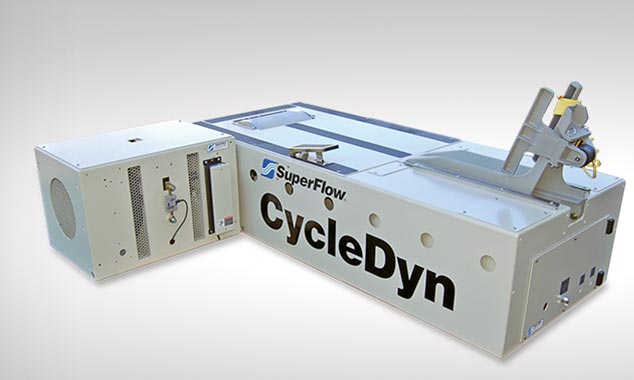
If you are going to use a chassis dyno it has to be a tool and not a toy. At RB Racing we use the Superflow CycleDyn as it best emulates the real world. We use it for development and not for publishing "dyno charts". Most of our work is with Pectel SQ6M controllers which have extensive internal datalogging and playback capabilities up to 2000Hz sampling rates. With the Superflow we can program specific tests and transient sweeps with our turbocharger systems up 750 hp in inertial mode or 500 hp in Eddy Current controlled accelerations.
For those of you who
like Dynojet "Dyno Graphs"..read
this article.
Steve Cole (TTS MasterTune) who has spent untold thousands of hours on every dyno imagineable has this to say about CycleDyns:
Steve Cole: "In the
development side what I can say is the SuperFlow when setup
properly emulates the real world much better. As an example
the only way to get a DynoJet to give you HP and TQ is a WOT
unloaded run. The SuperFlow allows that plus just about any
other combination you like with real torque output. So what
does any of it buy you becomes the question. I can tell you
that if we tune to a DJ and get the best we can, then repeat
on the SuperFlow using real world acceleration rates for the
engine being tested the results are very different. Take the
final calibrations and run them in both dyno's unloaded and
the DJ developed type calibration will show the most HP and
TQ in those conditions, on both the SuperFlow in DJ mode and
the DJ. Then take the SuperFlow controlled condition
calibration and load it in the bike the power will go up
when tested in the SuperFlow mode again which can only be
done on the SuperFlow.
Now the hooker, take the bike and put one of the finished
calibrations in it and give it to the customer and say go
ride it and come back after you've ridden it well, to know
how it feels/runs. They come back after an hour or so then
load the other calibration and ask them to do the same
riding over and come back again. Each and everytime we have
done this every customer has picked the calibration that was
done on the SuperFlow under the controlled acceleration
modes! So pick what works for you but there is a difference.
Does it take longer, does it end with a measurable
difference............. YEP!"
When we have turbo
bikes like our Road Glide Turbo
it gets a bit interesting to go testing in LA traffic with
police, cell phone cameras, and freeway cameras. We still do
real world riding with data acquisition as the real world is
where you ride.
People want "Dyno Sheets"...see below. We aren't going to test every damn camshaft, compression ratio, piston confguration, cylinder head etc as there is not enough money nor time to do so. However, we do testing for our own race development, R&D, and our personal development platforms.
Dyno Sheets

People call us all
the time asking for "Dyno Sheets" and we patiently tell them
we do not provide self-serving graphs predicting fantastic
horsepower and torque gains. Plenty of customers send us
dyno sheets but, as we've been at this a long time, we know
the tuning game is too complicated to provide numbers just
to sell an exhaust. Tuning is a multi-variable process.
When the EVO motors came out Jerry Branch published his famous manifesto on tuning 80" EVO motors...In short, unless you bumped the compression the horsepower was not forthcoming. Same these days. In 2014 John O'Keefe of Branch O'Keefe ran an extensive series of tests on OEM Twin Cam cylinder heads to see if he could offer a "less expensive" ported head as everyone with a grinder in his garage was suddenly an expert at cylinder head porting. John found out that any attempt to clean up the ports killed the flow and port velocities dropped. He scrapped that idea and kept his well-proven chamber modification, porting and valve replacement system.
Logic seems to be in
short supply when it comes to tuning. Tuning is not a pipe
changing exercise. The world these days is full of customers
who agonize endlessly over what to buy and then dump these
parts on some unsuspecting "shop-tuner" expecting miracles.
It just isn't going to happen. Coordinated development is
expensive and time consuming. If it was NASCAR developer
they might spend days searching for a few hp or a different
curve for a specific track.
If you are looking for warm cuddily sheets we are clean out of them. We are tuners and you can buy all the trick parts in the world and a guy with a well tuned mild bike with a good power to weight ratio will kick your ass. Real world. Find a good tuner or become one. Look in the mirror.
Soot
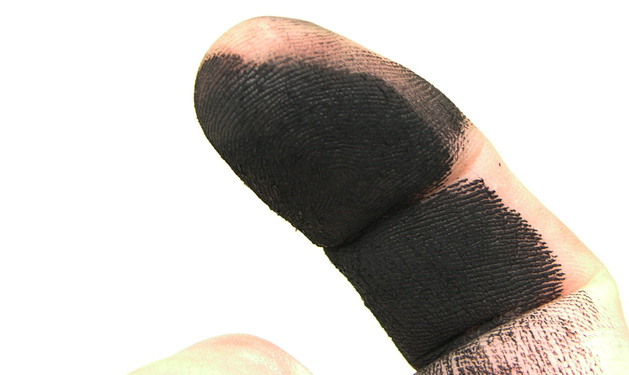
Whenever you look at an exhaust and see it caked in black soot you know the bike is not running or tuned correctly. Back in the mid 1980's we did a carburetor development program for Keihin Corporation for their 41mm CR Race carbs on both Shovelheads and the new Evolution motors. When we were finished the bikes got 56 mpg cruising and 46 mpg if you ran them harder...and after 500 mile tests the pipes were perfectly clean inside and the exhaust ports were dead clean.
If you take
the exhaust system off a modern Closed Loop BMW, as we
have, you will find them dead clean or whitish inside.
Harleys should be the same.
We always ask
what mileage people get from their "tuned" or modified
Harleys after "Dyno tuning"....The universal answer is
37 mpg or less. If they don't know, we ask them if
they have to gas at 100 miles. Most do.
Once a customer bought an exhaust from us and took his bike to two different dynos in search of the "117 Hp" he was looking for for his 103...He got 110Hp. After pissing and moaning we told the guy to give us our exhaust back and we found it caked in soot. So much for tuners and their tail pipe sniffers that see lean reversions...They just kept adding fuel. You tell the customer to put on our RSR Air Fuel Gauge to monitor the mixtures F/R in the real world...No, they want a "Dyno Tune". We have dynos...we know what they do and can't do.
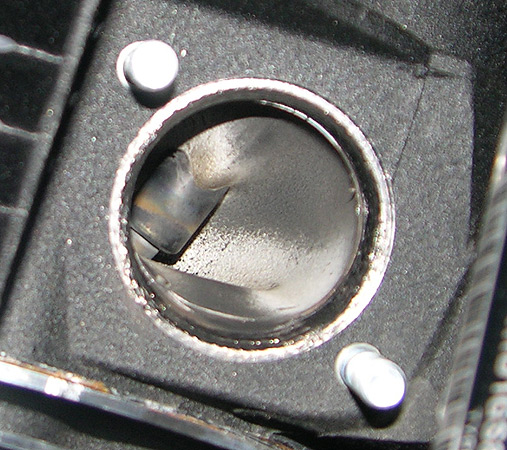
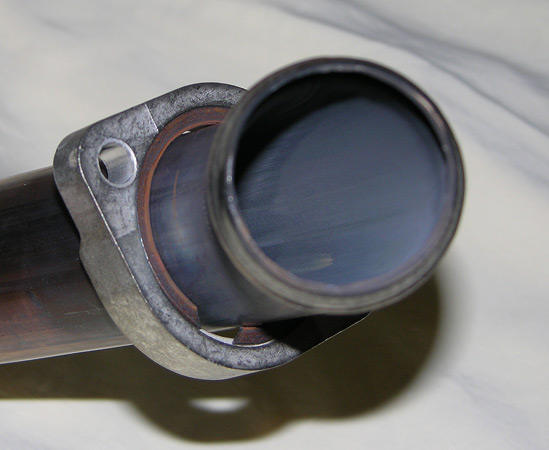
Pictured above is the exhaust port from a 2017 Dyna Low Rider S with about 100 miles on it. No soot. Delphi engineers seem to have done a very good job. Looks like the port you would see on a BMW. Now, when your "Tuner" gets finished with it, it will most likely be full of soot. Logic plays no part in people and their toys. EFI is complex...put in different cams, change air cleaners, port the heads and all this goes out the window. Brave new world.
No soot.
Fuel Injection..A Reality Check
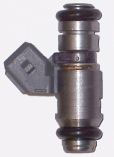
OEM Harley
Delphi Injectors come in various ratings: 3.91
grams/second; 4.35 grams/second; 4.89 grams per
second (CVO); and 6.00 grams per second. These
ratings are static i.e. shorted open. Pulsed static
is about 90% of this i.e. what you could expect if
you maxed them out in your ecu calibration software.
If you hold them to an 85% duty cycle they,
respectively, offer the following horsepower
potentials: 105 hp; 117 hp; 131 hp and 161 hp. Now,
you can squeeze more out of them by going past 85%,
but this is the point where they are still
controllable.
We get calls
from people building wazoo big engines and they are
still running the stock injectors. We suggest you
get the right injectors for your engine building
projects. We offer a several calculators for those
messing with efi systems. Fuel Injector Calculator
Professional Injector
Pulse width Calculator.

In 2010 FLT/H series went to the new small heated O2 sensors. The Dynas and Softails went to these in 2012 and the Sportsters in 2014.
We are tooled for these smaller sensors on all the newer models. The small O2 Sensor models have a floating ground voltage offset that has a complex scheme that varies the signal to meet emissions purposes. If you think you are going to trick these you are in for a surprise.
You must specify the year of
your motorcycle when ordering the RSR Dual O2 Gauge.
Models with OEM O2 12mm
sensors will already come with two additional 18mm O2
ports. Our RSR Dual Gauges will monitor the 18mm high
temperature O2 sensors we supply. It is the only method
to monitor both front and rear cylinders of your bike as
you ride. Real world observations to perfect your tune.
Better than a dyno which tends to overheat your motor
quickly skewing your tune.
18 mm ports are used on dynoa
with Bosch LSU Wideband sensors. We do not install four
18mm ports. If carbureted then one 18mm port in the
front cylinder.
RSR Air Fuel
Ratio Gauges...Dyno on your Bike
The Mother of all gauges! Not a gauge, but a precision tool that will tell you exactly what your engine is doing in real-time. Gives you instantaneous read-outs of air/fuel ratios from 17:1 to 10.5:1 and indicates maximum power ratios. Four color display is easily read in direct sunlight and automatically dims at night. Waterproof, billet aluminum construction. Your significant other will cheat on you but this gauge will never lie! It won't keep you warm at night, but a perfectly running engine will look and sound the same when you wake up next to it the morning after.


Single RSR O2 Gauge: Reads the front cylinder in non-efi models. It is simply the best way to evaluate the tune of your motorcycle and saves expensive and often inaccurate dyno time. Real world tuning while you ride...Observe and then make adjustments. Mounted permanently. Waterproof.
Mounts....Roll Your Own or Buy One
The gauges have a center back mount 5/16" x 18 x 1/2" Stainless Socket Head Cap Screw and stainless lock washer. You can fab your own bracket for this or use the 06-1025 hard anodized Billet Mount System for either 1.00" or 1.25" handlebars $49.95. Optional is the 06-1024 two piece laser cut 304 Stainless Steel mounting tabs for either near handlebar clamp or up the handlebar mounting: $9.95.
Since we have
been doing closed loop fuel
injection systems for Harleys for more than 30
years and have been putting O-Sensor Ports in our
exhausts for the same amount of time, we have both
single and dual O2 ports for our full range of exhausts.
Our RSR Air Fuel Ratio Gauge is
the best investment you can make for monitoring and
optimizing your engine tune.
All LSR 2-1
exhausts come standard with one or two O2 ports
(Sequential EFI models)...18mm or 12.5mm. O2 or Lambda
sensors are a necessity for either carbureted or non
closed loop efi (Weber Marelli and Early Delphi)
Harleys. We should know, as we have a lot of experience
with them and have been doing Closed Loop EFI systems
since 1989.
The Single and Dual gauges ship with six feet of MIL-W-22759/32 wire. The first 24" is Raychem DR-25 sealed on both ends. If you wish to have a connector at the 24" point there is a $50.00 charge to install either six position (single gauge) or eight position male/female Deutsch DTM connectors with Raychem DR-25 sleeving.
The gauge is housed in a hard anodized round enclosure in a standard 2" format with a 2.250" bezel, center back mount, with a 5/16" x 18 stainless socket head cap screw. The gauge will show fuel ratios from 17:1 to 12.0:1 (or richer). The gauge is visible in daylight and automatically dims for nighttime operation. Only a single L.E.D. illuminates.
Very easy to interpret at a
glance. Scale is, left to right, lean to rich: three
greens, three yellows, two orange and two red l.e.d.s.
You simply cannot "read" spooling digital numbers.
The white arrow indicates the maximum power mixture, the second orange light, which is 13.2:1. Transitory enrichments should not, if the engine is warm (>200F Oil temp), go past the first red light. Readings at the far right side of the scale, the second red light, are simply too rich. Proper closed loop operation will cycle back and forth from green to orange around the center of the display.
It is simply the best way to evaluate the tune of your motorcycle and saves valuable dyno time. Mounted permanently. Waterproof.
Whether your
bike is carb or efi this is the best way to tune...By
riding and observing, not on a static dyno. Dynos are
not exactly real world in terms of loads, airflow, or
transitionals, and even if you had a million dollar AC
Transient dyno room, you would still have to do real
world testing. The gauges are dead accurate and are
millisecond fast responding which makes it very simple
to interpret or remember, even at a glance, while you
are dodging cars watching for cops. We have a Superflow CycleDyn which gives
a better real world correlation than other dynamometers
but we still evaluate air fuel ratios when riding.
Anyone who tells
you optimizing tuning is easy is full of shit. Engineers
at Ford say they spend two years just perfecting tip-in
or initial throttle openings. Ride, observe,..then
change or edit. Real world.
Pretty soon Harleys will all be watercooled then you really won't be able to tell the difference between Milwaukee and Hammatsu. "The Man" will be sniffing your butt and planting microchips and gps modules up your ass so they can mail you a speeding ticket and keep track of your movements. They already have data recorders on your car so they know what you were doing when the biggie happened. Brave new world. Monitor your engine to get the most out of it before the NSA monitors your tail pipe.
RSR Air Fuel Ratio Gauge: Customer Comments
Customer writes: "When the gauge arrived I knew it would be of a very high quality, it has far surpassed my expectations. I was very eager to get this installed and take a look at my tune. Amazing to see how little adjustments on the carb effect the AFR. As a result of this gauge, I have dropped one size on the low speed jet, raised the clip on notch and confirmed the main jet on my Mik48. Thank you, I really like this gauge. Ed"
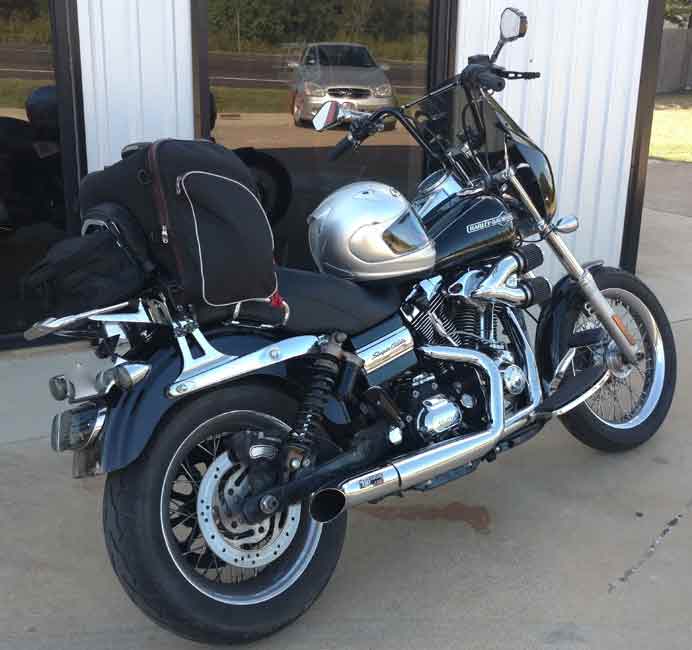
Customer writes: "Sounds like a FAST Harley! Revs quicker. Everyone that knows the bike immediately notices how the engine has better throttle response now. One blip of the throttle is all it takes to spark envy. It has a noticeable volume and powerful sound on acceleration complimented by a smooth deceleration growl. Cruising volume is somehow arguably quieter than the V&H slip-ons that were on the bike previously. The chrome is flawless. Packaging was excellent. It’s amazing how spot-on the fitment of the slip joints are. The mounting bracket is perfect in form, fit and function. Everything eases into place with a slow methodical hand. Don’t force or rush the installation and you will complete it without frustration. I bought the Dual AFR meter at the same time as the pipe. I cannot imagine an easier way to tune with my TTS MasterTune! I was able to actually improve the tune and power while maintaining 43 mpg. Thanks! Ryan"
Torque and Ruby Slippers
People get pissed at us when they ask
for "numbers". We always tell them we "don't know" because after
nearly 33 years of tuning and racing and designing we have seen
too much and done too much to give any placebo answer. In fact,
it always depends on the bike and the tuner. No two bikes are
alike. Maybe your bike was built on a Monday and they left a
coke bottle in the gas tank (old Detroit wive's tale)...Some
bikes are faster than others. Everyone believes their bike is
"faster".
It depends on the tuner and, these days, the bikes are more complicated. People change from chain to gear drives. They put on different cylinder heads. They switch cams. They add on tuning twiddle boxes. They tune, or the "shop" tunes. They "dyno" the bike...maybe even somebody rides the bike with instrumentation like our RSR Air Fuel Ratio Gauge.
People call us up then hang up when we tell them we don't know what their "gains" will be. We don't publish self-serving charts. We just take all the experience we have and build the best parts we can. People end up happy who buy the parts because they are well made and are designed to perform. We make different tube diameters and offer a wide range of systems for any particular bike so you will maximize your potential. There is no "One Size Fits All" at RB Racing.
People who don't buy the parts because we won't coddle them with assurances go elsewhere where Aunt Em will tuck them in and tell them what they want to hear.
Note: All LSR exhausts require the use of the early style chrome die cast OEM flanges and circlips. RB Racing chromed billet flanges and clips are part number 00-1002 for one complete set. The Harley die cast part numbers for these flanges and clips are: 65328-83 (exhaust ring clamp) and 65325-83A (retaining ring). S&S Cycle SA or B2 (145" Tribute) cylinder heads require four bolt flanges which we provide and are part of the pipe assembly captured by or Special Application Venturies.
FXR: There are FXRs and then there are aftermarket FXRs like Kenny Boyce frames and a variety of "Rubber Mounted" pro street and quasi-Softail designs. For all of these we provide a 1/4" steel plate that bolts to your transmission. The bracket is slotted to allow for variations in engine mounting and has a selection of dowels that take into account the different transmissions available. The bracket attaches directly to the back of the LSR 2-1 pipe, which has a slotted bracket heliarced to the pipe. The bracket does not interfere with billet aluminum swingarm pivot mounts like those on Kenny Boyce frames or other aftermarket pivot mounts.
Early FXR(P) police models with floorboards don't fit many pipes. Best bet is to install forward controls or mid pegs on this particular model...then regular part numbers apply. To fit LSR 2-1s to these ex Police models with floorboards it will be necessary to cut and modify the rear floorboard support (splined peg mount to floorboard bracket) for clearance on the pipes. FXRT models had mid pegs and pose no problems.
FLH/FLT/Road King : Dual mount: transmission and saddlebag. 1/4" laser cut steel plate dowel mounted to transmission. Oem rear saddle bag mount are used. Remove any oem brackets for the front pipe beneath the nose cone. If you are running a Baker 6 speed they are wider and we have to shorten the transmission mounts by 1/2".
DYNA (Evo) : Transmission mounted. 1/4" laser cut steel plate dowel mounted. No oem brackets are used. Remove any oem brackets. 00-1281 2" C Style for a 145" S&S Tribute motor pictured.
DYNA (TC88) : Transmission mounted. 1/4" laser cut steel plate dowel mounted. No oem brackets are used. Remove any oem brackets.
Softail (All) : Pipe bolts directly to frame via 3" wide heavy steel "Z" bracket. No oem brackets are used. Remove any oem brackets.
Evo Sportster: Laser Cut steel bracket replaces oem bracket (all rigid mount models). On rubber mounted models we supply a transmission bracket that supportes the mid part of the rear pipe. On these models remove the large oem bracket which requires the removal of the rear final drive cover aft of the transmission. #30 Torx required to unhook rear brake rod. 2004 Rubber mounted engines require early style exhaust flanges as the 2004 flanges are too thick for our turbo venturies.
Mounting Torques
For flanges and mounts we recommend 15 foot pounds of torque. On exhaust flanges you do not use any locking compound as our nuts are self-clinching. On bolts for frame and engine-mounted brackets we recommend that the threads be clean and that a low grade (Blue) thread locking compound be used with 15 foot pounds of torque. Bolts and nuts on our slotted brackets do not require a locking compound but can also be tightened to 15 foot pounds.
In lieu of torque wrenches do not overtighten exhaust flanges to the point where they bend. In the case of bolts going into transmissions and into frames also do not attempt to see how strong you are as aluminum threads and bolts are weaker than you and your wrench are. Simply tighten things till the bolt stops and give another partial turn to firmly snug it. The last bit of tightening actually stretches things a bit and the tension holds things tight. Tightening should always be done in a sequence. Never finally tighten one part then go to the next...Always loosely tighten things in sequence and then finally tighten things in sequence.
The exhaust should never be installed with any of its elements in tension. It has to rest in place without strain and be tigtened without strain.
We employ split lockwashers on most fasteners to prevent counter-rotation. This works surprisingly well if the bolt is properly torqued or tightened.
In any case, you have a responsibility to tighten things or at least check periodically as part of your normal maintenance. Harleys do shake and try to kill anything attached to, or even near them. If things get loose the additional shaking moment can break bolts and destroy threads.
General LSR 2-1 Installation Sequence
1. Remove the OEM exhaust and exhaust bracketry. If the bike has floorboards remove the right floorboard.
2. Pry the OEM exhaust gaskets out of the exhaust ports. We use billet gaskets instead.
3. Install the frame or transmission bracket provided. Use Blue Loctite on the mounting bolt threads into the transmission. Lockwashers under the bolt heads on the transmission mount. If through-bolt like on early rigid Sportsters or Shovels use lockwashers under the hex nuts.
4. Front and Rear
primary tubes: Install billet flanges and clips. Install
front pipe loosely with billet gasket and nuts provided.
Loosely affix the front heat shield to the pipe as you
might not be able to install the shield later with the
rear pipe in place. We use 1/4 drive ratchet plus
extensions and 3/8" socket and a 3/8" wobble for the
exhaust stud nuts.
5. If the rear
pipe has a slip joint (rubber mounted C Style) slip the
rear pipe into the tail section. You may use Permatex
ULTRA BLACK.
6. Begin slip of tail section/rear pipe into the front exhaust slip joint (You may use Permatex ULTRA BLACK) and work the rear exhaust and billet gasket into the exhaust port. Loosely affix exhaust stud nuts provided. We use 1/4 drive ratchet plus extensions and 3/8" socket.
7. Slide 5/16" x 18 bolt(s) into slotted bracket on back of exhaust and thread these through the mounting braket. Loosely affix with lock washer(s) and hex nuts provided. Some exhausts may require a spacer (provided) between the exhast slotted bracket and frame/transmission bracket.
8. Gently tighted up all fasteners and nuts. Nothing can be in tension. You may use a rubber mallet to seat the slip joint(s).
9. Install
remaining heat shields and tighten front heat shield
(5/16" Nut driver). Completely wipe the pipe and shields
down with a clean cloth to prevent grease and oil stains
from being baked on.
10. Run bike
briefly in place. Let it cool down and retighten
fasteners. Reinstall the right floorboard with hardware
provided.
11. If ceramic finishes it is wise to go through several heat cycles. On modern efi closed loop systems they go into closed loop within minutes. Let bike idle for a few minutes then shut it down to let it cool. Several sessions of this will cure the resins as they are only oven-fired to 400F. Exhaust temperatures are >1000F.
12. Double check all fasteners and ride the bike. Check your work afterwards. You bought a Harley so you are already showing signs of dementia.
Bonneville Proven
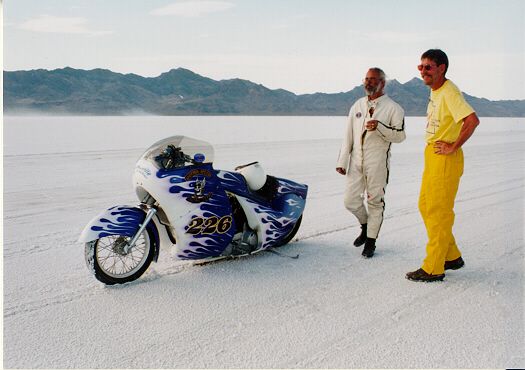
LSR stands for Land Speed Record and that means only one place...The Bonneville Salt Flats, the Great White Dyno. We have the only gas powered street legal bikes over 200 mph and we're damn proud of it. RB Racing doesn't race typewriters, we race motorcycles and when someone says they get a 70% gain from their system, ask them for their 200mph Bonneville Records or any records for that matter. Hell, if we raced typewriters it sure would be a lot easier, not to mention cheaper.
The technology we use with our turbos equally applies to our exhaust systems. Turbos don't make more power with excessive exhaust backpressure and normally aspirated exhausts don't like restrictive mufflers either. These are just antiquated 100 year old air compressors and they need all the help they can get.
New Cloisonne Tags
We place an LSR tag on each exhaust system we
make so they can be easily identified. Every now and then over
the last twenty plus years someone decides to copy one of our
designs, usually because some customer is very happy and he
"stirs up the pond". They copy the general look but not the
features that make them work. The tags eliminate any question
about whether it's an RB Racing design or not and allows
people admiring your bike to know the pipe's origin. The tags
have proven to be very popular and have been used since 1992.
Every now and then someone asks us to not place the tag on their system to which we answer..."send us an affidavit certifying that you have removed all manufacturer logos from your tires, engraved Performance Machine logos from your brakes, Mikuni or S&S identifications from your castings, Harley identifications from your gas tank, Nike logos from your tennis shoes etc. and we'll consider it". The last guy we let talk us out of this was getting his bike in Hot Bike magazine and said he'd give us "credit" for a one-off pipe we designed. When the magazine appeared on the newsstand all we saw was "computer designed pipe by Sands Racing". That was the end of that.
Like in the adage "The relentless search for perfection" we have upgraded the logos we put on our LSR Exhaust Systems. Previous tags were stamped and formed aluminum with silkscreened details. The new cloisonne tags are a precision die struck brass, nickel plated, with powdered glass fired in an oven then polished to a jewelry finish. These are direct replacements for our older tags and are available for US $25.00 postpaid via US Global Express (foreign) or Priority Mail (domestic US). They come with black headed rivets and are riveted in place with a light coat of high temperature silicone (Permatex 598B) behind the tag.
Performance Built In...Exactly, For Each Application
Our competitors must think you won't notice that they neck their 1 3/4" to 2 1/4" pipes down to as small as 1 1/2" to mate them to your exhaust ports. RB Racing's Turbo Venturies are expertly heliarced to each primary tube eliminating any internal obstuctions and insuring the maximum flow from each exhaust port. RB Racing won't build phony performance pipes...We sure as hell won't ask you to port your heads, put in bigger valves and a high performance camshaft then stick a bunch of stainless steel discs or machined aluminum butt plugs in the pipe to restrict the flow! And we damn sure won't put some silly "1950-ish" reverse megaphone pipe with internal flat plates, baffles and air foils to screw up your performance. Our pipes make anywhere from 6 to 18HP over these stupid designs. From the Turbo-Venturies to the exit of the pipe our pipes outflow all other pipes on the market. Pictured above is a 00-1261 LSR Black Hole 2-1 for a Dyna TC88, Style C, 1 3/4" shown without heat shields.
For those of you who bought the slip in "torque cones"....Throw them in the trash.
Our CNC machined Turbo Venturis are not compatible with the "bowl-shaped" late model OEM exhaust port gaskets and require early style "flat" gaskets for the LSR Exhaust Systems to both fit and seal properly. The narrow machined flat face of the Turbo Venturi must seat against a flat surface, not the bowl-shaped late model gaskets. Using the LSR Exhausts in combination with the wrong gasket will cause misalignment, inability to tighten the provided close tolerance aircraft nuts, and will force the bowl-shaped gasket into the exhaust port. The correct woven style gaskets to use are: Harley OEM 65324-83 or Drag Specialties DS 174742.
Customers have asked us to include our billet gaskets with each LSR exhaust system as it is a hassle to search for the correct flat woven, early style gaskets and they cost the same as our superior billet gaskets.
Mandatory for a nominal charge of $9.95 are a pair of our LSR CNC machined gaskets which mate perfectly with our Turbo Venturies. These are proven in over 16 years of use on our race and turbo applications...the only gaskets that will stay in a turbo bike for 25,000 miles! These gaskets prevent any gasket "creep" into the exhaust flow and are one more thing that will give you "an edge" on the competition. We always wondered why people would port their heads, put in bigger valves and then squish the gaskets into their exhaust ports. We bet you never paid attention to what was going inside your exhaust ports for one very simple reason...you can't see what's going on in there once the pipe is tightened! The LSR CNC machined gaskets also insure perfect alignment of the exhaust system. Most fitment and alignment problems are traced to using either the wrong type of gasket or using old gaskets that have taken a "set". We've always used these on our race applications and it's time everyone who's concerned about performance should do the same.
Goo
RB Racing LSR 2-1 exhaust systems use either one or two slip joints depending on the model. We suggest you put a coating of Permatex 598B ULTRA BLACK in the slip joint. None of our slip joints use any clamps because then they wouldn't be slip joints anymore. The inner pipe gets hotter that the outer pipe and they grow into each other and form a tight seal. The 598B is a non hardening gasket material and will prevent any leakage from condensation that forms in the pipe and, with the usual carbon particles, will actually seal better over time. It also makes the pipes easy to take apart later on. Get a tube before you install your RB Racing exhaust system.
All LSR 2 into 1 exhausts require special close tolerance aircraft nuts to bolt the LSR Turbo Venturies to the exhaust port. Standard 5/16" x 24 hex nuts will not fit. Each exhaust comes with the required four nuts. It is recommended that you order an extra set (4) of these nuts, part number 00-1001, when you order your exhaust. The exception to this is the four bolt "SA" and B-2 flanges on the S&S Special Application cylinder heads which use Allen bolts.
Chrome, Black, or Silver
Finish
Chrome, Black Ceramic, or Silver Ceramic: All chrome is full automotive grade duplex nickel, triple plate; Black Ceramic finishes have a semi-gloss black look. Silver Ceramic finishes have a polished surface finish. Black or Silver are fully polished as if they were to be chromed to remove any surface defects, then are blasted, and finally ceramic coated.
Ceramic finishes hold the heat in the exhaust better than does chrome. Chrome has the hardest surface finish. Ceramics do not change color. Ceramics can scuff or marr if hard, sharp objects scratch them. Heat shields for the primary tubes and collector area are recommended for all applications to prevent any contact with the pipe's surface.
Newer Dual Coat Black Ceramic Finishes
We have a lot more people looking for durable ceramic finishes and we think we have the best finishes on the market. In the late 70's and early 80's we tried all sorts of coatings and paints and even used porcelain on some of our products in the late 1980's. The newer ceramic finishes are tougher and we use both Polished Silver, and Semi-Gloss Black, to complement our usual chrome offerings. The newest "Turbo" Black finishes are a dual coat process that gives additional protection against scratches and nicks, providing two barriers against corrosion.
In more than 3 decades we have tried all sorts of black finishes: Kal Gard, VHT, Techline, and others. We also in the mid 1980's we even tried porcelain for awhile. It chipped and the heat distorted the parts. Most finishes will not survive over a long period unless they have a base coat to cushion rock strikes and scratches. The surface has to be perfectly prepared and most applications can fail if run too soon at elevated temperatures as they are typically baked at 450 to 500 deg F whereas the cure takes place at around 750 deg F. Lower temperatures will not cure the resins and they will fail once the bike is run. To get around this dilemma we have found the best solution is a 2500 Deg F Silver Ceramic cushion base coat and a secondary Black Semi-Gloss finish on top of this.
Dual Coat Black Ceramic
finishes are therefore the most expensive as they involve a triple process.
First the parts are polished to remove any
tooling marks.Then the parts are zirconia
media blasted to prepare the surface. Then
parts are cleaned. The parts are base coated
with a 2500 Deg F Silver ceramic and baked.
The next day they are sprayed with Black
Ceramic and baked for a third time.
On our Dual Coat Black Ceramic LSR 2-1 Exhaust Systems the heat shields and heat shield clamps are ceramic coated with 2000 Degree F satin black ceramic finishes. These finishes resist carb cleaners and other chemicals.
Heat Shields for LSR Pro Stock "Spyder" 2-1
Exhausts
On "C" Style pipes there are four shields: one on the rear pipe, one on the front pipe, one for the collector area, and one for the Black Hole muffler.
On "B" Style pipes there are five shields: Two on the rear pipe, one on the front pipe, one for the collector area, and one for the Black Hole muffler.
All LSR 2-1 Pro Stock Spyder Exhausts have a heat shield (mandatory) on the muffler section. This is where the exhaust energy is dissipated to muffle the sound. Cancelled energy generates or traps heat. If you are running at elevated RPMs under load for extended periods there can be some discoloration of the chrome in this area. The shield provides a heat barrier and decorative cover for this section of the muffler.
All primary tube and collector shields are hand-fitted and have sturdy internal clamp brackets that are helibrazed into place...not spot welded, which would break. The muffler shield is held in place by four stainless steel button head fasteners.
SS Titanium, black ,or silver ceramic coated shields are available for extra cost. Heat shields are generally done in chrome. The chrome surface resists scuffing.
RB Racing LSR Black Hole 2-1 Exhaust systems are now available for S&S Cycle Special Application "SA" B-1 and B-2 heads with 2 inch diameter primaries. The standard SA exhaust valve is a whopping 1.75" diameter with a special (non standard) exhaust port configuration. Newer B-2 heads employ 1.800" exhaust valves. These are the best production castings going with their raised inlet and exhaust ports. Oh, you can fool around with the usual porting bullshit, but you'll end up where these castings start out in terms of cfm.
Progress is progress and year to year the only horsepower gains come when you make the cylinder heads more efficient. The problem with the SA heads is that nothing fits their four bolt pattern and the shallow non-standard pocket is decidedly bigger than anything sitting on the shelf...stock flanges need not apply! S&S figures you are going to fab your own exhaust so they provide a machined spigot that slips through the four bolt flange. The idea is that you get some springs and make up a slip joint and go creative...this doesn't work on street chassis.
S&S B2 Head Porting
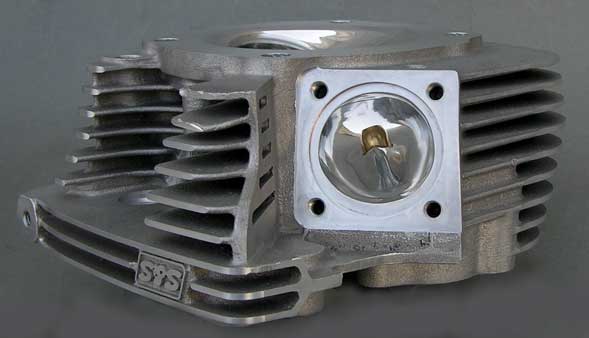
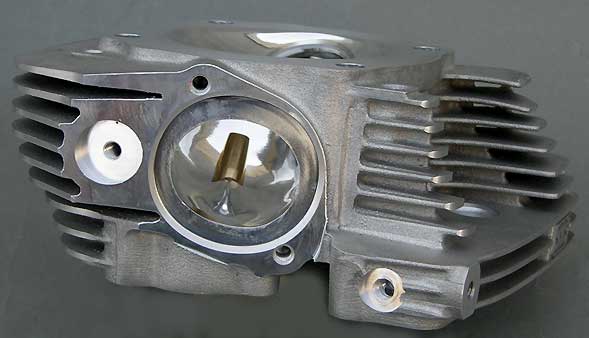
Whenever we do something serious like our 139" Bonneville ORCA motor we defer to the experts, especially when we are dealing with raw, unfinished ports the size of a dime. Branch O'Keefe is simply the best in the business and even Jerry Branch (retired) got involved in the decision making. Take a look at some S&S SA B2 ports that about 90 years cummulative experience came up with. All John O'Keefe and Jerry Branch asked was what we thought the exhaust ports should be like in terms of flow based on our 30 years of turbocharger experience. We all agreed on a number and this is what the result was. Ports for 400+ horsepower.
John has worked extensively with the S&S SA B2 heads, winning the S&S 50th Anniversary Horsepower shoot out contest. Normally aspirated B2 ported heads don't look like ours but John knows how to squeeze 200+ horsepower out of them.
John O"Keefe
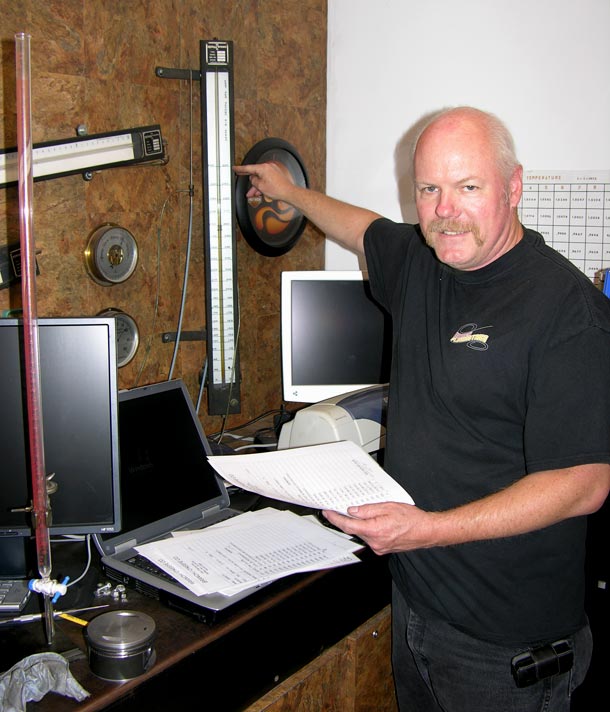
If you want the best cylinder head work for your Twin Cam 88/95/103/110 etc., Evo, or even Shovelhead contact Branch O'Keefe. That's what we do and have done since 1976 when Jerry Branch prepared our cylinder heads for the 24 hour Endurance racers we built and took to the 1977 Bol D'Or in France. John O'Keefe knows you don't want "down time" so he has an exchange program for cylinder heads. Harley has made a lot of changes in their castings and it's best to go with Branch O'Keefe as differences in machining, alloys, and specifications can cause problems if you deal with porters who don't have the inventory and the experience.
We discussed our Bonneville Bullett project with John and he promptly drug out two sets of S&S SA B2 heads that he had done extensive R&D on. He had the numbers so he was the best guy for the job.
John does not have "homing pigeons" like other outfits where seats come loose, the work is sloppy, or cheap valves that stick or gall are installed. He treats every head they produce as if it was his own. Sort of rare these days.
All RB Racing LSR Exhaust Systems feature our "new" (we've been quietly doing it since 1985!) CNC machined Turbo Venturis that actually "scavenge" to help your motor breathe. Machined from billet, these allow full 2" flow and eliminate the phony restrictions that other 1 3/4" to 2 1/4" pipes have at your exhaust port. We supply special close tolerance aircraft nuts for your exhaust studs because our machined venturis are too wide for a standard hex nut. Turbo venturis have also been machined for the large port, 4 bolt flange, S&S "SA" and newer B-2 heads.
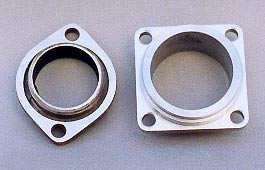
Compare the oem size exhaust flange on the left that is used on "billet" motors with the "SA" flange on the right...get out your calipers and see what's holding these other motors back. RB Racing is familiar with these four bolt critters as we use them in our 113" and 132" RSR Fuel Injected ORCA motors both turbo and normally aspirated. For our 113" and 132" ORCA motors we use cnc machined special Turbo Venturis that capture a laser cut four bolt flange and are in turn heliarced to our 2" LSR 2-1 primaries. The Turbo Venturis flow 8 to 12% more than a straight section pipe.
S&S SA B1 and B2 heads
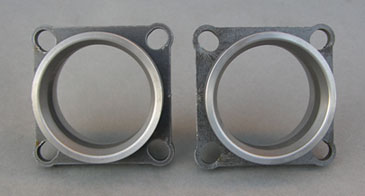
If you have a set of these "SA or B-2 Heads" and want a specific exhaust be sure to tell us at the time of your order. Adding an "SA" suffix to a listed part number will do the job. Remember they are only avaiable for LSR 2" primary designs. No gaskets are used with these. The special Venturi rides directly against the cylinder head.
S.T.D. Flanges for LSR 2-1 Exhausts
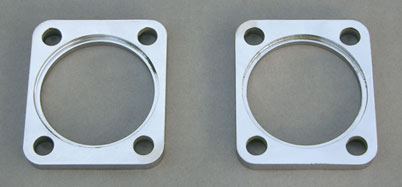
Dating way, way, back S.T.D. put four bolt or stud loctions in their cylinder heads. Lately they have been selling complete engines so we decided to make up some Four Bolt Flanges for our LSR 2-1 Turbo Venturis. These are available at the time you order your system for $29.95 per set in a chrome finish. Billet gaskets requiredfor standard dimension (Non S&S SA) ports.
Purpose Built...No True Dual or Thunder Crap
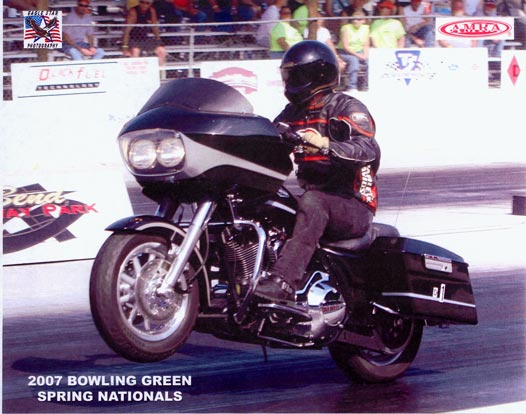
RB Racing flat-ass doesn't build things that don't work. There is a beauty in things that work well for their intended use and no one design is right for everybody. We build LSR 2-1 exhausts in both 1 3/4" and 2" varieties for everything from a stock EVO or TC88 right up to whatever big inch custom you can think of, including limited production Confederates, Bourgets and other aftermarket chassis. In addition, we make purpose built LSR 2-1 Pro Stock pipes that are the best flowing race pipe on the market.
The LSR Black Hole Spyder 2-1 fills another need...the need to have performance without the compromise of more noise. There is beauty in purpose and like the yacht or the plane..."If it looks right it is right". These are right.